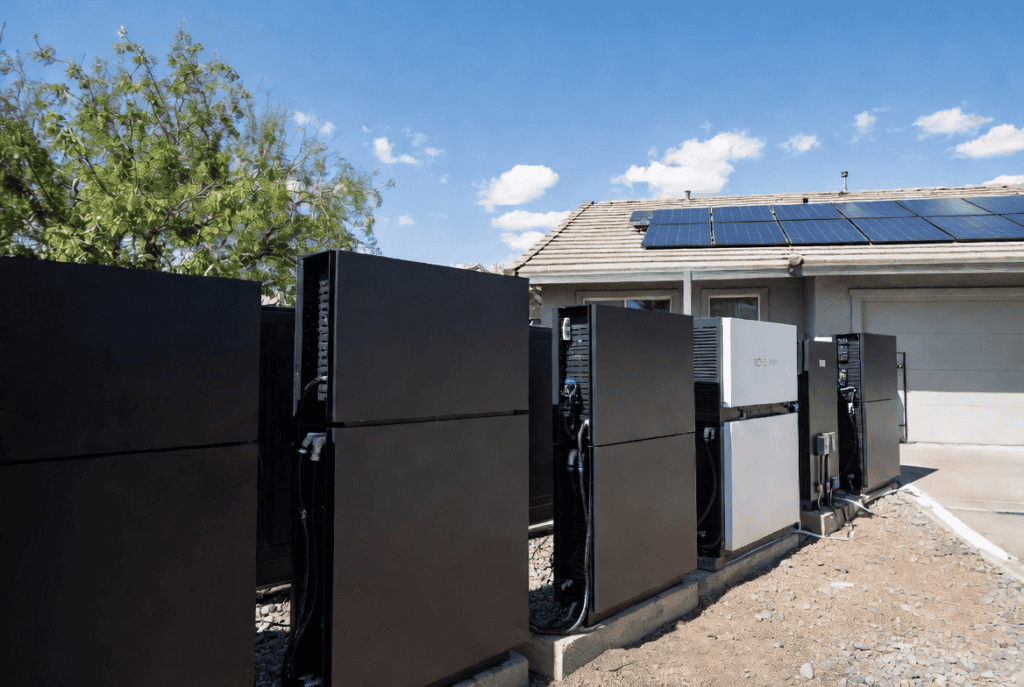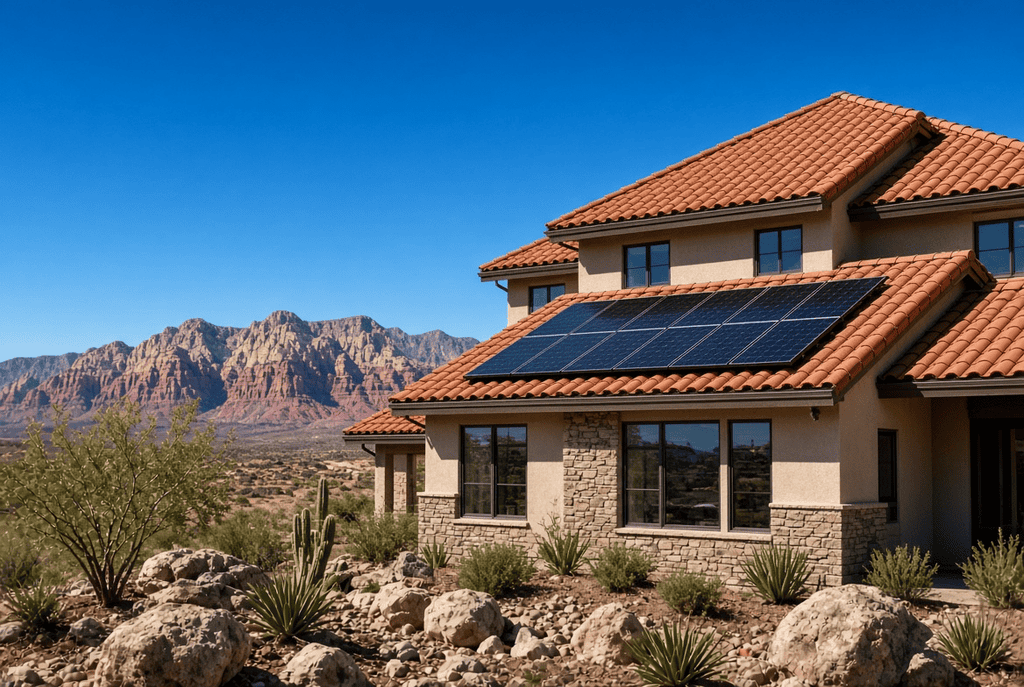
Factory testing stickers show standard ratings measured at a crisp 77°F. But a west-facing tile roof in Summerlin or Henderson in the middle of July is a completely different story.
When panels are mounted flush against a roof, cell temperatures routinely jump 50°F to 70°F above the outside air. That means a standard 110°F afternoon easily pushes the silicon up into the 140°F–160°F range. Every panel loses power as it heats up—the real question is just how much efficiency you’re giving away.
Dust acts as a second tax on your system. Clark County isn’t getting a weekly rain to rinse things off. Fine Mojave silt, local construction grit, and monsoon clay bake straight onto the glass. That grime quietly steals several percentage points of power before you ever notice a drop on your monitoring app.
This comparison ranks 2026 residential panels based on how a Las Vegas roof operates: heat tolerance first, followed by degradation and warranty, and finally overall cost. Consider this an equipment guide rather than a lab report or a replacement for a custom, site-specific roof layout.
What “Heat & Dust Tested” Should Mean
Las Vegas marketing loves to sling around the word “tested.” But on a 110°F tile roof, that needs to mean a whole lot more than just a pretty sunset picture of solar panels sitting in the desert.
What Nobody Has
Neither this guide—nor virtually any blog claiming a “tested” headline—runs a 25-year side-by-side test farm of every single 2026 panel model on a west-facing roof in Summerlin. Consumer Reports, EnergySage scores, and installer anecdotes are helpful, but they’re no substitute for reading the actual spec sheet for your specific model number. If an installer’s quote promises “heat tested” tech but can’t point to a spec sheet number, you’re looking at marketing, not engineering.
What You Should Demand
- A Published Pmax Temperature Coefficient: The closer this number is to zero, the better. For a new roof in the valley, treat -0.30%/°C as your absolute bare minimum, and aim for -0.24 to -0.26%/°C for true heat-class performance (typical of HJT and top-tier IBC panels).
- N-type Cells: Look for TOPCon, HJT, or IBC architecture. Avoid leftover p-type PERC panels, which routinely dump roughly 14% of their rated power once cells reach 65°C.
- Solid Certifications and Warranties: Ensure IEC 61215 and 61730 listings, alongside a 25-year performance warranty that guarantees at least 90%+ of original output in year 25.
- Real-World Wind & Hail Ratings: Check that mechanical load limits match actual desert wind conditions, rather than a generic brochure built for Midwest weather.
- Durable Glass and Protective Coatings: You need glass and encapsulants that won’t haze after years of intense UV exposure and baked-on dust. Anti-soiling coatings help with loose dirt, but they don’t eliminate the need for maintenance.
What “Dust Tested” Is Not
No residential panel magically “self-cleans” after a quick two-minute monsoon drizzle. In fact, light rain mixed with desert dust usually bakes dirt into a clay-like film right on the glass. A dust-resistant coating helps a bit, but an actual wash with purified water every 4 to 12 months is the only real solution.
How to Use Installer Stories
Feedback from installers in Phoenix and Las Vegas is great for context—like hearing how HJT panels hold up in July while cheap PERC options start sagging by 2 p.m. Use those stories as real-world color, but always cross-reference them with the exact wattage and heat coefficient listed on your official quote.
Red Flags to Watch For
- Labels like “Desert Rated” that conveniently leave out the temperature coefficient.
- A shiny 450W rating paired with a terrible -0.38%/°C temperature coefficient.
- A panel manufacturer that pulled out of North America without leaving behind a US service network.
- A sales quote that estimates your yearly power production using ideal lab conditions while completely ignoring desert dirt and heat loss.
What this means
When we talk about “heat and dust tested,” we mean ranking panels based on the relentless physics a Las Vegas summer applies every single day: temperature coefficients, cell architecture, long-term degradation warranties, and glass that can survive an arid basin. Demand the spec sheet, verify the numbers, and then make your decision.
How Las Vegas Heat Cuts Output
Solar panels are rated based on cell temperatures of 25°C (77°F). But a Las Vegas roof in July is a totally different ballgame.
When you combine 110°F air with dark glass and roof tile that has been baking in the sun since 10 a.m., flushed panels on a west plane routinely sit in the 60–70°C (140–158°F) range. Silicon doesn’t “love heat.” The sun keeps delivering photons, but voltage sags and total wattage drops.
The Number That Matters
The Pmax temperature coefficient (γ) represents the percentage of rated output you lose for every single degree Celsius above 25°C. The closer this number is to zero, the better the panel performs.
P_hot = P_STC × [1 + (γ / 100) × (T_cell – 25)]
Here is what happens at a realistic 65°C cell temperature (40°C above the factory rating baseline):
- Old p-type PERC (-0.35 to -0.38%/°C): Loses roughly 14–15% of rated power.
- N-type TOPCon (-0.29 to -0.32%/°C): Loses roughly 12–13% of rated power.
- IBC (Maxeon class, -0.27 to -0.30%/°C): Loses roughly 11–12% of rated power.
- HJT (REC Alpha class, -0.24 to -0.26%/°C): Loses about 10% of rated power.
On an 8 kW system, that 3–5 percentage point gap equals hundreds of lost kilowatt-hours over the summer—right during the exact afternoon hours your air conditioner is running at full tilt. Real-world desert field results follow this exact order: HJT holds onto power best, TOPCon acts as the reliable workhorse, and old PERC has no business going on new valley roofs.
Why the Sticker Wattage Can Be Misleading
A 440W PERC panel and a 430W HJT panel can easily trade places by mid-afternoon. The PERC panel wins on the sales brochure, but the HJT panel produces more real electricity at 2:00 p.m. Lab efficiency at 25°C matters if your roof is small, but the heat coefficient is what matters when your roof turns into a skillet.
Factors That Drive Cell Temps Even Higher
- Flush mounts installed with minimal airflow underneath.
- Dark roof tiles and west-facing angles.
- Dust and grime films that trap extra ambient heat.
Leaving a healthy ventilation gap under your mounting rails provides free convection cooling. Conversely, a dirty, unwashed array runs both hotter and dimmer at the same time.
What This Doesn’t Mean
Panels don’t just “shut down” when it hits 110°F. (Inverters and mounting attachments can fail from extreme heat, but that’s a separate topic.) A quality panel’s job is simply to lose less efficiency than the cheaper option mounted next to it.
Key Takeaway
When designing a solar array in Clark County, size your expectations around 65°C cell performance, not the idealized factory spec sheet. Demand the exact γ value for your model number. If two installer quotes are competitive on price, the panel with the better heat coefficient is the one that pays off when July hits.
Dust, Monsoon Film & Cleaning
If heat robs your panels of voltage, dust robs them of light—and in Clark County, they gang up on you.
Why the Valley Soils So Fast
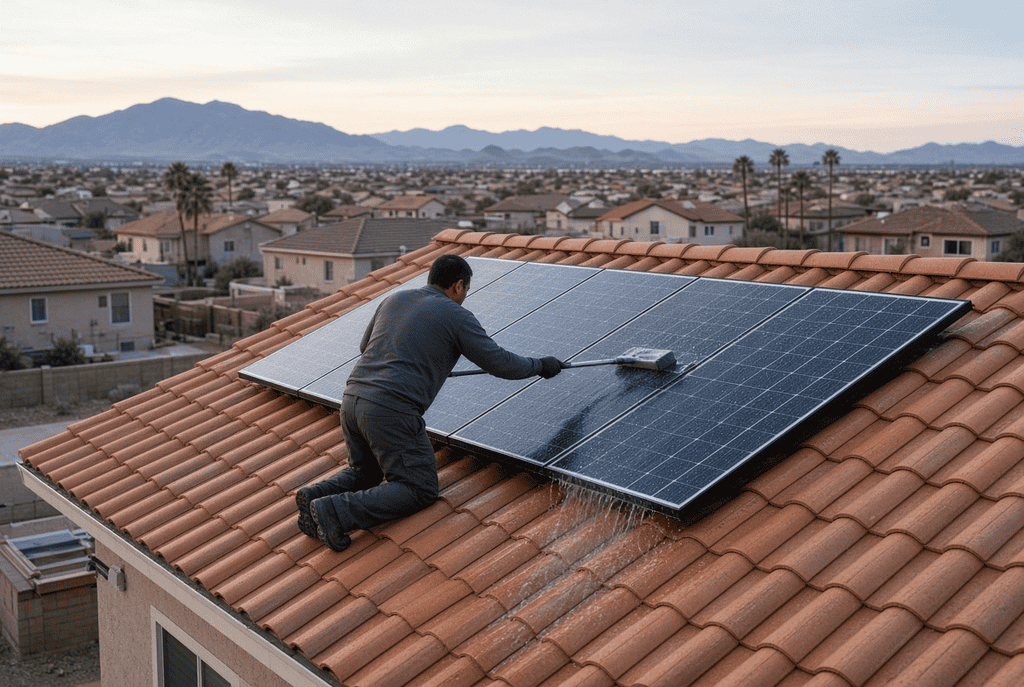
The Mojave Desert doesn’t rinse your roof. Fine silt, stucco dust, freeway grit, and construction powder settle onto the glass and stay there for months. That two-minute monsoon sprinkle won’t wash it away; it just dampens the dust so the blazing sun can bake it into a dull, hard clay film. By late summer, neglected arrays quietly surrender a chunk of their output. If you live near active construction or a pigeon roost, your monitoring app will show losses far worse than temperature loss alone.
What the Module Can (and Can’t) Do
High-quality tempered glass with factory anti-soiling coatings sheds loose dust much better than cheap, heavily textured glass. A decent roof tilt also helps loose particles slide off. Low-slope, dead-flat arrays, on the other hand, hold onto silt. But make no mistake: none of this equals a “self-cleaning” panel. A “dust-resistant” label on a brochure is a minor assist, not a replacement for maintenance.
What You Still Need to Do
You’ll need a proper rinse with purified or deionized water every 4 to 12 months—even more often if you’re next to open dirt or construction. Stick to a soft brush, skip the pressure washer, and avoid raw tap water to prevent mineral spots. Always clean during the cool early morning hours so cold water doesn’t shock and crack scorching-hot glass. Inspect your array after a monsoon storm: if the surface looks matte instead of glossy, that rain did you no favors.
How Dirt and Heat Team Up
A dull, dirty panel absorbs more ambient heat, causing it to run hotter while producing less current. You end up paying twice. Paying top dollar for high-end HJT panels with a great -0.24%/°C heat coefficient and then skipping two years of cleaning completely wipes out the performance premium you bought.
Pigeons and Shade
Pigeon droppings aren’t just “dust”—they create permanent hot spots and risk etching the glass. Installing bird wire or exclusion mesh around a tile roof array is essential protection for the glass you paid for.
The Bottom Line
Look for durable glass and anti-reflective coatings that won’t haze over time, then budget for panel cleanings the same way you budget for HVAC filter replacements. When comparing installer quotes, look for realistic dirt and heat derate calculations rather than lab-spec fantasy numbers. Even the highest-ranked panel in Las Vegas is only as good as the last time someone washed the Mojave off it.
Head-to-Head: 2026 Panels That Belong on Valley Roofs
These are the residential product lines that hold up after factoring in 65°C cell temperatures and a bone-dry, dusty summer. Just be sure to double-check the exact SKU on your installer’s proposal, as wattage ratings change rapidly from year to year.
REC Alpha Pure-RX (HJT) — The Heat-First Pick
- Efficiency: ~22.1%–22.6%
- Temperature Coefficient: ~ -0.24%/°C (still the gold standard for residential solar)
- 25-Year Guaranteed Output: ~92%
- Warranty: 25-year product warranty (be sure to register it, as base terms can be shorter)
You will pay a bit more for REC than mid-tier TOPCon, though it stays cheaper than Maxeon. Go with this option if maximizing your July kilowatt-hour production matters more than chasing the highest nominal wattage on paper.
Maxeon 6 / 7 (IBC) — Maximum Power Density
- Efficiency: ~22.8% for Maxeon 6; Maxeon 7 SKUs push into the mid-24% range
- Temperature Coefficient: ~ -0.27% to -0.30%/°C
- Warranty: Highlighted by an industry-leading 40-year product and performance warranty
This is the top choice for small or complex tile roofs where making the most of every square foot is essential. Premium quality comes at a top-shelf price, and it is wise to confirm warranty servicing details in writing given recent corporate restructuring.
Qcells Q.TRON (N-Type TOPCon) — The Installer Workhorse
- Efficiency: ~21.8%–22.5% on black residential panels
- Temperature Coefficient: ~ -0.29% to -0.32%/°C
- 25-Year Guaranteed Output: ~90.6%
Qcells panels are widely stocked by local crews, and Georgia manufacturing makes them a strong talking point for domestic content incentives. You give up a slight edge in summer heat performance compared to REC, but you gain a lower price tag and high availability. It is the go-to option for many valley quotes.
Silfab Elite / Prime Series — North American Reliability
- Efficiency: Low-to-mid 22% range
- Temperature Coefficient: ~ -0.27% to -0.30%/°C
- Warranty: Select lines include a 30-year product warranty
Silfab combines strong heat tolerance with a solid North American manufacturing footprint. It is a compelling pick when localized support and supply chain proximity matter as much as a fraction of a percent in heat performance.
Mainstream Tier-1 TOPCon (Jinko Tiger Neo, Canadian Solar TOPCon, JA, Trina)
- Efficiency: ~22%–23%+
- Temperature Coefficient: ~ -0.29%/°C (with select flagships pushing closer to -0.26%/°C)
- 25-Year Guaranteed Output: ~87%–90%
These panels offer a practical solution for large, open roof layouts when premium HJT panels exceed the project budget. Just review the spec sheet carefully to ensure a leftover, lower-performing PERC panel isn’t substituted into your quote.
What to Skip
- Older p-type PERC panels with temperature coefficients near -0.35%/°C or worse
- White-label, off-brand equipment
- Any module lacking official IEC 61215 and 61730 safety certifications
Putting It All Together
Choose REC for peak summer heat tolerance, Qcells or Tier-1 TOPCon for the best overall balance of price and output, and Maxeon for tight roof spaces where long warranty coverage is a priority. Plug the exact model numbers into your estimate, apply realistic desert heat and dirt loss factors, and compare the net return.
How to Choose for Your Roof Size and Budget
The “best” panel is simply the one that fits your available roof space and aligns with your actual budget. Las Vegas roofs rarely offer 30 wide-open, perfectly south-facing tile squares.
Small or Chopped-Up Roofs
Dormers, tile setbacks, plumbing vents, and strict HOA restrictions can quickly shrink your usable space. On a limited layout, high power density (watts per square foot) paired with a low temperature coefficient is crucial. Maxeon 7 or REC Alpha Pure-RX panels are usually the top contenders here. Opting for a cheaper, lower-wattage PERC panel that forces you to leave your primary sun-facing roof plane empty isn’t saving you money—invest in higher-efficiency modules to maximize your best slope.
Standard 8 kW-Class Roofs (South or West Facing)
This represents the vast majority of tract homes across the valley. REC is the premier choice for heat performance if the price difference stays modest. Qcells Q.TRON or a current Tier-1 TOPCon option serves as the best value pick if REC adds significant cost without yielding proportional kilowatt-hour gains after summer temperature loss. Compare both options using identical energy usage data and realistic desert loss assumptions. If a proposal requires 12 kW of lower-grade panels to match the annual output of a smaller high-efficiency array, the installer is selling you extra roof hardware rather than better technology.
Large, Unshaded Roofs (Fastest Simple Payback)
If you have ample, unshaded roof area, filling it with reliable N-type TOPCon panels offers a solid return. You likely won’t miss the slight July output advantage of HJT panels as much as you’ll appreciate the lower upfront cost. However, you should still avoid older PERC technology.
Domestic Content & Local Support Preferences
Qcells (manufactured in Georgia) and Silfab are the primary choices in this category. Always verify whether specific tax incentive documentation requires domestic origin before paying extra for the designation.
Long-Term Ownership & Extended Guarantees
Maxeon leads this category with its 40-year warranty coverage. Be sure to confirm who handles warranty servicing down the line, as long-term coverage depends on the stability of the serving network.
What Avoid Optimizing
- Don’t pay for premium HJT panels and then skimp on inverter quality, roof flashing, or ongoing panel maintenance.
- Don’t fall for a high 450W label if it comes with an inferior -0.38%/°C heat coefficient.
- Don’t sign a lease agreement solely to secure a specific brand name—system ownership mechanics in Nevada require a completely different financial evaluation.
The Crux
Start with your roof area, prioritize the temperature coefficient, and select the brand last:
- Small Roof: Prioritize power density with HJT or IBC panels.
- Average Roof: Evaluate REC against Qcells using a realistic output model.
- Large Roof: Opt for standard TOPCon panels.
Remember to evaluate your budget based on total installed system costs rather than comparing standalone module sticker prices.
Specs That Matter More Than the Brochure Wattage
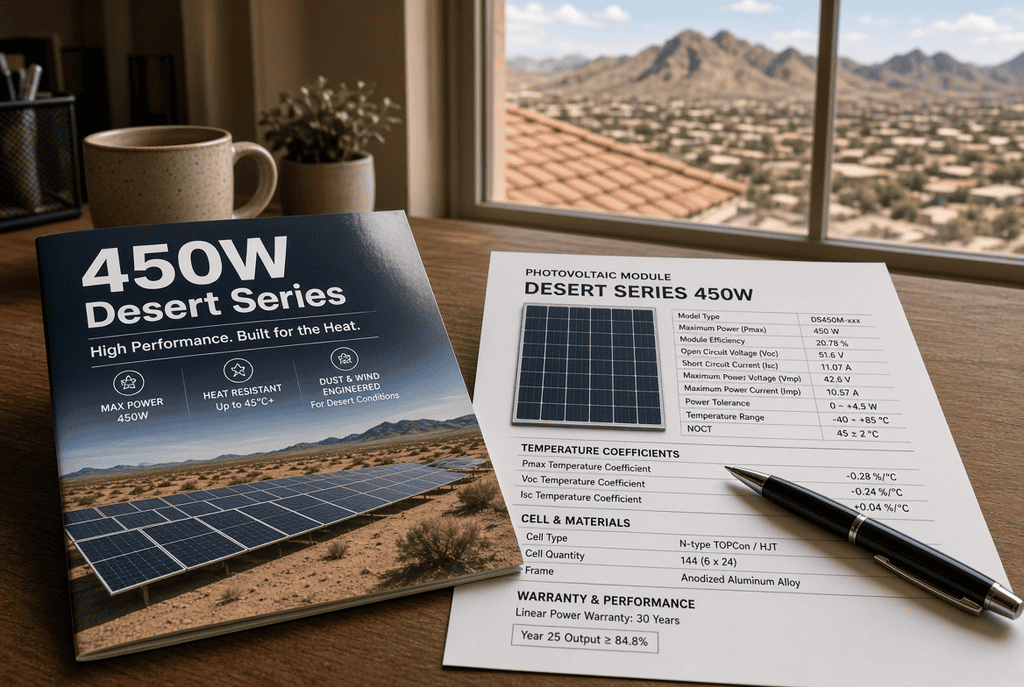
A panel’s advertised 440W rating is measured in a factory lab at a cool 77°F (25°C) and under ideal 1,000 W/m² light. Out in the real world, your roof is going to be much hotter, dirtier, and tighter on space.
When you read a spec sheet, rank the details in this order:
1. Pmax Temperature Coefficient
This is the single most important spec for a Las Vegas roof—demand to see it for your exact model number. Treat -0.30%/°C as your absolute baseline for any new valley installation, with -0.24 to -0.26%/°C serving as the target for true heat-class performance (found on HJT and top-tier IBC panels). Gaining 10 watts on paper isn’t worth it if you give up 4 extra percentage points of efficiency when cell temperatures reach 150°F (65°C).
2. Cell Architecture
Look for N-type TOPCon, HJT, or IBC technology, and skip old p-type PERC panels. N-type cells avoid classic light-induced degradation and hold up better over time. Don’t be fooled by a brochure that simply says “Monocrystalline”—PERC panels are monocrystalline too, but they degrade much faster in extreme desert heat.
3. Year-25 Guaranteed Output
A guaranteed output of 90%+ at year 25 is the benchmark for high-quality residential solar (REC panels guarantee around 92%, while many TOPCon options sit between 87% and 91%). What your system produces in 2045 depends on its initial degradation drop combined with its yearly output slope, not the day-one brochure rating.
4. Product Warranty Details
While a 25-year warranty is standard (and Maxeon offers up to 40 years), the fine print matters. Pay close attention to warranty registration rules, home transfer policies, and the financial stability of the manufacturer backing it. Panasonic’s exit from the North American panel market serves as a prime example: great heat specs don’t mean much if local supply chains dry up.
5. Mechanical and Hail Ratings
Valley wind gusts and occasional severe storms are genuine risks for roof arrays. Check the front and back load ratings to ensure the panel frame is solid. Flimsy, low-quality frames can bow under stress, letting water pool and potentially cracking internal solar cells.
6. Installer Supply and Replacement Parts
A hard-to-find, high-efficiency panel with a six-month wait for replacement parts is a liability. It’s often smarter to go with a widely stocked Qcells panel that local crews regularly install and keep in inventory. Ask what your contractor installed in your area code last month rather than picking off a national marketing sheet.
7. Panel Dimensions vs. Usable Roof Area
A “higher-wattage” panel is often physically larger, which can force you to install fewer total panels due to roof setback rules. On a complex or multi-angled tile roof, power density (watts per square foot) is far more important than raw panel wattage.
What You Can Safely Ignore
- Celebrity endorsements and brand sponsorships.
- Vague labels like “450W Desert Series” that leave out the temperature coefficient.
- Bifacial panel claims on dark, flush-mounted tile roofs (bifacial gains only work on ground mounts or light-colored flat roofs).
The Heart of the Matter
Before you get distracted by a panel’s advertised wattage, insist on seeing four key numbers on your installer’s quote: the temperature coefficient, cell type, year-25 performance guarantee, and exact model number. If a contractor can’t provide all four, you aren’t comparing real equipment—you’re just comparing sales brochures.
Installation Details That Protect the Panels You Buy
Even a top-tier panel with an industry-leading -0.24%/°C temperature coefficient will bake if it is mounted flush against dark roof tiles with zero airflow. The hardware underneath the glass dictates whether the specs you paid for show up on a scorching July afternoon.
1. Prioritize Airflow First
Cell temperature depends heavily on how well air circulates under your solar array. High-quality tile attachments that maintain a consistent gap beneath the panels far outperform low-profile mounts installed purely for aesthetics. Dark barrel tiles and west-facing roof planes already run extremely hot; sandwiching panels directly against the roof deck turns the space beneath them into an oven. If two installers quote the exact same REC panel, but one uses a flush mount with no standoff gap, they aren’t offering the same system.
2. Demands Proper Tile Attachments and Flashing
Las Vegas is a tile-roof town, and improper mounting techniques can crack roof pans, void home warranties, and lead to attic leaks right above your electrical system. Always ask your installer for specific details on:
- The exact brand of tile attachments and flashing being used.
- How roof penetrations are sealed.
- Who covers the cost if the crew breaks tiles during installation.
A premium panel on a poorly installed hook is just a future roof leak with a great temperature coefficient.
3. Match Inverters to the Desert Environment
Shading from plumbing vents, neighboring multi-story homes, or bird exclusion screens is common. Using microinverters or DC optimizers helps mitigate output losses from mismatched strings, but these components sit right on the roof in the same intense heat. Make sure your system specifies module-level power electronics rated for extreme desert operating temperatures, and avoid installing string inverters on unshaded, west-facing exterior walls. Heat degrades solar electronics just as quickly as it reduces panel output.
4. Maintain Access for Cleaning
Layouts should always include clear pathways for washing the array. A edge-to-edge installation that looks sleek but leaves no room for service will end up coated in dirt by late summer. Budget for professional cleanings using purified or deionized water, and inspect the glass after monsoon drenchings—rain in the desert bakes dirt into a film rather than rinsing it clean.
5. Protect Against Wildlife and Wind
Installing bird wire or exclusion mesh around tile roof arrays is essential for preventing pigeon nesting, hot spots, and glass damage. Similarly, ensure the wind ratings for rails and mid-clamps match actual valley wind events, rather than relying on standard manufacturer marketing photos.
6. Compare Quotes on an Equal Basis
When evaluating installer proposals, ensure you are comparing identical metrics:
- The same annual power usage baseline.
- Identical roof orientation (azimuth) and tilt angles.
- Matching temperature loss and dirt derate calculations.
- Equivalent inverter technology.
A proposal that assumes ideal factory conditions and zero dirt accumulation can make cheap PERC panels look attractive on paper. A proposal that details quality roof hooks, proper airflow gaps, and a regular washing plan is the one that protects your investment in high-efficiency panels.
Putting it Together
Invest in a low temperature coefficient first, then secure the mounting hardware, flashing, electronics, and maintenance routine required to keep that panel performing on a 150°F (65°C) roof. Be sure to look up your contractor on the Nevada State Contractors Board (NSCB) license lookup database. The brand logo on the glass is only half of the heat equation—the quality of the installation completes it.
Final Advice
Clark County isn’t getting any cooler. The core decision when buying panels comes down to whether your array sags by 10% or 15% when cell temperatures hit 150°F (65°C)—and whether desert dust and a sloppy installation steal whatever power is left.
Default Picks for 2026 Valley Roofs
- REC Alpha Pure-RX: The go-to choice when maximizing summer kilowatt-hours is your top priority and the price premium fits your budget.
- Qcells Q.TRON or Tier-1 N-Type TOPCon: The ideal value pick when you want a widely stocked panel that offers solid efficiency and a faster financial payback.
- Maxeon 6 or 7: The best option for compact roof spaces or homeowners who value a 40-year warranty (provided you’ve confirmed who will service it down the line).
- Older P-Type PERC: Cross these off your list entirely for new installations.
Force Installers to Bid on an Equal Playing Field
Require every contractor to use the exact same evaluation criteria on a single energy usage file:
- The precise panel model number
- The Pmax temperature coefficient
- The year-25 performance guarantee
- The specific roof attachment system
- Realistic temperature and dirt derate calculations
A panel with a high 450W label paired with an inferior -0.38%/°C coefficient isn’t built for the desert. Similarly, orphaned stock or discontinued lines raise long-term warranty and replacement questions rather than offering a reliable supply plan.
Protect Your Equipment Investment
Buying high-end silicon only pays off if the rest of the installation supports it:
- Ensure a generous airflow gap beneath tile mounts.
- Use roof flashing that maintains your home’s roofing warranty.
- Specify power electronics rated for extreme desert ambient temperatures.
- Install bird exclusion screens to keep pigeons out.
- Schedule a purified-water panel wash a few times a year.
Even advanced Heterojunction (HJT) panels can’t perform through a baked-on layer of monsoon grime.
Choose a Properly Licensed Contractor
Always verify that your installer holds an active Nevada State Contractors Board (NSCB) license under the appropriate electrical (C-2) or solar (C-37) classification, rather than relying on marketing claims. Qualified installation crews and high-grade solar glass are equally essential for a system built to withstand the desert heat.
The Bottom Line
Look past sales brochures and demand the official spec sheet. In Las Vegas, the winning panel is the one that continues generating strong power when the glass is too hot to touch—and stays clean enough to deliver on its ratings. Focus your quotes on complete systems using components engineered for extreme heat.
Considering solar for your Nevada home? Explore customized solar quotes once you’ve selected equipment that matches your actual roof layout.
A quick, honest heads-up: A few of the links on this page are affiliate links. That just means we might earn a small commission if you decide to use them, at absolutely zero extra cost to you. We only ever link to trusted, local Southern Nevada pros and hardware that have proven they can handle our brutal desert climate. Thank you for supporting the site!