Solar Savings & Incentives

A Solar United representative describing how Clark County's Switch Together solar program works to a group of interested Nevadans.

Group-Buy Solar Programs in Nevada: How Clark County’s Switch Together Works

Group-buy programs aggregate local demand to obtain pricing and process support from participating installers. Clark County partners with Switch Together and Solar United Neighbors under the All-In Clark County initiative which is a program that covers rooftop solar, battery storage, and EV chargers for homeowners and small businesses. This guide covers program structure, pricing, and

Group-Buy Solar Programs in Nevada: How Clark County’s Switch Together Works Read More »

A Nevadan family reviewing their personalized Expanded Solar Access Program plan.

Understanding Nevada’s Expanded Solar Access Program (ESAP)

Rooftop solar is not feasible for many Nevada customers as renters cannot install equipment on property they do not own and low-income households may face credit, capital, or ownership constraints. Homeowners may be limited by shading, roof condition, or homeowners’ association rules. The Expanded Solar Access Program (ESAP) provides a lower program energy rate for

Understanding Nevada’s Expanded Solar Access Program (ESAP) Read More »

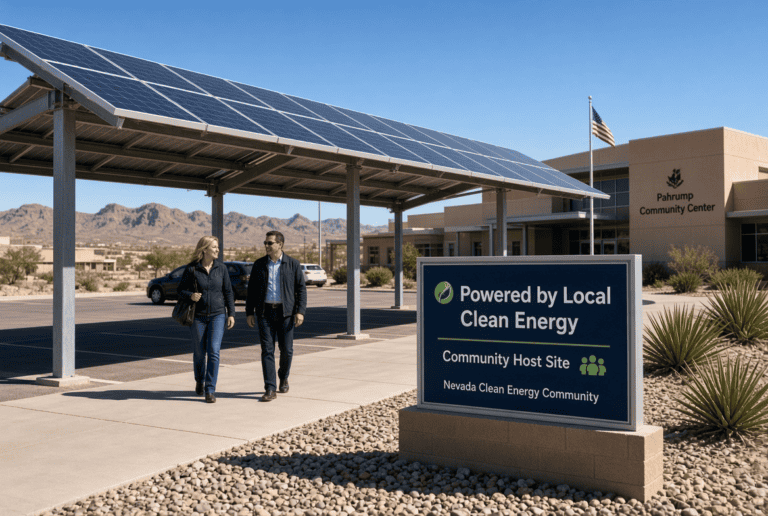
Pahrump Community Center participating in the Community Based Solar Resources (CBSR) Program in Nevada.

Community Based Solar Resources (CBSR) Program in Nevada

Rooftop solar is not practical for every household. Renters, homes with limited roof space or shading, and households that prefer to avoid the upfront cost of an owned system have limited options under standard interconnection rules. NV Energy’s Community Based Solar Resources (CBSR) program addresses part of that gap by developing smaller solar installations on

Community Based Solar Resources (CBSR) Program in Nevada Read More »

A Nevada solar salesman explaining current buyback rates for solar work to a customer that just bought solar for their North Las Vegas home.

Selling Solar Excess Power in Nevada: Current Buyback Rates & Community Solar Options 2026

A common question from Nevada homeowners is what happens to excess electricity generated by a solar system. When production exceeds on-site use, the surplus is credited rather than lost. This section explains how excess power is valued under Nevada’s net metering rules, how bill credits are applied, and what options exist for homeowners who cannot

Selling Solar Excess Power in Nevada: Current Buyback Rates & Community Solar Options 2026 Read More »

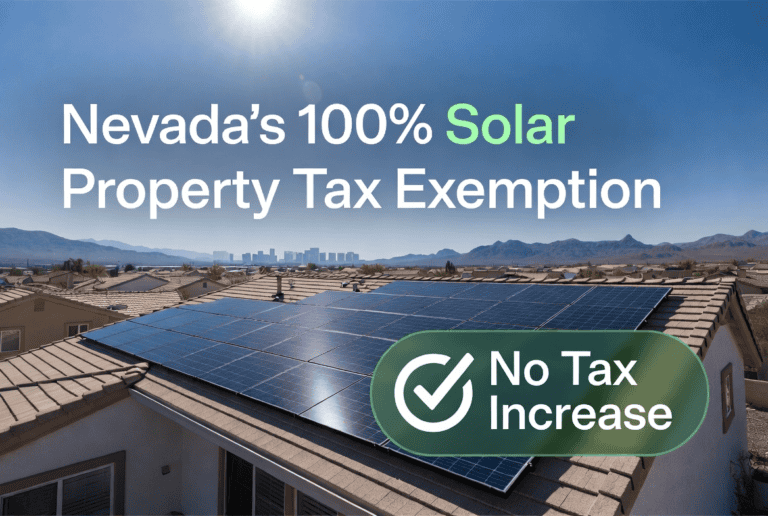
Image illustrating Nevada's 100% Solar Property Tax Exemption.

Nevada’s Secret Solar Perk: Boost Your Home’s Value, Keep Your Taxes Exactly the Same With 100% Solar Property Tax Exemption

One of the most valuable—and least discussed—advantages of installing solar in Nevada is the state’s 100 percent property-tax exemption. In most cases, a substantial home improvement raises the county’s assessed value and therefore the annual tax bill. A renovated kitchen or a new pool typically produces this result. Solar is treated differently. Under Nevada law,

Nevada’s Secret Solar Perk: Boost Your Home’s Value, Keep Your Taxes Exactly the Same With 100% Solar Property Tax Exemption Read More »

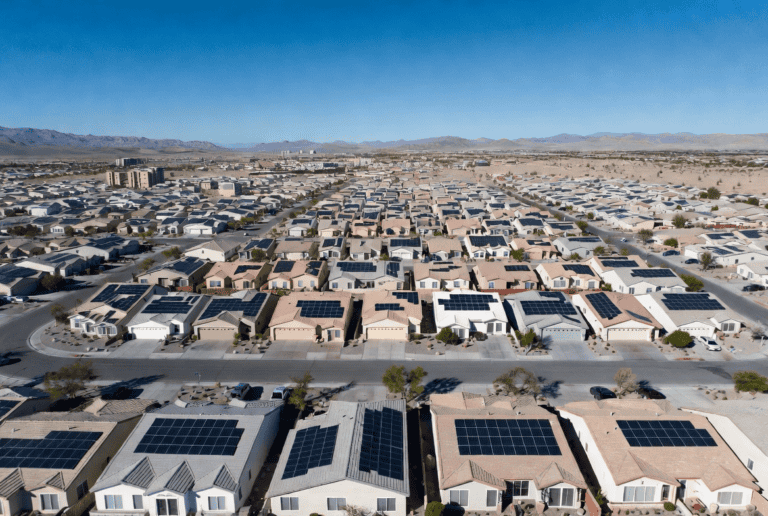
Houses in Las Vegas, NV that understand how Time-of-Use rates affect solar ROI in Southern Nevada.

How Time-of-Use Rates Affect Solar ROI in Southern Nevada – Strategies to Maximize Credits

Long-term solar economics for a Las Vegas or North Las Vegas residence depend on the interaction between on-site generation and the local utility’s time-varying rates. The earlier practice of installing an array and leaving its output unadjusted for rate structure no longer captures the available value. The hours in which air-conditioning, electric-vehicle charging, and other

How Time-of-Use Rates Affect Solar ROI in Southern Nevada – Strategies to Maximize Credits Read More »

Home battery system protecting a Las Vegas home during the 6:01 PM to 9:00 PM on-peak window.

Surviving NV Energy’s 6:01 PM to 9:00 PM On-Peak Window: How Home Batteries Protect You During the Most Expensive Hours of the Summer

From June 1 through September 30, NV Energy’s optional residential time-of-use plan applies higher summer on-peak rates from 6:01 p.m. to 9:00 p.m. each day and during this window, household demand often remains elevated while solar production declines. Published rates for the optional TOU plan place on-peak energy in the mid-to-high 40¢/kWh range, compared with

Surviving NV Energy’s 6:01 PM to 9:00 PM On-Peak Window: How Home Batteries Protect You During the Most Expensive Hours of the Summer Read More »

Las Vegas home with rooftop solar and Nevada desert mountains

Complete 2026 Solar Incentives Guide for Nevada Homeowners (No Rebates Left – Here’s What Still Works)

Note: Last checked September 19th, 2026.  If a solar quote still includes a 30% federal tax credit or an NV Energy rebate, it is using outdated numbers. The federal Residential Clean Energy Credit (Section 25D) is not available for installations completed after December 31, 2025. Under the rules following Public Law 119-21, systems that were

Complete 2026 Solar Incentives Guide for Nevada Homeowners (No Rebates Left – Here’s What Still Works) Read More »

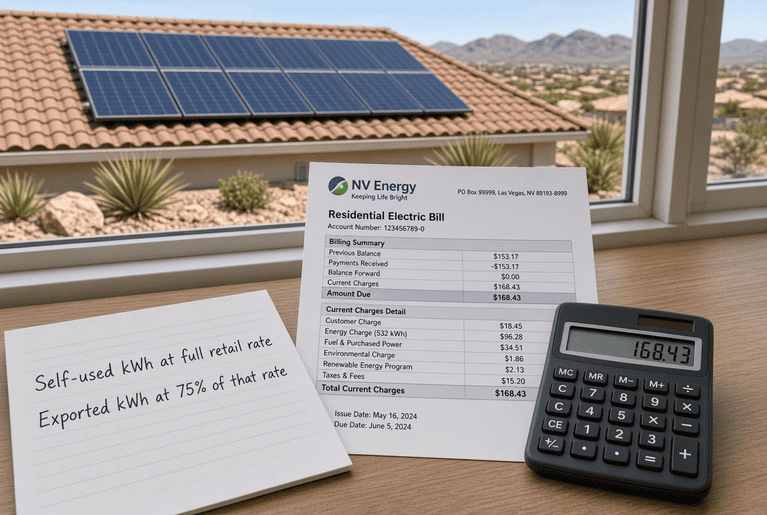
“Real Before vs After: 8kW solar system in North Las Vegas – See how much one local family saved on their NV Energy bills.”

Real NV Energy Bill Savings with Solar: Before & After 8kW System (Las Vegas Case Study)

This case study uses a realistic composite household in Las Vegas / North Las Vegas—it isn’t a named family, and it isn’t a guarantee. The kWh figures, the 8 kW system, and the NMR-405 rules reflect what appears on real local roofs in 2026. The main lesson applies to every honest quote: solar reduces your

Real NV Energy Bill Savings with Solar: Before & After 8kW System (Las Vegas Case Study) Read More »

A studio image symbolizing a Southern Nevada homeowner calculating their solar payback.

2026 Federal ITC + Nevada Tax Exemptions: Solar Payback Calculator for Southern Nevada Homeowners

Last checked: September 20, 2026 Most payback calculators are only as accurate as the numbers you put into them. If you’re modeling an owner-occupied solar installation completed in 2026, including a 30% federal tax credit will make the numbers look better on paper than they are in practice. Under Public Law 119-21, Section 25D credits

2026 Federal ITC + Nevada Tax Exemptions: Solar Payback Calculator for Southern Nevada Homeowners Read More »