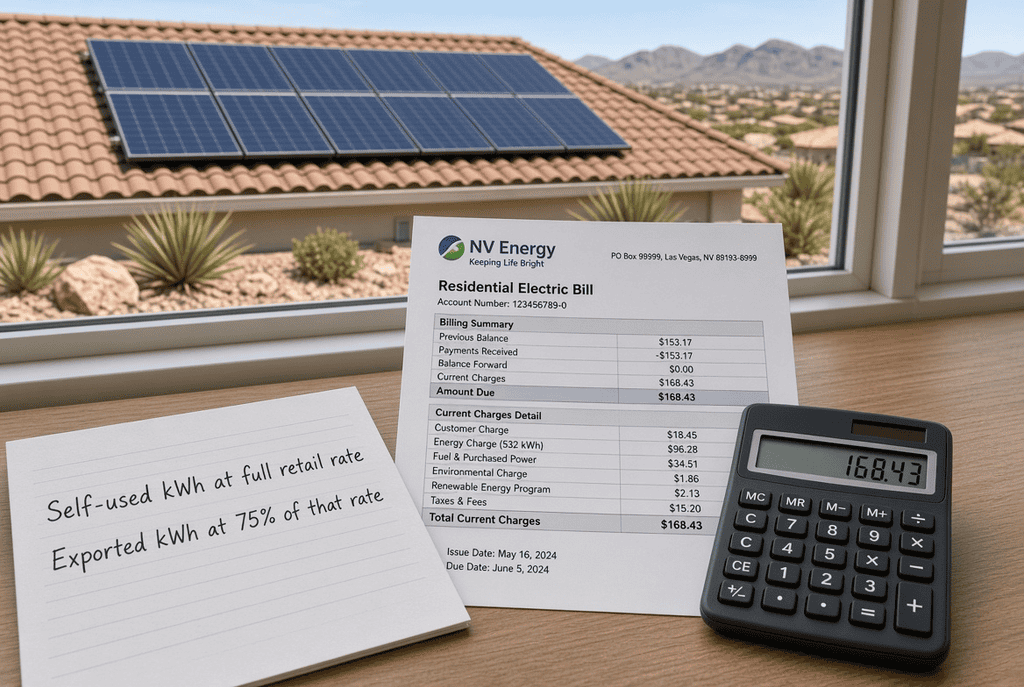
A common question from Nevada homeowners is what happens to excess electricity generated by a solar system. When production exceeds on-site use, the surplus is credited rather than lost. This section explains how excess power is valued under Nevada’s net metering rules, how bill credits are applied, and what options exist for homeowners who cannot install panels on their own roof.
How Current Buyback Rates Work
In 2026, NV Energy credits excess rooftop solar power under a structured net metering program:
- Tier 4 Net Billing Export Rate (75% Retail Offset): Under current NV Energy tariff structures, residential solar customers receive utility bill credits valued at 75% of the retail electricity rate for surplus solar generation exported back to the grid.
- 20-Year Grandfathered Rate Protection: Once an installation interconnects and receives utility approval, the established export credit percentage is legally locked in for a 20-year term tied to the property location, shielding long-term financial returns from future regulatory shifts.
- Month-to-Month Excess Generation Rollover: Unused export credits roll over continuously month-to-month within the annual billing cycle, allowing surplus energy banked during high-production summer months to offset utility charges during lower-yielding winter periods.
Community Solar & Shared Solar Alternatives
Homeowners and renters who cannot install rooftop panels may still access solar through community or shared-solar programs. These programs serve renters, condominium owners, low-income households, and properties with unsuitable roofs. Participants receive bill credits from an off-site array applied directly to their NV Energy account, without on-site installation.
Note: To keep up with fast-moving solar trends in Nevada, I use AI tools to help with research and writing. Every post is personally reviewed and edited by me.
How Excess Solar Production Is Credited
When a rooftop system produces more electricity than the home uses at a given time, the surplus is exported to the grid. NV Energy records the exported kilowatt-hours and applies a corresponding credit to the customer’s account. Understanding how these credits are calculated and applied is useful for evaluating the financial performance of a solar system.
1. Net Metering Rules for Systems of 25 kW or Less
Residential systems installed today are enrolled in Nevada’s Tier 4 net metering program, established under Assembly Bill 405:
- Southern Nevada Service Territory (NMR-405 Tariff): Newly interconnecting residential solar customers within NV Energy’s Southern service territory are assigned to the NMR-405 net billing rate classification.
- Northern Nevada Service Territory (NMR-2025 Tariff): Residential solar interconnection applications formally approved on or after October 1, 2025, across NV Energy’s Northern service territory fall under the updated NMR-2025 rate structure.
Under these programs, excess electricity exported to the grid receives a credit equal to 75% of the retail rate. The credit is applied in dollars rather than as a kilowatt-hour offset. Unused credit balances carry forward to subsequent billing periods and can reduce charges in months when on-site production is lower.
2. Monthly Bill Calculation
Each billing cycle, NV Energy compares electricity delivered to the customer with electricity exported to the grid. Any net surplus is credited at 75% of the retail rate, after applicable fees. The resulting credit appears on the account and may offset charges in later periods.
Systems larger than 25 kW, up to 1 MW, are assigned to commercial net metering schedules such as NMR-B, which use different credit rules. Most single-family residential installations remain below 25 kW and stay under the standard residential 75% credit rate.
3. Additional Considerations
The following points clarify how credits are applied and what they do not cover.
- Non-Refundable Credit Structure: Utility export credits carry no cash value and cannot be redeemed for direct financial payouts; accrued credits are strictly applied toward reducing future volumetric electricity usage charges.
- Exclusion of Fixed Service Charges: Net billing credits apply exclusively to volumetric kilowatt-hour usage and cannot be used to offset mandatory monthly customer service charges, basic connection fees, or fixed regulatory surcharges.
- Sub-Retail Compensation Mechanics: Surplus generation is compensated below full retail energy rates—unlike original net metering frameworks prior to 2016—reflecting the structured step-down tiers established under current Nevada regulatory mandates.
4. How to Get the Most Value Out of Your Setup
Self-consumption avoids the full retail rate, while exports are credited at only 75% of that rate. Direct use of on-site production therefore yields a higher value than exporting the same kilowatt-hours. Understanding this difference can inform system sizing, the timing of high-load activities such as laundry or vehicle charging, and the decision of whether battery storage is warranted.
For more details about solar savings & incentives, explore our 2026 guides on Community Based Solar Resources, the Expanded Solar Access Program, and Group-Buy Solar Programs.
How the 75% Rate and 20-Year Lock Work
Nevada’s current residential net metering credit rate of 75% originates from Assembly Bill 405, which established a series of declining compensation tiers for excess generation. Earlier tiers provided higher rates of 95%, 88%, and 81%. As participation increased and those tiers closed, new installations are placed in Tier 4, which credits exports at 75% of the retail rate.
Effect of the 75% Retail Credit
Exported kilowatt-hours receive a credit equal to 75% of the applicable retail rate, after designated fees. When residential rates are in the mid-to-high teens per kilowatt-hour, the resulting credit typically falls between 11 and 13 cents per kilowatt-hour, depending on the specific tariff. Because the credit is calculated as a percentage of the retail rate, its dollar value increases if that rate rises.
20-Year Credit Rate Term
Upon interconnection under Tier 4, the 75% credit rate is fixed for 20 years at that service address. Subsequent changes to net metering rates for new systems do not alter the rate applicable to an existing interconnection.
Relative Value of Self-Consumption and Exports
Under Nevada’s net metering rules, the value of a kilowatt-hour depends on whether it is consumed on site or exported. Self-consumption offsets the full retail rate, while exports are credited at a lower percentage. This difference is a primary factor in the financial return of a system.
Direct Usage = 100% Value
Electricity consumed at the same time it is produced offsets the full retail rate for that energy. Each kilowatt-hour used on site avoids a purchase from the utility at the applicable retail price.
Exporting = 75% Value
Surplus generation that exceeds instantaneous load is exported and metered by the utility. Those exports receive a credit of 75% of the retail rate. The remaining 25% is not credited, which reduces the annual value of exported energy relative to an equivalent amount of self-consumed energy.
Increasing the Value of On-Site Generation
Because self-consumed energy has a higher value than exported energy, aligning high-load activities with periods of generation can increase the financial return of the system. The following practices support that alignment:
- Strategic Load Shifting and Daylighting Usage: Shift major energy-intensive loads—such as EV charging, electric water heating, and laundry cycles—to peak daylight hours to directly consume real-time solar generation rather than exporting excess power to the grid.
- Right-Sized System Capacity: Design array capacity to match actual annual load profile rather than intentionally oversizing the system, maximizing direct self-consumption and avoiding low-yield export monetization.
- Behind-the-Meter Energy Storage Integration: Deploying a home battery system captures daytime surplus power for evening discharge, converting what would be a discounted 75% export credit into 100% self-consumed utility offset and insulating the home from peak grid tariffs.
Battery Storage and Credit Value
The 75% export credit increases the relative value of storing surplus generation for later use. Stored energy that displaces evening purchases from the grid is valued at the full retail rate rather than the reduced export credit. For some households, this difference improves the economic return of a battery system.

Community and Shared Solar Programs
Rooftop solar is not feasible for every household. Renters, properties with significant shading or HOA restrictions, and households that prefer to avoid the capital cost of an owned system have other options. Traditional virtual community solar, in which subscribers receive bill credits from an off-site array, is more limited in Nevada than in some other states. Several utility programs and alternative arrangements are available.
1. Community Based Solar Resources (CBSR)
Under the Community-Based Solar Resources (CBSR) initiative, NV Energy develops and operates photovoltaic systems at host sites that include schools, businesses, county facilities, and nonprofit organizations.
- Capital-Expenditure-Free Host Site Development: Commercial and institutional host organizations acquire clean energy generation infrastructure on their properties with zero upfront capital outlay, typically facilitated through power purchase agreements (PPAs) or long-term site leases.
- Regional Grid Integration and Community Solar Equity: On-site renewable generation feeds directly into the local utility distribution grid, supplying energy to utility-backed community solar programs and expanding clean energy accessibility for regional residents.
2. Expanded Solar Access Program (ESAP)
NV Energy’s Expanded Solar Access Program (ESAP) operates in conjunction with CBSR projects to provide bill credits to customers who are unable to install rooftop systems.
- Target Demographic and Equity Focus: The program specifically prioritizes income-qualified households, multi-family renters, and other designated customer segments traditionally excluded from distributed rooftop solar adoption.
- Virtual Solar Subscription Mechanics: Enrolled participants receive proportional bill credits derived from centralized community or utility-scale solar arrays at a guaranteed discount rate, operating entirely without on-site hardware requirements.
- Periodic Enrollment and Portal Verification: Enrollment occurs through periodic intake cycles administered by NV Energy, requiring prospective participants to verify current income eligibility thresholds and application windows directly via the utility’s ESAP portal.
3. Group-Buy Programs
Households with suitable roofs that prefer a coordinated procurement process can participate in group-buying programs. Switch Together, a partnership between Clark County’s Department of Environment and Sustainability and Solar United Neighbors, aggregates demand from nearby homeowners and small businesses. Participants obtain pricing for rooftop solar, battery storage, and electric-vehicle charging equipment through a pre-vetted procurement process.
4. Federal Grants & Community Workshops
Additional funding initiatives, including federal Solar for All grants, support expanded access for low-income and underserved communities. Local nonprofit organizations also conduct informational workshops and open houses that address available programs and project considerations.
Practices That Increase the Value of On-Site Generation
Exported energy is credited at 75% of the retail rate, while energy consumed on-site avoids the full retail rate. Increasing the share of generation that is used on-site therefore raises the financial value of the system. The following practices will help you maximize your return on investment:
1. Matching System Size to Load
System capacity that substantially exceeds annual consumption increases the volume of energy exported at the 75% credit rate. Sizing the array to approximate expected annual load increases the share of generation that is consumed on-site and reduces the volume of lower-value exports.
2. Shifting Discretionary Loads to Daylight Hours
Scheduling high-consumption activities during periods of high solar production increases the share of generation that is consumed on-site rather than exported.
- Midday EV Charging Synchronization: Schedule electric vehicle charging sessions during peak solar production hours (typically 10:00 AM to 3:00 PM) to absorb excess generation directly before it exports to the grid.
- Daylight Appliance Load-Shifting: Coordinate high-draw mechanical and domestic loads—such as variable-speed pool pumps, dishwashers, and laundry appliances—to operate sequentially throughout daylight hours when real-time array yield is highest.
- Thermal Pre-Cooling Strategy: Lower thermostat setpoints during late afternoon peak production hours to sub-cool the living space, effectively storing thermal energy in the structure to reduce compressor load during post-sunset peak utility hours.
3. Evaluating Battery Storage
Battery storage can hold excess daytime generation for later discharge during evening hours when the household would otherwise purchase energy at the full retail rate. This shifts energy that would have been exported at the 75% credit rate into on-site consumption. The economic result depends on evening load, system size, and equipment cost.
4. Monitoring Production & Usage
Monitoring system data together with monthly utility statements provides a record of on-site consumption versus exports. The resulting pattern can inform adjustments to load timing and the evaluation of storage.
5. 20-Year Credit Rate Term
Under the Tier 4 terms, the 75% credit percentage is fixed for 20 years at the interconnected address. The rate therefore remains constant for the duration of that term regardless of subsequent changes to the tariff.
6. Following Regulatory Developments
Retail rates and net metering terms are subject to change through legislation or Public Utilities Commission proceedings. Awareness of those changes supports informed decisions as household load or system equipment evolves.
Potential Future Policy Changes
Future changes by the Public Utilities Commission of Nevada (PUCN) or the Legislature may modify net metering terms for new interconnections. Areas subject to potential revision include:
- Potential Tariff Tier Step-Downs: Future regulatory proceedings by the Public Utilities Commission of Nevada (PUCN) could sunset existing export structures, establishing lower compensation tiers for subsequent applicant cohorts.
- Transition to Granular Interval Settlement: Potential shifts from monthly aggregate netting to sub-hourly (such as 15-minute) calculation windows would devalue uncoordinated solar exports while strongly prioritizing behind-the-meter battery storage integration.
- Restructuring of Credit Application Rules: Regulatory modifications could alter which underlying utility rate components and fixed fees remain eligible for offset by excess generation credits.
- System Capacity and Interconnection Restrictions: Future policy revisions may tighten allowable nameplate capacity caps or introduce stricter engineering review thresholds for large-scale residential arrays.
- Emerging Grid-Service and VPP Mandates: Implementation of proactive utility programs or incentives requiring smart inverter functionality and residential battery dispatch capabilities to support local grid reliability.
Importantly, policy shifts like these typically apply only to new solar applications, protecting existing system owners who are already enrolled.
Sources for Regulatory Updates
Sources that publish regulatory and tariff changes before they take effect include:
- Regulatory Docket Monitoring (PUCN): Track active dockets, policy revisions, and general rate cases filed before the Public Utilities Commission of Nevada (PUCN) to anticipate structural tariff shifts.
- Utility Policy Tracking (NV Energy): Monitor periodic tariff updates, customer notices, and administrative advisories issued directly by NV Energy regarding net billing compliance and program changes.
- Legislative and Statutory Oversight: Follow energy-sector legislation, renewable energy mandates, and utility rate reform bills moving through the Nevada State Legislature during biennial sessions in Carson City.
- Strategic Industry Partnerships: Collaborate with established regional solar contractors and compliance specialists who maintain active oversight of evolving regulatory and interconnection standards.
Thank you for reading! If you have any feedback or a specific Nevada solar topic you’d like us to cover next, please reach out directly at admin@nevadasolarguide.com.