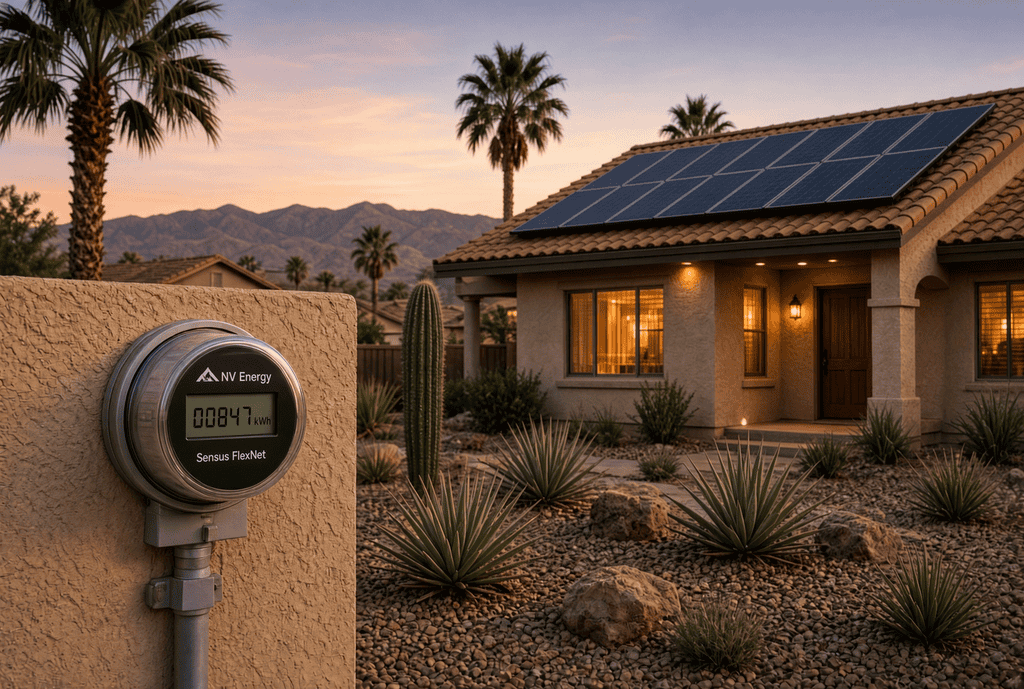
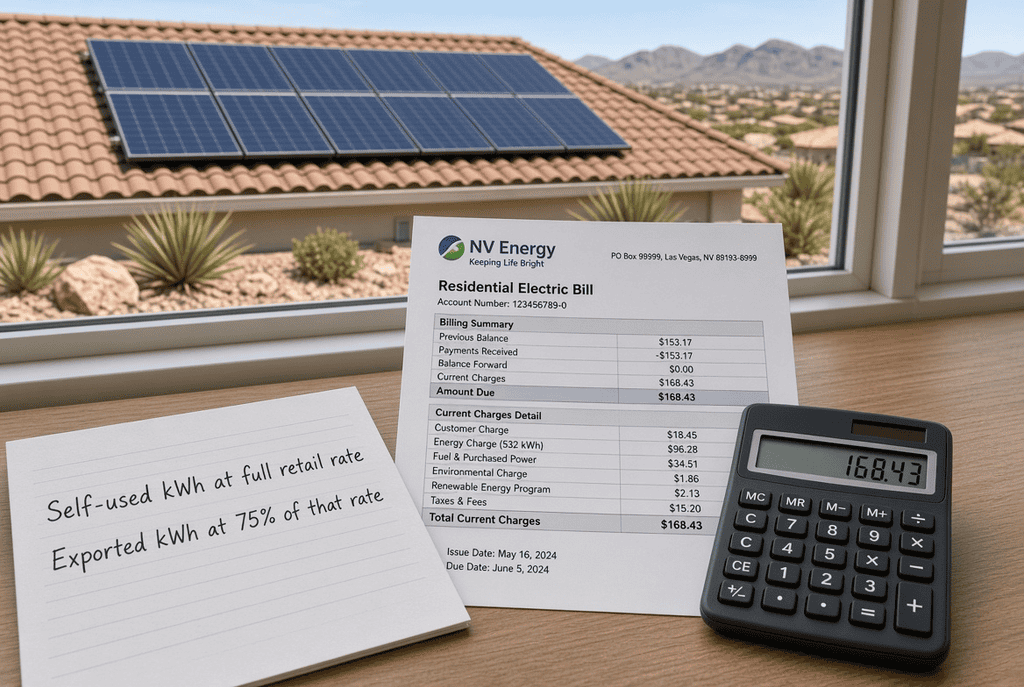
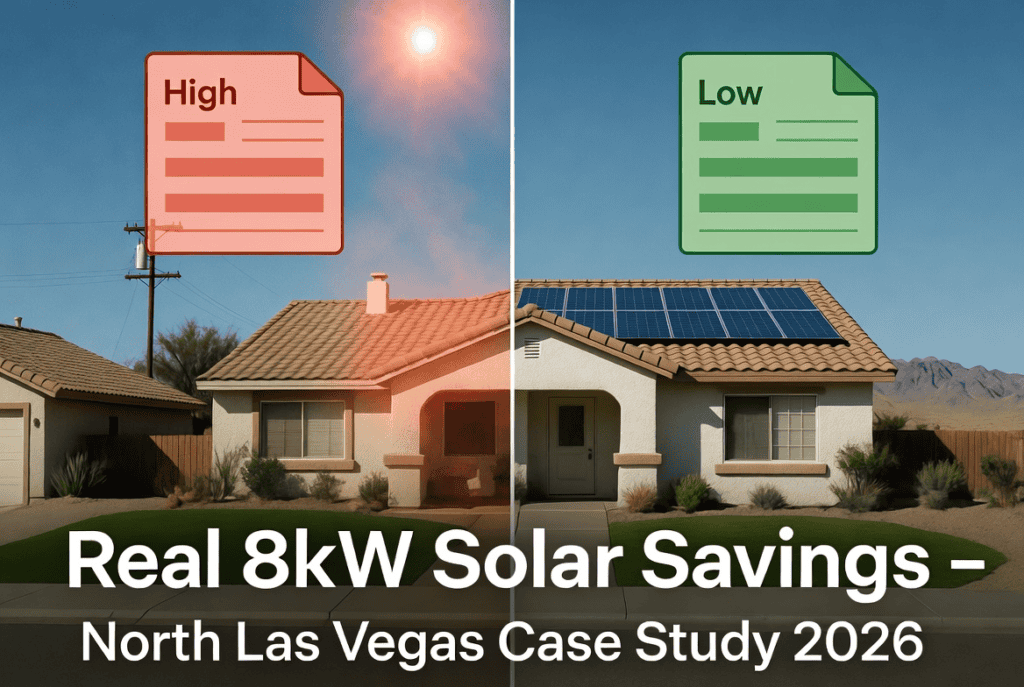
For decades, Southern Nevada’s residential power bills were straightforward: you paid a fixed monthly fee, plus a set price for every kilowatt-hour (kWh) you used. Rooftop solar targeted that second number. Under current Tier 4 net-metering rules, excess energy exported back to the grid chips away at it further, returning 75% of its value.
The new daily demand charge changes the equation entirely. Instead of measuring total energy used over a month, it looks at your single highest 15-minute spike of electricity use each day—essentially charging you for how hard you lean on the neighborhood grid at your peak moment.
The Public Utilities Commission of Nevada (PUCN) approved this structure for NV Energy’s residential and small-commercial customers. While initially slated for April 2026, NV Energy pushed the start date back for customer outreach (check your bill or nvenergy.com/dailydemand for the exact rollout timing). The date moved, but the financial math didn’t change.
Two key facts determine how this impacts solar owners:
- The standard rate drop: NV Energy lowers the basic per-kWh price when adding the demand line, aiming to keep non-solar bills roughly the same overall.
- Net-metering credits won’t cover demand: Excess solar credits offset kWh charges, but they cannot be applied to your daily demand fee. If your air conditioner kicks on at 7 p.m. while dinner is in the oven, that evening power spike generates a fresh charge on your invoice. Estimates put the average hit to solar customers around $12 a month, but heavy evening overlaps will run higher.
Solar isn’t broken or rendered useless by this shift—the volumetric kWh savings remain intact. It simply means power bills now operate on two separate scoreboards instead of one.
Note: To keep up with fast-moving solar trends in Nevada, I use AI tools to help with research and writing. Every post is personally reviewed and edited by me.
What the Daily Demand Charge Is
Kilowatt-hours measure the total amount of electricity you use, while kilowatts measure how much power you pull at a single moment. The daily demand charge bills you for that peak moment.
If your 4-ton AC compressor, clothes dryer, and oven all run at the same time, they can create a 6–8 kW spike in a single 15-minute window—even if your overall monthly power usage is pretty low. On older bills, that brief surge was invisible, blended into your basic cents-per-kWh rate. Southern Nevada’s updated rate structure calls it out directly.
How NV Energy Calculates the Charge
- Tracking daily peaks: Your meter logs your single highest 15-minute demand spike (measured in kW) each day.
- Adding them up: At the end of the month, NV Energy totals those daily peaks across your entire billing cycle.
- Applying the rate: That total is multiplied by a set rate per kW. Early projections pointed toward $0.14 to $0.18 per daily peak kW.
A home that tops out at 4 kW every day for 30 days would see a demand line item around $17 to $22 (before factoring in the drop in standard per-kWh rates). If that same home spikes to 8 kW during dinner prep for 20 nights in July, that line item grows quickly.
The Purpose Behind the Shift
This charge is meant to cover the neighborhood distribution gear—like transformers and local power lines—that must be sized to handle maximum power surges rather than light, steady use.
NV Energy maintains this isn’t a net revenue increase. Instead, it unbundles existing grid costs from the volumetric energy rate. Because the base per-kWh rate drops when the demand charge is added, a standard non-solar bill is intended to stay roughly flat. However, consumer advocates point out that rooftop solar households feel a sharper impact because they already purchase far fewer total kWh from the grid.
What It Is Not
- Not an export balance rule: It isn’t northern Nevada’s 15-minute netting system.
- Not the basic service fee: It’s an entirely separate line item.
- Not optional: This is an automatic change for the primary Southern Nevada residential class, not a voluntary pilot program.
- Not payable with solar credits: Just like your fixed monthly customer fee, net-metering credits cannot be applied to clear this charge.
Scope and Strategy
This rollout applies specifically to Nevada Power customers in Southern Nevada; Sierra Pacific territory in the north would require its own rate case to implement something similar.
Ultimately, power bills now feature three distinct scoreboards: your fixed customer charge, your total kWh energy usage (plus 75% export credits), and the sum of your daily 15-minute peaks. Rooftop solar is designed to tackle the second scoreboard. Managing the third requires shifting daily habits or relying on home battery storage.
For more details on solar savings and regulations, explore our 2026 guides on Federal ITC + Nevada Tax Exemptions, a case study on before & after an 8kW system, and the net metering 15-minute billing update.
April 2026—and Why the Calendar Slipped
The original PUCN order and NV Energy’s initial materials slated the new southern residential daily demand charge for April 2026. However, the rollout timeline has shifted considerably since then.
What Was Approved
The 2025 Nevada Power rate case made a daily demand charge standard for residential and small-commercial customers across Southern Nevada. While opt-in demand plans already existed, changing a kilowatt-based charge into a default line item for the general public marked a major policy change.
Why the Timeline Shifted
NV Energy delayed the official rollout to give customers more time to understand the changes and to prepare its own support systems.
- First delay: A announcement pushed the go-live target to October 1, 2026.
- Subsequent delay: Follow-up reporting pointed toward a further push to January 1, 2027, driven by ongoing regulatory discussions about public readiness.
- Communication gaps: Utility webpages and news outlets have occasionally published conflicting dates during the transition. While confusing, these delays reflect administrative staging—not a cancellation of the rate structure itself.
Why Delays Don’t Change Long-Term Math
A solar or battery system installed today is built to operate for decades. Treating a temporary delay as a permanent cancellation creates an inaccurate financial forecast. Any solar estimate that ignores demand charges simply because the rollout date shifted is omitting a crucial long-term cost factor.
What You Should Do Now
- Verify the current schedule: Check nvenergy.com/dailydemand directly to confirm the latest effective date.
- Review your usage data: If NV Energy’s portal offers interval tracking for your account, check your daily power spikes.
- Focus on the underlying rule: The core mechanics remain unchanged—your daily 15-minute peak power spikes will be summed and billed, and net-metering credits cannot be used to pay that line item.
The Purpose of the Postponement
NV Energy’s stated goal for the delay was customer education—specifically to explain that standard non-solar bills are projected to remain relatively flat due to offsetting reductions in standard energy rates. For solar owners, the extra time provides an opportunity to evaluate how home energy storage or shifting daily habits can keep future peak charges to a minimum.
How the Charge Is Calculated: 15 Minutes × Every Day
To understand daily demand, set aside your total monthly energy usage for a moment. Demand isn’t about total consumption over time—it operates as a monthly log of short power spikes.
Understanding the Daily Spike
Your smart meter calculates your average power draw across continuous 15-minute intervals throughout the day. Your highest 15-minute average becomes your official peak demand for that day.
Running your central air conditioner, clothes dryer, and electric oven simultaneously within the same 15-minute window can easily push that day’s peak to 8 kW—even if your home stays completely quiet for the remaining 23 hours and 45 minutes. Staggering those same high-load tasks across separate intervals can keep that daily peak closer to 4 kW.
How Daily Peaks Add Up Monthly
At the end of your billing cycle, NV Energy adds the highest peak from each individual day together:
- Consistent daily habits: Peaking at 4 kW every day for 30 days equals 120 total kW for the month.
- Fluctuating usage: 20 hot summer days peaking at 7 kW plus 10 mild days peaking at 3 kW equals 170 total kW.
That combined monthly total is then multiplied by the established rate per kW. The final charge reflects the sum of your daily high points, rather than a single worst moment of the year or a broad monthly average.
Why the 15-Minute Interval Matters
A 15-minute window is short enough to capture overlapping high-power appliances, but long enough to smooth out momentary electrical surges (like the initial split-second startup draw of an AC compressor).
For homes with solar panels, peak demand often happens during early evening hours—for instance, between 6:15 p.m. and 6:30 p.m. in July. As the sun drops and solar generation fades, household air conditioning and appliances switch over to grid power. Even if your solar array exported significant energy at noon, a brief evening surge sets your demand rate for that entire day.
Sample Calculation
While specific utility rates move over time, a simple breakdown illustrates the underlying math:
- 4 kW daily peak × 30 days × $0.18/kW ≈ $21.60 demand charge
- 6 kW daily peak × 30 days × $0.18/kW ≈ $32.40 demand charge
Because NV Energy unbundles this charge by lowering standard per-kWh rates at the same time, the net change on a standard non-solar bill may remain relatively small. However, the demand line item itself remains an active cost factor to manage.
Ultimately, high daytime exports, an annual net-zero energy balance, and accumulated net-metering credits cannot reduce or offset these daily peak numbers. The demand charge responds to a single factor: smoothing out short-term power surges. Spreading out high-energy household tasks or relying on battery storage to clip evening spikes is the only direct way to flatten that monthly sum.

Why Solar Looks Different Under Demand
Rooftop solar is designed to generate overall energy over time (measured in kilowatt-hours), while a demand charge targets short-term power spikes (measured in kilowatts). These two systems only line up when your solar panels are producing maximum power at the exact moment your home reaches its highest electrical draw.
What Solar Still Does Well
Your solar array continues to handle its core job effectively:
- Reduces total energy delivered from the grid.
- Increases self-consumption of your own generated power.
- Banks 75% export credits under southern Nevada’s NMR-405 Tier 4 rules.
That financial benefit remains intact; the introduction of a demand charge doesn’t eliminate standard energy savings.
Where Solar Falls Short
A standard roof array often struggles to eliminate early evening power spikes. By 6:15 p.m. on a hot July day, a south-facing system is producing far less power, and even west-facing panels cannot fully match heavy air conditioning loads during extreme heat.
The single 15-minute interval that sets your demand rate for the day can end up drawing almost entirely from the grid. Strong solar production at noon does not offset or erase a peak created after sunset.
Why Solar Bills See a Larger Impact
Standard utility customers previously paid grid distribution costs through higher per-kWh rates. Unbundling those costs—adding a separate demand charge while lowering the base kWh price—is designed to keep average non-solar bills relatively flat.
Solar households, however, have already minimized their kWh consumption. When grid costs move from a per-kWh line item to a separate peak-demand line item, solar homes absorb the new charge without receiving as much benefit from the lower kWh rates. Furthermore, accumulated net-metering credits cannot be applied to cover demand fees.
Limitations of Panel Orientation and Capacity
Adding more solar panels or prioritizing west-facing roof space increases overall late-afternoon energy production and export credits, but it offers limited protection against post-sunset demand spikes. Relying solely on extra panel capacity to manage short-term demand charges yields diminishing returns.
Managing Demand with Storage and Time-of-Use Rates
Pairing solar with smart energy storage addresses peak demand more directly. Optional Time-of-Use (TOU) rates feature peak pricing during early evening hours—the same window when demand spikes typically occur.
A home battery configured to discharge during peak evening hours can reduce both high-cost kWh consumption and 15-minute demand spikes simultaneously. (Note that a battery kept strictly in backup mode for power outages will not manage daily peak demand.)
Beyond Monthly Energy Offsets
Standard metrics showing an annual energy offset (such as “88% solar coverage”) do not reflect daily 15-minute peak usage. Reviewing detailed 15-minute interval data during peak summer months provides a clearer picture of when evening grid demand actually occurs.
Rooftop solar remains an effective tool for offsetting total energy consumption. Managing the separate daily demand charge requires shifting peak usage habits or incorporating targeted battery storage.
Planning Math: What “About $12” Means
NV Energy and local news coverage have frequently cited $12 per month as the average bill increase for rooftop solar homes after adding the demand charge and reducing the standard per-kWh rate. Treat that figure as a general benchmark rather than a guarantee for your specific home.
Separating Raw Demand Charges from Net Impact
To understand your true monthly bill, it helps to distinguish between two distinct figures:
- The raw demand line item: Calculated as your sum of daily 15-minute peaks multiplied by the rate per kW. Using initial rate illustrations ($0.14 to $0.18 per kW) and typical daily peaks (3.5 kW to 5 kW), the raw demand charge ranges from $15 to $27 per month.
- The net bill impact: Calculated as the raw demand charge minus your savings from lower per-kWh rates. For standard non-solar homes, these amounts largely cancel each other out. For solar homes that already purchase very few kWh, the rate reduction offers less offsetting savings, leading to the estimated $12 net increase (or higher for homes with larger peak spikes).
Why Individual Usage Varies
Household energy habits differ significantly, and peak demand shifts throughout the year:
- Seasonal variation: July cooling demands differ greatly from mild spring weather in March.
- Thermostat settings: Continuous air conditioning creates different demand profiles than letting indoor temperatures rise during the day.
- Vehicle charging: Plugging in an electric vehicle at 6:20 p.m. creates a sharp peak compared to charging overnight during off-peak hours.
Estimated Monthly Scenarios
| Daily Peak | 30-Day Sum | Line Item at $0.18/kW | Estimated Net Impact After kWh Rate Cut |
| 3 kW | 90 kW | $16.20 | Minimal change / near flat |
| 4 kW | 120 kW | $21.60 | Near flat to +$8/month |
| 6 kW | 180 kW | $32.40 | +$12 to +$20/month |
| 8 kW (Stacked loads) | 240 kW | $43.20 | Well above average estimates |
(Note: These figures serve as illustrative planning examples; final billing impacts depend on approved tariff rates.)
Long-Term Financial Impact on Solar Return on Investment
A $12 monthly difference equals $144 per year, which may seem minor initially. Over a 10-year period, however, unmanaged demand charges—especially with added electric loads like EVs—can accumulate to over $1,400 in unexpected costs. Accurate financial planning for new solar installations should incorporate an estimated demand line rather than assuming zero peak-demand costs.
Utilizing Utility Tools for Accurate Planning
When evaluating system economics, reviewing actual account interval data through NV Energy’s portal provides a more reliable picture than generalized averages. Because net-metering credits cannot be applied against the daily demand line item, controlling your peak 15-minute intervals remains the primary lever for managing this expense—whether through shifting appliance usage times or deploying home battery storage to clip peak surges.
What Cuts Demand
The daily demand line item shrinks only when your highest 15-minute power spikes drop. Standard energy-saving habits reduce total kilowatt-hours, but managing peak demand requires targeted strategies focused on short-term power draw.
Stagger High-Power Appliances
Avoid starting the clothes dryer at 6:15 p.m. while your air conditioner is running heavily and the electric oven is preheating.
- Shift heavy loads: Run dishwashers and laundry equipment during midday hours or later in the evening.
- Space out usage: Stagger high-draw appliances by 20 to 30 minutes.
Combining major loads into a single 15-minute window can create an 8 kW daily peak. Spreading those same tasks across separate intervals can reduce that billed peak significantly.
Strategic Pre-Cooling
Adjusting thermostat timing helps manage air conditioning loads during peak demand hours:
- Pre-cool during peak solar hours: Lower indoor temperatures between 3:00 p.m. and 5:00 p.m. while rooftop solar production is high (and off-peak rates apply under Time-of-Use plans).
- Ease evening load: Raise the thermostat setpoint slightly between 6:00 p.m. and 9:00 p.m. A home that is already cooled before evening hours requires less compressor activity during peak grid demand windows.
Schedule EV Charging
Electric vehicle charging during dinner hours can easily set your highest daily demand peak. Scheduling Level 2 charging overnight or during peak midday solar hours prevents vehicle charging from stacking on top of household electricity use.
Optimize Timers for Pool Pumps and Equipment
Set pool pumps and secondary equipment to run outside the early evening window. While background electrical loads do not single-handedly create high peak spikes, they add to your total power draw when major appliances cycle on.
Utilizing Battery Storage for Peak Clipping
Home battery systems (such as Tesla Powerwall, Enphase IQ Battery, or FranklinWH) directly reduce grid demand when configured to discharge during peak usage windows.
- Operation mode: Ensure the battery is set to peak shaving, Time-of-Use, or self-consumption mode rather than backup-only mode.
- System sizing: Verify that the system’s continuous output capacity matches your typical household peak draw. A battery kept exclusively in reserve for power outages will not offset daily demand charges.
Ineffective Strategies for Reducing Demand Charges
- Adding extra solar panels: Increases total daytime energy exports, but offers limited protection against post-sunset demand spikes.
- Morning panel maintenance: Improves overall kWh generation, but does not alter evening peak draw.
- Relying on net-metering credits: Export credits offset standard kWh usage charges, but cannot be applied to daily demand line items.
Tracking Results After Behavior Adjustments
Reviewing 15-minute interval data after adjusting household habits helps measure progress. If staggering appliance use lowers your daily peak spikes from 7 kW down to 4 kW, implementing behavioral adjustments first provides a clear baseline before investing in additional energy storage. Managing demand relies primarily on scheduling routines, backed by battery storage where needed, while rooftop solar handles overall energy generation.

Batteries vs. Load-Shifting vs. Oversizing
Choosing the right approach depends on understanding which part of your power bill you are trying to manage. Each strategy targets a different line item, with varying costs and effectiveness.
1. Load-Shifting (First and Cheapest Step)
Managing daily habits offers the most immediate reduction in peak demand at zero upfront cost:
- Actions: Stagger heavy appliance usage (dryer, oven, AC), pre-cool your home between 3:00 p.m. and 5:00 p.m., and shift EV charging away from dinner hours.
- Cost: Free—requires only minor habit adjustments and simple timers.
- Impact: Directly lowers your 15-minute kW spikes and reduces peak consumption under Time-of-Use (TOU) rates. (Does not provide emergency backup power during a grid outage.)
If simple load-shifting drops your July peak spikes from 7 kW down to 4 kW, you may find that behavioral changes alone resolve a large portion of your demand charges.
2. Battery Storage for Peak Shaving (The Dedicated kW Tool)
A home battery configured for peak shaving or TOU self-consumption actively reduces your draw on the grid during high-demand windows:
- Actions: Automatically discharges stored power during early evening hours (e.g., 6:00 p.m. to 9:00 p.m.) to cover household energy spikes.
- Cost: Typically $10,000 to $20,000+ installed, depending on capacity and equipment brand.
- Impact: High reduction in peak demand charges, lower high-tier TOU costs, and optional backup power if a portion of the capacity is reserved for outages.
- Key Considerations: A battery set to 100% backup mode, exposed to extreme heat throttling, or undersized for heavy compressor loads will not effectively clip peak demand.
3. Oversizing the Solar Array (The Wrong Tool for Demand)
Adding extra solar panels increases overall daytime energy generation, but does not solve evening demand charges:
- Actions: Installing extra panels beyond your typical daytime consumption needs.
- Cost: Additional upfront equipment and installation costs.
- Impact: Increases total daytime kWh exports (subject to 75% net-metering credit reductions), but provides no protection against demand spikes occurring after sunset.
Expanding panel capacity is beneficial if you have significant daytime energy needs—such as daytime EV charging or pool pumps—but it is an inefficient strategy for managing post-sunset demand charges.
Comparing Strategy Effectiveness
| Tactic | Impact on Total kWh / Exports | Impact on 15-Minute Peak kW | Emergency Backup | Typical Upfront Cost |
| Load Shifting / Pre-Cooling | Moderate reduction | Moderate to High reduction | None | ~$0 |
| Right-Sized Solar Array | High self-consumption | Low impact after sunset | None | Baseline installation cost |
| Oversized Solar Array | High exports (reduced credit rate) | Minimal impact after sunset | None | Higher installation cost |
| Battery (Peak-Shave Mode) | Moderate reduction | High reduction | Optional reserve | High ($10k–$20k+) |
| Battery (100% Backup Mode) | Minimal reduction | Minimal reduction | High (Full backup) | High (unleveraged for demand) |
Building a Practical Strategy
For most Southern Nevada homeowners, the most cost-effective sequence is to start with habit adjustments and timers. Once high-demand usage is staggered, a right-sized battery system can be added to clip remaining peak spikes and optimize TOU rates.
Rooftop solar remains the core solution for generating total energy, while load-shifting and targeted battery storage provide the tools needed to control peak demand.
What to Ask on a 2026 Quote
If a solar proposal only models total energy usage, baseline rates, and 75% export credits, it is relying on an outdated financial model. A modern quote for Southern Nevada must account for peak demand.
1. Demand Charge Modeling
- Is a daily demand line item included in the cash-flow projection?
- Which rate per kW and effective date were used? (e.g., the original April 2026 order vs. October 2026 or January 2027 rollout targets).
- Are peak estimates based on actual 15-minute usage history or generic assumptions? (Assuming a default 3 kW peak for every household distorts financial projections).
- Does the proposal explicitly note that net-metering credits cannot offset demand charges?
2. Usage Interval Analysis
- Will the installer analyze actual 15-minute interval data from peak summer months?
- Does the proposal rely solely on an annual energy offset percentage? (A high annual offset percentage does not reflect short-term evening demand spikes).
3. Battery Configuration and Performance
If energy storage is included in the proposal:
- Is the battery programmed for peak shaving and Time-of-Use management during early evening hours (6:00 p.m. to 9:00 p.m.)?
- What percentage of battery capacity is reserved strictly for emergency backup? (Systems set to 100% backup mode will not reduce daily demand charges).
- Can the battery handles the continuous power output and startup surge required by your central air conditioner?
4. Tariff and Territory Accuracy
- Does the proposal apply Southern Nevada NMR-405 Tier 4 rules (monthly netting at 75% export value)?
- Does it avoid mixing up Northern Nevada rules or premature rate structures? (Ensure Northern Nevada 15-minute export rules are not applied to Southern Nevada accounts, or vice versa).
5. Evaluating System Oversizing
- If extra solar panels are recommended to manage demand, does the proposal show projected 15-minute usage at 6:20 p.m. with and without those panels? (Additional solar panels cannot offset power drawn after sunset).
6. Tax Incentives and Policy Verification
- Are current federal investment tax credits (ITC) and local incentive values accurately calculated? (Errors in baseline incentive assumptions can significantly alter long-term financial projections).
- Is the financial model documented in writing to account for potential utility rollout date adjustments?
7. Licensing and Interconnection Compliance
- Is the installer fully licensed (Nevada State Contractors Board C-2 license) and handling all standard utility interconnection requirements (PowerClerk submission and Permission to Operate)?
Proposal Checklist
A complete proposal for Southern Nevada should clearly display three distinct financial columns:
| Column 1: Energy Usage | Column 2: 75% Export Credits | Column 3: Daily Peak Demand |
| Measures total grid energy (kWh) consumed. | Calculates net-metering credits earned on excess daytime generation. | Projects the monthly sum of daily 15-minute peak spikes (kW). |
If a proposal omits the third column, request an updated file that reflects current Southern Nevada rate structures before moving forward.
Final Advice
Southern Nevada’s daily demand charge introduces a distinct peak-power scoreboard: the sum of each day’s worst 15-minute peak, multiplied by a set rate per kW. While the PUCN originally scheduled the rollout for April 2026, NV Energy delayed the official billing start date to expand customer outreach. However, the underlying formula remains unchanged. Be sure to check NV Energy’s daily demand explainer page to confirm the current live date when reviewing your setup.
Solar Still Delivers on Energy Usage
Rooftop solar remains an effective solution for managing overall energy consumption:
- 75% export value: Under Southern Nevada’s NMR-405 Tier 4 rules, excess energy exported to the grid continues to earn 75% credits with monthly netting.
- 100% savings on self-consumption: Every kilowatt-hour generated and used directly in your home avoids standard grid energy charges completely.
The core energy-saving benefits of solar remain fully intact.
Solar Doesn’t Automatically Control Peak Demand
A standard solar array cannot eliminate post-sunset demand spikes. Running central air conditioning alongside evening household tasks after solar generation fades sets your peak demand for that day. Crucially, accumulated net-metering credits cannot be applied to cover this line item. While utility estimates cite a ~$12 monthly average impact for solar customers, your actual bill depends entirely on your specific summer usage patterns.
Action Plan for Homeowners
- Adjust habits first: Stagger high-draw appliances and pre-cool your home during off-peak hours to flatten daily usage spikes.
- Deploy targeted storage: If evening usage spikes remain high, add a home battery configured for peak shaving and Time-of-Use management.
- Avoid incorrect sizing: Do not add extra solar panels solely to manage demand charges, as daytime generation does not offset evening peak draw.
- Demand detailed proposals: Reject single-percentage offset estimates that omit explicit daily demand calculations.
Ultimately, Southern Nevada power bills now operate across three distinct areas: your fixed customer charge, total energy usage (with 75% export credits), and daily peak demand spikes. Accurate financial planning requires addressing all three.
Thank you for reading! If you have any feedback or a specific Nevada solar topic you’d like us to cover next, please reach out directly at admin@nevadasolarguide.com.