From June 1 through September 30, NV Energy’s optional residential time-of-use plan applies higher summer on-peak rates from 6:01 p.m. to 9:00 p.m. each day and during this window, household demand often remains elevated while solar production declines. Published rates for the optional TOU plan place on-peak energy in the mid-to-high 40¢/kWh range, compared with substantially lower off-peak rates, though specific figures are subject to Public Utilities Commission of Nevada adjustments.
Customers are not required to enroll in the TOU plan and may remain on the standard residential rate; however, the evening period is still relevant for many solar households because it coincides with higher grid demand and reduced solar output. Home batteries can supply power during these hours rather than exporting midday generation under the current 75% net-metering credit. The practical objective is typically to reduce purchases during the highest-priced hours rather than to operate the full home from battery alone for extended periods.
Note: To keep up with fast-moving solar trends in Nevada, I use AI tools to help with research and writing. Every post is personally reviewed and edited by me.
What the 6:01–9:00 p.m. Window Is
Southern Nevada’s optional residential time-of-use plan defines summer peak hours as 6:01 p.m. to 9:00 p.m. every day from June 1 through September 30. All other hours during those months are treated as off-peak. From October through May the plan uses a single winter schedule with no evening peak differential. An optional EV charging rider, when added, typically applies a separate overnight window (commonly 12:01 a.m. to 8:00 a.m.). Some optional riders may also call critical peak events inside the same 6:01–9:00 p.m. summer window, subject to an annual hour limit. The schedule is set by tariff rather than by sunset or weather.
Read the Rate Sheet for Your Specific Meter
Nevada Power (Southern Nevada) and Sierra Pacific (Northern Nevada) publish separate rate schedules. Southern residential time-of-use plans have consistently used a 6:01–9:00 p.m. summer peak window. Northern schedules apply that same window on some residential plans and longer afternoon peak periods on others. Customers billed from Reno, Sparks, or Carson City should confirm their specific rate schedule on the NV Energy website rather than relying on Southern Nevada parameters.
Optional Really Does Mean Optional
Solar customers are not required to enroll in a time-of-use rate as net-metering credits apply to whichever standard residential schedule the customer selects. Remaining on the flat residential rate (RS/D-1) avoids the higher on-peak charges that appear under the optional TOU plan. NV Energy provides a first-year comparison under which any excess cost relative to the flat rate is credited and the customer may opt out. The guarantee reduces enrollment risk; it does not change the level of the published peak rates themselves.
Why 6:01 p.m. Instead of 6:00 p.m.?
Utility tariffs define peak periods with precise one-minute boundaries so interval meters can classify usage without overlap. Battery scheduling software should be set to the same start and end times. A generic 6:00–9:00 p.m. profile written for another utility can cause the battery to discharge before the peak begins or to remain idle after 6:01 p.m., resulting in grid purchases during the higher-rate window. Matching the tariff times exactly avoids both gaps.
For more details about solar savings and incentives, explore our 2026 guides on how Time-of-Use rates affect solar ROI, the 100% solar property tax exemption, and solar + battery payback.
Solar Production Decline During Evening Peak Hours
A typical 8 kW rooftop array in the Las Vegas Valley produces the majority of its daily energy between roughly 10:00 a.m. and 4:00 p.m. Output declines steadily after that; by 6:01 p.m. in midsummer only the western-facing modules continue to generate meaningfully, and system-level production is already well below its earlier peak. Household demand commonly moves in the opposite direction during the same hours as occupants return, cooking and air-conditioning loads rise, and vehicles are plugged in. For many homes, consumption at 7:00 p.m. exceeds midday use. The resulting mismatch is a primary reason batteries are considered for evening peak reduction.
How Net Metering Handles the Mismatch
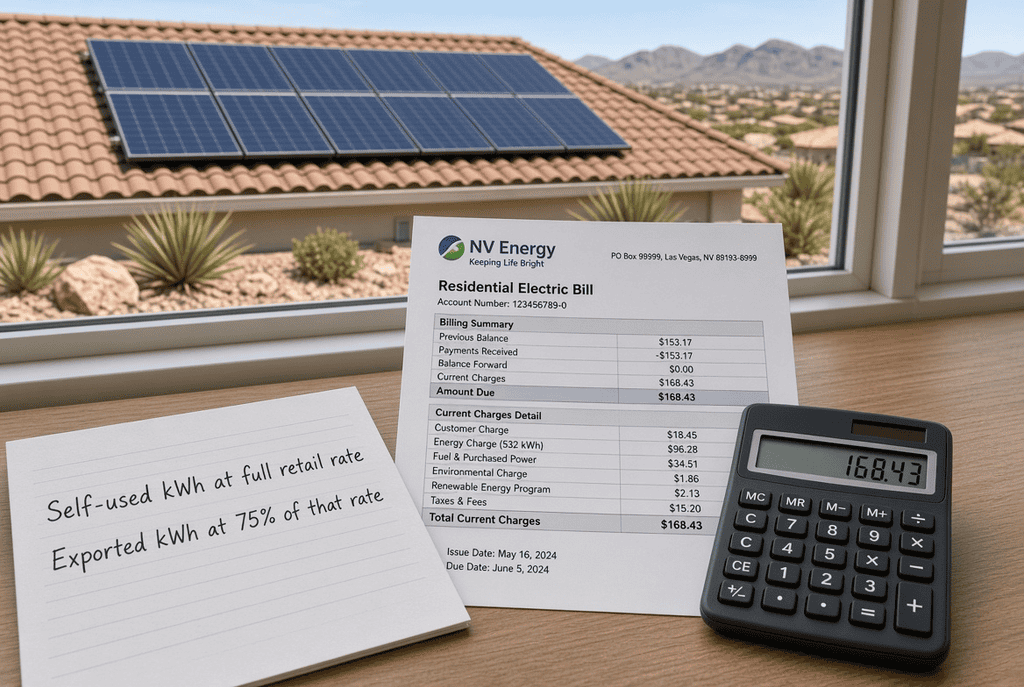
Under current net-metering rules (NMR-405 Tier 4 for Southern Nevada and NMR-2025, which uses 15-minute netting, for new Northern Nevada systems), exported surplus generation is credited at approximately 75 percent of the volumetric energy rate after public-policy adders. The credits do not offset the basic service charge.
- Midday Generation Surplus & Net Billing Discount: Solar output reaches its daily peak while household electrical demand remains low. Excess generation is exported back to the grid under NV Energy’s Net Metering (NEM) transition rates, where energy credits are awarded at a reduced, tiered percentage of the full retail electricity rate.
- Evening Demand Peak & High-Rate Grid Import: Solar production diminishes rapidly as household power consumption surges during evening hours. To meet peak residential demand, your system must draw 100% of its power from the utility grid at standard retail rates.
On the optional southern ORS-TOU schedule, energy purchased during the evening peak window is priced at approximately 47¢/kWh as of July 2026, versus single-digit rates during off-peak hours. Without storage, midday surplus is exported at the reduced net-metering credit and evening demand is met with higher-priced grid energy, producing a daily price differential between export and import.
West-Facing Panels Help, but They Can’t Eliminate the Evening Decline
West-facing orientation shifts a portion of generation later into the afternoon, but it does not produce meaningful output at 8:30 p.m. Once the sun has set, module orientation has no further effect on generation.
Flat Rates Change the Math, Not the Mechanics
Remaining on the standard flat residential rate avoids the elevated on-peak charges associated with the optional TOU schedule, but it does not alter the timing of household consumption or solar production. Evening air-conditioning and other loads continue to draw from the grid while midday surplus is exported at the reduced net-metering credit. The resulting price differential is smaller than under TOU rates, yet the underlying mismatch between generation and demand is unchanged.
How Monthly Dashboards Can Deceive
A monthly dashboard showing that “solar covered 90% of your usage” can easily mask significant grid imports. Reviewing hourly or 15-minute usage data for July often reveals a heavy cluster of grid imports between 6:00 p.m. and 9:00 p.m.—a clear signal that solar production isn’t covering your peak evening demand.
How a Home Battery Covers the Window
During summer months the primary function of a home battery is to charge before 6:01 p.m. and discharge through the 6:01–9:00 p.m. peak window. Each kilowatt-hour supplied by the battery during those hours displaces an equivalent quantity of higher-priced grid energy.
The Best Way to Charge
Charging the battery from on-site solar is preferable, because midday surplus stored locally retains its full retail value rather than being exported at the reduced net-metering credit. When solar production is insufficient, the battery may be charged from the grid during lower-priced off-peak hours so that it is available before the peak window begins. The system should be set to a self-consumption or time-based control mode that follows NV Energy’s published schedule, with the objective of serving household loads rather than exporting stored energy.
Exporting battery energy at the discounted credit while later purchasing higher-priced grid energy reduces the economic benefit. A “backup only” configuration that holds a 100 percent reserve prevents discharge during the peak window; the setting is appropriate for outage preparedness but leaves the battery idle during the highest-priced hours of the day.
System Architectures
Several common battery systems can handle peak-shaving when properly configured:
- Tesla Powerwall 3: A fully integrated hybrid solar-plus-storage system featuring an internal inverter with six maximum power point tracking (MPPT) inputs and up to 11.5 kW of continuous AC output. Its high DC-to-AC power capability efficiently captures high-power midday solar generation without experiencing thermal or inverter clipping.
- Enphase IQ Battery: An AC-coupled LFP storage solution engineered for seamless native integration with Enphase microinverter architectures, offering distributed reliability, modular scalability, and microgrid backup capability.
- FranklinWH aPower: A versatile AC-coupled battery system optimized for retrofitting existing residential photovoltaic installations, providing whole-home backup power, high surge capacity, and flexible balance-of-system integration through its aGate management unit.
Regardless of the manufacturer, system performance depends entirely on accurate rate scheduling during commissioning.
Balancing Reserve Capacity and Peak Use
If grid reliability in your area is generally high, keeping a 10% to 20% backup reserve provides protection against brief utility interruptions while leaving the rest of the capacity to cover the 6:01–9:00 p.m. window. Unless higher reserves are required for critical equipment, holding maximum charge “just in case” limits the system’s day-to-day bill savings.
Understanding Power vs. Energy
Successfully navigating peak hours requires managing both total energy capacity (kWh) and real-time power output (kW):
- Energy Capacity (kWh): Measures the total electrical storage volume of the battery bank, determining how many cumulative hours the system can sustain household loads during an outage or off-peak grid period.
- Power Output (kW): Measures the maximum continuous and surge delivery rate of the inverter, determining whether the system can instantaneously handle high-draw inductive loads—such as the locked-rotor amperage (LRA) surge required when a central air conditioning compressor starts up.
If an air conditioner’s starting surge exceeds the battery’s peak output, the system may briefly pull power from the grid even if total energy remains in the battery. Proper sizing ensures both continuous wattage and surge demands are covered.

Sizing the Three-Hour Problem
Battery capacity isn’t just about picking a popular brand name. It comes down to calculating three hours of the essential household loads you intend to run, along with the peak wattage required to start your air conditioner’s compressor.
Energy Math: Calculating Kilowatt-Hours
To find your baseline requirement, multiply your average power draw during peak hours by three hours, then add roughly 10% to account for standard round-trip efficiency losses:
- Low-Usage Profile (2–4 kW Demand | 6–12 kWh Total Capacity): Assumes proactive load management—such as pre-cooling the home prior to 6:00 p.m. and deferring high-draw loads (EV charging, electric clothes drying). A single 13.5 kWh unit or a dual 5 kWh battery bank comfortably sustains this baseline consumption through peak hours.
- Standard Family Profile (4–6 kW Demand | 12–18 kWh Total Capacity): Reflects unconstrained evening HVAC operation against high desert ambient temperatures alongside typical household cooking, lighting, and entertainment loads. A single 13.5 kWh unit will operate near maximum capacity; a dual-battery or multi-module configuration provides necessary operational head-room.
- High-Usage Profile (6–10 kW Demand | 18–30 kWh Total Capacity): Covers heavy continuous loads, including multi-stage central air conditioning without setback schedules, variable-speed pool pumps, and peak-hour EV charging. Fully offsetting grid reliance across this profile mandates a parallel multi-battery array operating under unified load management.
Power Math: Handling Starting Surges
Sustaining basic household appliances requires minimal continuous wattage. However, starting a central air conditioning compressor demands a brief, high-current surge—often measured as Locked Rotor Amps (LRA). Modern storage systems like the Tesla Powerwall 3 and FranklinWH aPower 2/S are designed to deliver high surge capacity (up to 185 LRA) to accommodate these demands. If an inverter lacks sufficient surge capability, an AC start-up can trip the system at 7:15 p.m., forcing the home back onto high-cost grid power for the remainder of the peak window.
Use 15-Minute Interval Data
Monthly energy totals average out consumption spikes and obscure peak evening usage. Reviewing 15-minute or hourly interval data from your utility or inverter software during peak summer months like July provides an accurate picture of maximum demand. System capacity should be matched to your highest three-hour consumption window rather than an annual or monthly average. If interval data is unavailable, installing a whole-home energy monitor for a week can establish an accurate usage baseline before finalizing system sizing.
Separate Outage Backup from Rate Optimization
Sizing a battery for daily rate management differs from preparing for multi-day utility outages. Daily peak-shaving utilizes the available capacity of the battery to offset high utility rates. If you also require significant backup power reserved for potential grid outages, that capacity must be added on top of your daily usage needs—or you must adjust your daily reserve settings accordingly.
Control Settings That Determine Peak Savings
Hardware alone does not determine the economic outcome. If the battery’s control software is not configured to NV Energy’s published schedule and rate structure, the system will continue to purchase grid energy during the higher-priced hours.
1. The Clock
Under southern Nevada residential TOU schedules, summer on-peak pricing applies from June 1 through September 30 between 6:01 p.m. and 9:00 p.m., seven days a week. The window is neither 4:00–9:00 p.m. nor limited to weekdays, and it does not follow the schedules used by typical California utilities. After any firmware update or daylight-saving transition, the peak times should be confirmed in the battery control application each spring.
2. The Operating Mode
Select a dynamic control mode—commonly labeled Time-Based Control, TOU, or Self-Consumption, depending on the manufacturer—rather than leaving the system in Backup Only. Backup Only holds the battery at or near full charge for outage protection and therefore prevents discharge during the higher-priced peak window, resulting in continued grid purchases at peak rates.
3. Reserve Level
Set a backup reserve between 10% and 20% if your local grid is stable and you don’t support critical medical equipment. This maintains emergency backup capability while leaving 80% to 90% of the battery’s capacity available to offset high evening energy rates. High reserve limits reduce the energy available to offset peak charges.
4. Pre-Cooling Strategy
Lower your thermostat setpoint between 3:00 p.m. and 5:00 p.m. while rooftop solar output remains strong and off-peak rate structures apply. Cooling the home ahead of time reduces the workload on your air conditioner during peak hours. Starting the 6:01 p.m. window with a pre-cooled interior decreases overall battery discharge rates.
5. Flexible Load Scheduling
Keep high-demand appliances out of the peak window:
- Electric Vehicle Charging: Defer EV charging to designated overnight off-peak windows or utilize dedicated EV rate schedules rather than plugging in during early evening hours. Initiating a Level 2 charging session at 6:30 p.m. can completely deplete a standard residential battery reserve within an hour.
- Pool Filtration & Heavy Appliance Scheduling: Program pool pumps, dishwashers, and electric clothes dryers to run exclusively during mid-morning solar surplus hours or late-night off-peak periods to protect stored energy for primary household loads.
6. Battery Export Restrictions
Configure your system settings to prioritize powering your home rather than discharging the battery back into the grid. Exporting stored battery power for a reduced 75% net-metering credit while continuing to draw high-cost power from the grid reduces overall return on investment. Preserve stored battery capacity for internal household consumption.
7. Post-Commissioning Review
Audit your 15-minute energy interval data following the first week of July operation. Continued reliance on grid power between 6:01 p.m. and 9:00 p.m. indicates a setup error—such as an inaccurate tariff schedule, excessive reserve limits, or a home load demand exceeding the inverter’s output capacity. Addressing parameter adjustments early prevents unnecessary utility expenses.
TOU and Flat-Rate Outcomes with Battery Storage
A Time-of-Use schedule without a battery that discharges during the evening window will raise costs for households whose air-conditioning and other loads coincide with the 6:01–9:00 p.m. peak. When a battery is configured to serve those hours, the same TOU schedule frequently produces the lower net cost. In the absence of storage, or when the battery is held in backup-only mode, the standard flat residential rate remains the more predictable baseline.
1. Solar Only (No Battery Storage)
- Strategic Rate Selection (Schedule RS / D-1): Retain NV Energy’s standard residential flat-rate tariff (Schedule RS or D-1) unless detailed interval consumption data confirms that your household energy usage naturally and consistently drops off during the utility’s peak demand hours.
- Economic Mechanics of Flat vs. Peak Tariffs: Under standard net metering, excess midday solar generation exports to the grid at the regulatory export credit rate (75% of the retail tier). Crucially, a flat-rate structure shields solar-only homes from punishing Time-of-Use (TOU) peak import penalties—where evening grid power can exceed 40¢ per kWh—making Schedule RS a safer, lower-risk financial choice for unbuffered systems.
2. Solar Plus Storage (Active Peak-Shaving Mode)
- Leverage the Peak-to-Off-Peak Rate Spread: Capture and store surplus midday solar generation in a home battery system, discharging stored energy on-site to fully offset utility rate differentials and eliminate high-cost grid imports during peak evening demand windows.
- NV Energy First-Year Rate Protection Guarantee: Capitalize on NV Energy’s mandatory first-year Time-of-Use (TOU) rate guarantee. If your total annual utility expenditures under a TOU tariff exceed what you would have paid under the standard flat-rate schedule (Schedule RS), NV Energy credits you the difference—enabling risk-free, empirical evaluation of battery-backed TOU optimization.
3. Solar Plus Storage (Configured for Backup-Only)
- Defer TOU Tariff Enrollment Prior to System Reconfiguration: Delay transitioning to a Time-of-Use rate schedule until your energy storage system’s operating profile is explicitly reconfigured from emergency backup to active time-of-use or self-consumption mode.
- Financial Risk of Misconfigured Battery Systems: Operating a home battery locked in “Backup-Only” mode under a TOU structure exposes your household to peak evening import rates (often exceeding 40¢ per kWh) while leaving stored solar energy idle—negating the battery’s economic value and inflating monthly utility bills.
4. Demand Charges and 15-Minute Netting Intervals
- Mitigate 15-Minute Peak Demand Spikes: Program your battery storage system to perform peak shaving during high-demand windows, automatically discharging power to suppress brief consumption spikes and flatten your household’s peak load profile.
- Economic Optimization for Demand-Sensitive Tariffs: For rate structures, riders, or experimental tariffs that calculate charges based on 15-minute netting intervals or maximum daily demand thresholds, shaving power spikes between 6:00 p.m. and 9:00 p.m. significantly lowers overall demand charges and capacity fees—delivering substantial billing reductions even outside traditional Time-of-Use plans.

What a Battery Will Not Do
A 13.5 kWh home battery is an effective financial tool for managing summer rates, but it isn’t a magic fix for your entire power bill. Understanding its operational limits prevents unrealistic expectations about total energy independence.
1. It Will Not Eliminate Fixed Utility Charges
Your monthly basic service charge remains on your bill regardless of system performance. Home storage manages energy consumption costs, but it doesn’t eliminate baseline utility connections and fixed administrative fees.
2. It Will Not Change Net-Metering Credit Rules
Energy exported back to the grid is still credited at the standard net-metering rate (~75% of retail value). A battery’s main economic benefit comes from storing excess solar power on-site to power your home directly during peak hours, avoiding the cycle of selling solar output cheap only to buy grid power back at full price.
3. It Will Not Run Central AC Through a Multi-Day Outage
Sizing a battery for a daily three-hour peak window is very different from prepping for a prolonged blackout. Running heavy air conditioning loads for several consecutive days in July requires significantly more storage capacity and higher backup reserves.
4. It Will Not Start an Oversized Air Conditioner
Inverter power ratings and motor starting current (LRA) remain hard physical constraints. If an air conditioner’s starting surge exceeds the inverter’s maximum surge capacity, the system will trip—forcing your home back onto grid power right in the middle of peak rates.
5. It Will Not Correct Inaccurate Schedule Settings
Programming errors—such as using California peak schedules, weekday-only rules, or generic 4:00–9:00 p.m. templates—will cause your battery to miss NV Energy’s daily 6:01–9:00 p.m. summer window entirely.
6. It Will Not Disguise Extreme Demand Spikes
For utility rate structures or optional riders that track 15-minute peak demand intervals, turning on every major appliance simultaneously at 6:02 p.m. creates a noticeable usage spike. Staggering high-demand appliances helps maintain a smooth load profile.
7. It Will Not Perform at Full Capacity in Direct Sun
Battery storage systems and hybrid inverters reduce power output (derate) to protect internal components when exposed to extreme thermal stress. Installing equipment on an unshaded, west-facing exterior wall exposed to direct afternoon heat can throttle performance right when maximum output is needed. Whenever possible, install hardware in a shaded location or garage.
8. It Will Not Replace Smart Load Management
Plugging in an electric vehicle at 6:30 p.m. can fully deplete a 13.5 kWh battery before dinner is over. Maximizing battery benefits requires pairing smart hardware settings with sensible energy habits, like scheduling EV charging for overnight off-peak hours.
Who Should Buy Storage for This Window?
Investing in a home battery makes sense if NV Energy’s 6:01–9:00 p.m. peak window is actively driving up your power bills—or if you plan to switch to a Time-of-Use schedule where a battery can actively offset high evening rates.
A Strong Fit
- Enrolled in an Optional Time-of-Use (TOU) Tariff: Interval consumption data confirms significant grid reliance during the peak evening window (7:00 p.m. to 9:00 p.m.) throughout high-demand summer months (July and August).
- Subject to the Net Metering Credit Mismatch: Midday solar generation exports to the utility grid at the reduced 75% regulatory credit rate, while evening household demand requires repurchasing grid power at full retail pricing.
- Prepared for Active Load Management: The household is aligned with operational shifting, including pre-cooling living spaces prior to 6:00 p.m. and scheduling flexible loads—such as EV charging, pool filtration, and laundry—for off-peak hours.
- Seeking Dual-Purpose Energy Storage: The objective is daily rate arbitrage and utility cost optimization as the primary operating mode, with resilient emergency backup power during grid outages as a secondary benefit.
- Interval Data Validates Battery Sizing: Historical summer usage during peak hours averages between 6 kWh and 15 kWh, confirming that a single residential battery system (10 to 13.5 kWh usable capacity) will effectively offset peak grid reliance.
A Possible Fit (Pending Calculations)
- Transitioning to a Time-of-Use (TOU) Tariff Structure: You currently operate under a standard flat-rate schedule (Schedule RS) but intend to transition to a TOU program specifically because a programmed, automated battery system can seamlessly absorb and discharge peak evening loads without manual intervention.
- Expanding PV System Generation Capacity: You are expanding your existing rooftop photovoltaic array in tandem with battery storage, creating an efficient on-site sink for surplus midday generation that would otherwise be exported at reduced net-metering rates.
- Requiring Dedicated Critical-Load Reliability: You maintain high-priority power dependencies—such as a critical home office setup, remote server infrastructure, or essential medical devices—that require a reserved state of charge for uninterruptible backup alongside daily rate arbitrage functions.
A Weak Fit
- Minimal Evening Energy Consumption Profile: The household maintains negligible electricity demand during peak evening hours—characteristic of seasonal residents, homes without central air conditioning, or properties with minimal nighttime base loads—rendering the financial arbitrage of a battery system unnecessary.
- Unwillingness to Manage System Operating Modes: A preference for a strictly “plug-and-play” experience without the inclination to monitor, configure, or periodically update battery dispatch profiles within the control application.
- Unrealistic Backup Expectations: The misconception that a single 13.5 kWh residential battery can continuously power central air conditioning and heavy loads through a multi-day grid outage.
- Sub-Optimal System Commissioning: Hardware quotes dependent on “Backup-Only” operating restrictions or configured using inaccurate, non-local utility rate schedules that fail to optimize real-world savings.
- Extended Return on Investment: Investing $12,000 to $18,000 in a storage system that yields negligible monthly bill savings (e.g., under $20 per month) and offers low personal value for emergency resilience.
Thank you for reading! If you have any feedback or a specific Nevada solar topic you’d like us to cover next, please reach out directly at admin@nevadasolarguide.com.