
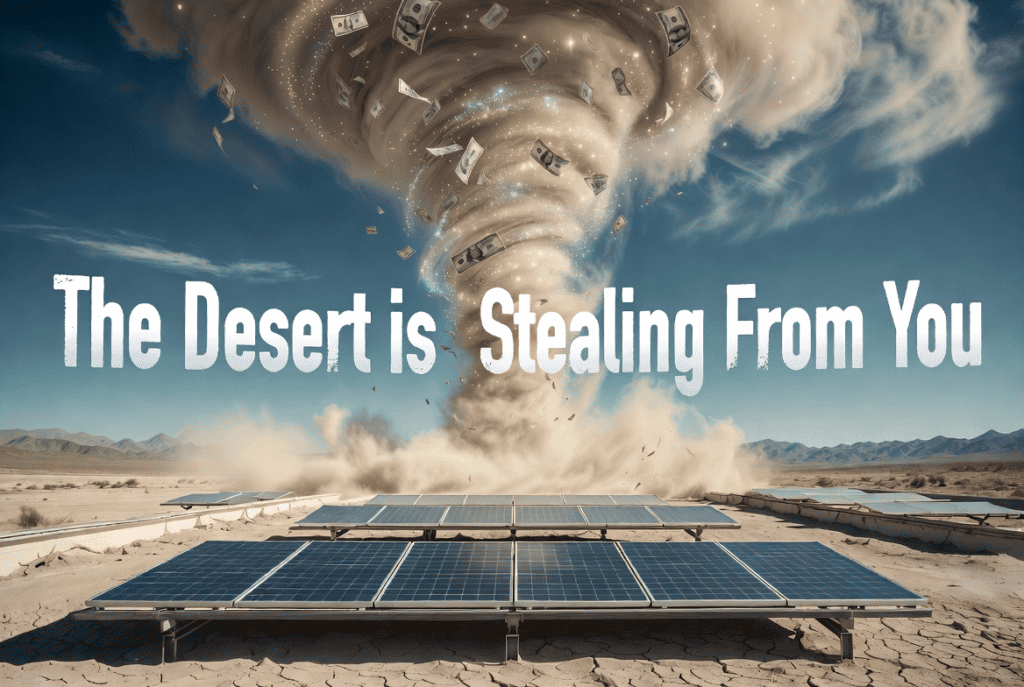
Dust accumulation can reduce the output of solar panels in the Las Vegas area. Fine desert dust, including caliche particles, tends to settle on panel surfaces and can limit sunlight absorption. During the summer months, this buildup may lower production by a noticeable amount. The following sections examine the factors that contribute to soiling losses in Southern Nevada and outline practical steps for maintaining panel performance.
Note: To keep up with fast-moving solar trends in Nevada, I use AI tools to help with research and writing. Every post is personally reviewed and edited by me.
How Caliche Dust Can Affect Solar Panels in Las Vegas
Many homeowners in the Las Vegas Valley notice a light, grayish film on their solar panels. This film often consists of fine dust derived from local caliche soils, which contain calcium carbonate and other minerals. When the dust settles and interacts with moisture, it can adhere more firmly than ordinary dirt and reduce the amount of sunlight reaching the panels.
What Is Caliche Dust?
Caliche is a hardened layer of soil common in the Mojave Desert. It forms when calcium carbonate and other minerals cement fine particles together over time, often creating a dense, concrete-like crust near the surface. Wind can break this material into fine particles that become airborne and settle on rooftops and solar panels throughout the Las Vegas Valley.
Why Caliche Dust Can Reduce Solar Panel Output
Caliche dust can affect solar panels more than ordinary dirt because of its mineral composition and the way it interacts with moisture and heat. The main factors include:
- Binds Like Concrete: Unlike ordinary dust that disperses in the wind, fine desert caliche particles react with morning dew or irrigation overspray to form a cementitious compound. As intense solar radiation bakes this mixture, it cures into a stubborn, rock-hard crust that standard rain showers cannot dissolve or flush away.
- Attenuates Solar Irradiance: This chalky mineral film creates a semi-opaque barrier directly over the photovoltaic cells, severely restricting light transmission. Even a moderate accumulation acts as an optical filter, reducing module irradiance absorption and slashing overall system energy yields by 15% to 25%.
- Causes Alkaline Etching & Surface Degradation: Caliche is rich in calcium carbonate and inherently alkaline, making it chemically reactive when exposed to moisture. Repeated wetting-and-drying cycles allow this high-pH crust to react with the anti-reflective coating, gradually etching and pitting the tempered solar glass over time.
- Induces Thermal Overhead & Amplifies Power Losses: Layered mineral buildup acts as a thermal insulator, trapping heat and elevating operating cell temperatures above baseline conditions. Because photovoltaic efficiency degrades as panel temperatures rise (governed by the module’s negative temperature coefficient), this added heat stress compounds optical shading losses and further suppresses overall system performance.
Conditions That Increase Dust Buildup on Solar Panels in Southern Nevada
Several aspects of the local climate can contribute to dust accumulation on solar panels:
- Inadequate Natural Precipitation: The Las Vegas Valley receives minimal annual rainfall, eliminating any reliance on natural precipitation to wash or clear module surfaces.
- Continuous Aeolian Dust Deposition: Persistent desert winds continuously re-suspend and deposit fine caliche particulate directly across roof surfaces and array tilt planes.
- Accelerated Solar Curing & UV Degradation: High ambient temperatures and intense ultraviolet radiation rapidly bake moist mineral deposits onto the tempered glass, accelerating crust formation.
- Geographical Hyper-Concentrations: Certain North Las Vegas micro-climates feature soil compositions with exceptionally high caliche density, exposing nearby arrays to heightened particulate loading and rapid surface fouling.
For more details about solar evergreen topics, explore our 2026 guides on the complete DIY solar installation checklist, understanding Nevada SB 440, and solar repair & insurance claims.
Estimated Energy Losses from Dust on Solar Panels in Southern Nevada
Many homeowners in the Las Vegas area may not fully account for the gradual reduction in solar output that can occur from dust accumulation. Production losses tend to develop over time and may only become apparent when reviewing energy bills or monitoring data. The following figures illustrate typical soiling impacts observed in Southern Nevada.
The Breakdown: Dust vs. Efficiency
The amount of production lost to dust generally increases with the length of time between cleanings. Typical ranges observed in the area include:
- Light Particulate Film: A barely visible dust layer that silently degrades optical transmission, reducing annual energy yield by 8% to 15%.
- Moderate Soil Accumulation: A distinct, chalky grey coating visible from ground level, causing an optical shading loss of 15% to 25%.
- Heavy Caliche Crust: A sun-baked, cementitious mineral layer that severely restricts light penetration, choking power generation by 25% to 40% or more.
Doing the Math (The Real Cost of Dirty Panels)
As an example, an 8-kW residential system in the Las Vegas area typically produces between 13,500 and 15,800 kWh per year when clean. Moderate dust accumulation can reduce annual output by roughly 2,000 to 4,000 kWh. At current NV Energy rates, this reduction may correspond to approximately $450 to $950 less in annual bill credits or savings, depending on the rate schedule and net metering terms.

Recommended Practices for Cleaning Solar Panels in the Las Vegas Valley
Dust in the Las Vegas area can adhere more firmly than ordinary dirt, particularly when moisture is present. Rinsing panels with local tap water alone may leave mineral deposits that can contribute to further buildup. The following approaches are commonly recommended for removing accumulated dust while minimizing the risk of residue or surface damage.
1. Professional Cleaning with Purified Water and Soft Brushes
Many local cleaning services use low-pressure purified water systems with soft brushes. This method is intended to remove surface dust and residue without high pressure, which can risk damaging seals or coatings. Some services may also apply mild, panel-compatible solutions to loosen adhered material before rinsing.
- The Remediation Process: The cleaning process safely dissolves and lifts stubborn, sun-baked mineral crusts without abrasive scrubbing that could scratch the anti-reflective glass coating or damage fragile roof tile underlayment. A standard residential array cleaning typically requires 2 to 4 hours of field service.
- Investment & Pricing Structure: Professional cleaning services generally range from $350 to $750, with exact costs contingent upon total system module count, roof pitch, array accessibility, and the severity of surface encrustation.
- Optimal Maintenance Frequency: To combat continuous aeolian dust deposition and maintain peak solar energy yields in dry desert environments, professional panel washing is recommended every 3 to 4 months.
2. Automated & Robotic Cleaners
For larger commercial arrays, some operators use robotic cleaning systems that travel along the panels to remove dust. These systems involve higher initial costs but may reduce long-term labor requirements compared with manual cleaning on very large installations.
3. The DIY Route
Homeowners who choose to clean their own panels should follow manufacturer guidance on approved methods and materials. Deionized or distilled water is often recommended for the final rinse to reduce the chance of mineral spotting from local hard water. Soft brushes or microfiber tools on extension poles can be used for gentle cleaning when panels are cool, typically in the early morning or evening. High-pressure equipment and abrasive materials are generally avoided to protect surface coatings and seals.
4. What to Avoid
Certain cleaning approaches can damage panel coatings, seals, or other components, or may be inconsistent with manufacturer recommendations. The following practices are generally advised against:
- High-Pressure Washers & Power Sprayers: Avoid high-pressure water streams, which can fracture tempered solar glass, breach module junction box seals, or compromise the water-tight integrity of perimeter frame gaskets.
- Abrasive Brushes, Scrapers, or Harsh Pads: Refrain from using stiff-bristle scrub brushes, metal scrapers, or abrasive pads. While caliche crusts are dense, mechanical scraping permanently scratches the anti-reflective coating and tempered glass, creating irreversible optical shading losses.
- Household Detergents, Chemical Cleaners & Vinegar: Steer clear of standard glass cleaners, dish soaps, or acidic solutions like vinegar. These reagents leave chemical films that attract rapid re-soiling and can chemically degrade or strip the module’s specialized anti-reflective surface coating.
Periodic cleaning is one factor that can influence solar system performance in the local climate. The potential recovery of production depends on the degree of prior soiling, system size, and rate structure. Whether a given cleaning service offsets its cost through additional generation varies by individual system and should be evaluated based on monitored output before and after cleaning.

Smart Prevention & Long-Term Plans to Keep the Dust at Bay
Dust deposition rates depend on local conditions such as wind patterns, nearby construction or unpaved areas, panel tilt, and weather events. While accumulation cannot be eliminated entirely in arid environments, certain installation and maintenance practices may slow the rate of soiling or make subsequent cleaning more effective. The practical impact of any given measure varies by site.
Site and Installation Considerations to Mitigate Dust
Dust builds up at different rates depending on your site and how the panels are installed. No approach fully prevents soiling in a desert climate, but certain factors can influence how quickly it accumulates. Common considerations include:
- Apply an Advanced Hydrophobic Anti-Soiling Coating: Specialized anti-reflective, hydrophobic nano-coatings create a ultra-smooth, low-surface-energy barrier that prevents mineral particulate and caliche dust from adhering to the glass surface. In arid, high-dust environments, these coatings can reduce soil accumulation by 30% to 50%, allowing light wind and rare rainfall to self-clean the array. Professional application typically ranges from $800 to $1,800, with a single treatment maintaining efficacy for 3 to 5 years.
- Optimize Ground-Level Landscaping & Microclimate Management: Unconsolidated desert soil around your property acts as a continuous source of windborne dust. Replacing open dirt with decorative gravel, crushed rock, or hardscaping stabilizes the topsoil and significantly suppresses aeolian dust movement. On larger parcels, strategically placing windbreak vegetation—such as drought-tolerant trees or native desert shrubs—creates a physical barrier against prevailing winds. Additionally, audit nearby irrigation systems to ensure sprinkler heads do not mist high-mineral, hard water onto the rooftop array.
- Design for Optimal Tilt and Passive Dust Shedding: If your system is currently in the engineering or design phase, prioritize steeper array tilt angles where structurally feasible. Modules installed on higher-pitch roofs leverage gravity more effectively, accelerating the passive shedding of loose surface particulate, pollen, and light rain runoff compared to low-slope or flat-roof mounting configurations.
The Las Vegas Maintenance Blueprint
Cleaning frequency varies by location and conditions. Many Las Vegas-area owners monitor production or inspect panels and clean when output drops as intervals commonly range from a few times a year to more often after dust storms or near construction.
| Frequency | Task | What to Look For |
| Every Month | Quick Visual Check | Take a peek from the ground. Can you see a gray haze? Are birds nesting underneath? |
| Every 3–4 Months | Professional Wash | Clean and clear off the baked-on caliche before it etches the glass. |
| Once a Year | Full Health Inspection | Have a pro check the electrical connections, racking, and inverter health. |
What Does It Cost?
Local providers often quote annual cleaning and inspection packages in the $1,500–$2,500 range, depending on system size and how often you want service. The energy recovered depends on how dirty the panels were. You can check whether the cost pays off by comparing production data before and after cleaning as warranties usually cover defects rather than dirt-related losses, so review any specific maintenance requirements in your terms.
Using Monitoring Data to Assess Dirt Impact
You don’t have to wait for the panels to look grimy from the ground. Checking your monitoring app on clear, sunny days gives a clearer signal. Track the peak output on those days and compare it with similar conditions from earlier in the season and if the numbers have steadily dropped 15% or more, dust is often the culprit—and a cleaning may be worth scheduling. Other issues like new shading or equipment problems can cause the same pattern, so it’s worth ruling those out too.
Thank you for reading! If you have any feedback or a specific Nevada solar topic you’d like us to cover next, please reach out directly at admin@nevadasolarguide.com.


