Long-term solar economics for a Las Vegas or North Las Vegas residence depend on the interaction between on-site generation and the local utility’s time-varying rates. The earlier practice of installing an array and leaving its output unadjusted for rate structure no longer captures the available value. The hours in which air-conditioning, electric-vehicle charging, and other loads operate now influence net cost as directly as the array’s annual production. The following sections describe how southern Nevada time-of-use rates affect solar return on investment and the practical steps available to increase the value of exported and stored energy.
Note: To keep up with fast-moving solar trends in Nevada, I use AI tools to help with research and writing. Every post is personally reviewed and edited by me.
How NV Energy Time-of-Use Rates Work in 2026
For any residence with solar generation, or any household evaluating an installation, NV Energy’s time-of-use rate structure is a primary determinant of net savings. In 2026 the schedule and its associated price differentials govern the economic result of both exported and self-consumed energy more directly than array size alone.
The Basics: Peak vs. Off-Peak
NV Energy splits your day into two different pricing zones:
- Peak Windows (High-Demand Tariffs): Typically designated from 6:00 p.m. to 9:00 p.m. daily during peak summer months (June through September). This window coincides with maximum regional grid stress as residential cooling demand surges alongside evening household activity.
- Off-Peak Windows (Standard Base Rates): All remaining hours of the day—including weekends, holidays, and the entire shoulder and winter season (October through May)—where grid demand lowers and standard off-peak electricity pricing applies.
Why Unmanaged Solar Arrays Capture Less Value Under TOU Rates
Solar production peaks in the midday hours when time-of-use prices are lowest, while residential demand, particularly air-conditioning, is typically highest in the evening when prices are elevated. A solar-only installation therefore exports energy at the lower rate and later purchases energy at the higher rate, reducing the net economic benefit relative to a system that can shift energy across the price differential.
Measures That Increase the Value of Solar Output Under TOU Rates
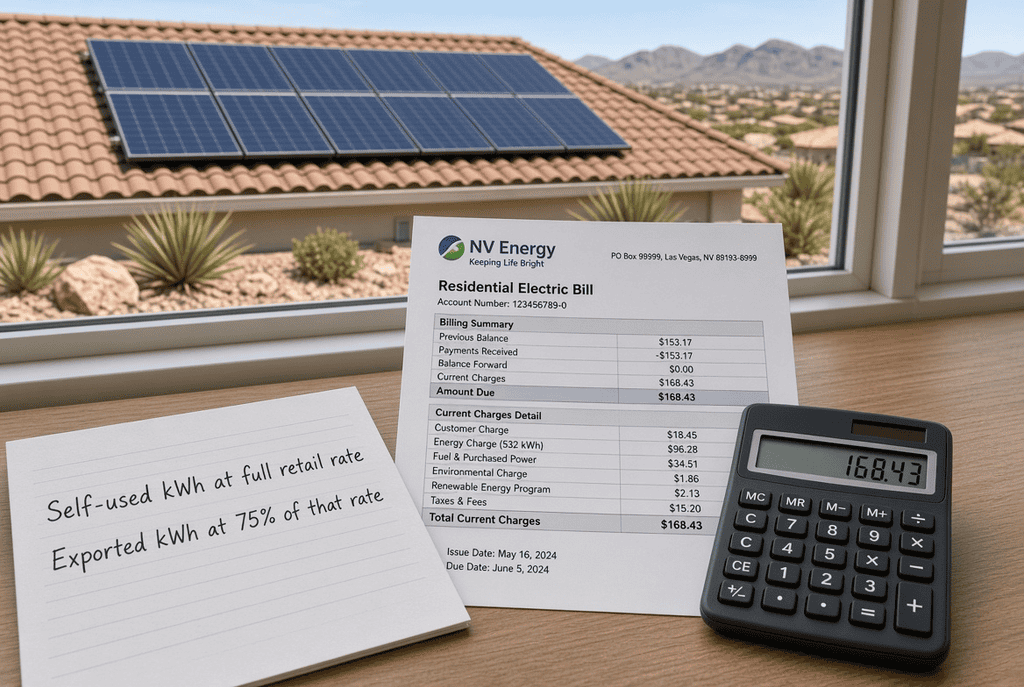
Energy exported during off-peak hours receives a reduced net-metering credit, currently set at approximately 75 percent of the retail rate. Energy imported during the peak window is billed at the full peak price. Under these conditions the higher-value use of solar generation is self-consumption—either immediate on-site use or storage in a home battery for later discharge during the elevated evening rates.
For more details about solar savings and incentives, explore our 2026 guides on the 100% solar property tax exemption, solar + battery payback, and the 6:01 PM to 9:00 PM on-peak window.
The Impact on Solar ROI in Southern Nevada
NV Energy’s time-of-use rates can change how much money your solar system saves you. Whether those rates help or hurt depends on whether your setup uses solar power (or stored battery power) during the expensive evening hours instead of buying it from the grid.
The Reality of an Unoptimized Setup (Standard Solar-Only)
For a typical 8 kW solar array installed on a Las Vegas or North Las Vegas home, the economic outcome without changes in energy use or the addition of battery storage is generally as follows:
- Estimated Annual System Production: 14,000 to 16,000 kWh
- Projected Annual TOU Cost Savings: $1,850 to $2,450 per year
- Calculated Simple Payback Period: 8 to 11 years
Many local homeowners find that realized savings fall 15 to 25 percent short of the figures originally projected. The shortfall occurs because the array produces the majority of its energy during the midday hours when the applicable rate is lowest.
The Power of an Optimized Setup (Smart Load Shifting or Battery Storage)
When household loads are shifted into the daytime production window, or when a home battery is added and programmed to discharge during the evening peak, the economic result changes as follows:
- Realized Annual Cost Reductions: $2,900 to $4,200+ per year
- Accelerated Simple Payback Period: 6.5 to 8.5 years
Why is There Such a Gap?
- Temporal Generation-Load Mismatch: Rooftop photovoltaic production peaks during mid-day hours (10:00 a.m. to 4:00 p.m.) when solar irradiance is highest, whereas household electrical demand reaches its daily maximum during evening hours when occupants return home.
- Asymmetric Export-Import Valuation: Surplus solar energy exported to the utility grid during midday hours is credited at a reduced regulatory rate (approximately 75% of the retail tier), whereas energy repurchased from the grid during peak evening hours is billed at full retail or Time-of-Use pricing.

Proven Strategies to Maximize Your Solar Credits Under TOU Rates
Although the rate rules have changed, substantial savings remain available. Homeowners throughout Las Vegas and North Las Vegas are applying established practices that align energy use and storage with the time-of-use schedule, thereby capturing a larger share of the value produced by their solar systems.
1. Load Shifting: The Easiest High-Impact Tweak
The most direct step is to move the largest household loads into the hours of highest solar production. Between 10:00 a.m. and 4:00 p.m. the array generates at or near its peak; using that energy on site rather than exporting it preserves its full value instead of converting it into the reduced net-metering credit.
- Load-Shifting Routine: Schedule high-consumption appliances—such as dishwashers, clothes dryers, and pool filtration pumps—to operate during mid-day solar peak hours (11:00 a.m. to 3:00 p.m.) to directly consume excess rooftop generation.
- Thermal Mass Pre-Cooling: Lower indoor thermostat setpoints by 2°F to 4°F during late morning hours while solar production is ramping up. Pre-cooling the home’s thermal mass allows living spaces to remain comfortable during NV Energy’s late afternoon peak window, significantly reducing compressor cycling during high-tariff hours.
- Self-Consumption Impact: Implementing automated load scheduling and thermal pre-cooling can increase on-site solar self-consumption rates from a baseline of 55% to over 80%, maximizing the financial value of rooftop generation without requiring additional battery storage.
2. Add Battery Storage: The Ultimate Game Changer
For households that prefer automated operation rather than manual load shifting, a 10 to 15 kWh home battery paired with the solar array provides the most complete means of capturing daytime generation for later use.
- Solar-Plus-Storage Operational Mechanics: The battery system captures and stores surplus midday photovoltaic generation on-site. When high-cost evening tariff periods activate, the system automatically transitions to self-consumption mode, discharging stored energy to completely eliminate evening grid imports.
- Desert-Optimized Hardware Architecture: Industry-leading residential storage platforms—such as the Tesla Powerwall 3, Enphase IQ Battery, and FranklinWH aPower—featuring robust thermal management engineering designed to withstand Southern Nevada’s extreme desert ambient temperatures without performance derating.
- Financial and Operational Payoff: Complete insulation from punishing Time-of-Use peak rates and utility demand charges, ensuring long-term electricity bill predictability and uncompromised backup resilience.
3. Dial In Your Smart Inverter Settings
Factory default settings rarely align with NV Energy’s time-of-use schedule. Systems from manufacturers such as SolarEdge and Enphase include configurable software modes designed for rate plans of this type; enabling the appropriate mode allows the equipment to prioritize on-site use and battery dispatch during the higher-priced hours.
- Optimized Operational Mode Selection: Direct your installation contractor or system commissioner to configure the inverter software to “Self-Consumption” or “Time-of-Use Arbitrage” mode. This setting explicitly prioritizes serving immediate household loads and charging the on-site battery storage bank prior to exporting any residual solar generation back to the utility grid.
4. Optimize Your EV Charging Routine
Electric vehicles offer substantial energy capacity, yet charging them during the peak-price window can erase a large portion of the savings a solar system would otherwise deliver.
- Smart EV Charging Schedule Optimization: Avoid plugging in electric vehicles immediately upon returning home from work, which directly coincides with the utility’s high-cost evening peak window. Instead, utilize smart charger scheduling or vehicle-app automation to align charging sessions strictly with maximum midday solar surplus hours or deep late-night off-peak periods.
- Quantifiable Annual Financial Impact: Taking active control of electric vehicle charging timing prevents expensive peak-rate grid imports, delivering an estimated $600 to $1,200 in additional annual utility savings for Southern Nevada households.
5. Adjust Your System Size Upfront
If you are still in the planning phases of getting solar, think about slightly oversizing your array. Building an 8kW to 10kW system instead of a baseline 6kW system gives you the extra headroom needed to cover your real-time daytime usage while still leaving enough power to fully charge a home battery before sunset.
Role of Batteries in TOU Optimization
By 2026, a home battery has become the best way to keep your solar savings intact under NV Energy’s time-of-use rates. What used to be an optional add-on is now a core part of most systems that deliver strong results.
Why Batteries Make a Difference
- Energy Time-Shifting & Rate Arbitrage: A residential battery storage system acts as an economic buffer by capturing and storing low-cost, surplus midday photovoltaic generation on-site. When the high-cost evening peak window activates, the system automatically discharges to serve household loads—effectively converting low-value exported solar energy into high-value on-site offsets precisely when utility import rates are highest.
- Maximizing On-Site Solar Self-Consumption: Unbuffered solar installations export a substantial portion of their peak midday output back to the utility grid at reduced regulatory credit rates. Integrating a properly sized home battery elevates on-site solar self-consumption from a baseline of approximately 55% up to 95%, keeping the vast majority of your energy production working directly within your home.
The Numbers for Southern Nevada Homes
The difference on an annual statement in the Las Vegas Valley is hard to ignore:
| System Setup | Average Annual Savings |
| 8kW Standard Solar-Only | ~$2,150 per year |
| 8kW Solar + 13.5 kWh Battery | ~$3,650 – $4,100+ per year |
Smart Battery Moves for This Year
- Optimal Storage Capacity Sizing (10–15 kWh): A 10 to 13.5 kWh storage capacity represents the ideal sweet spot for a typical 3-to-4 bedroom home in the Las Vegas Valley or North Las Vegas, providing ample reserve to comfortably bridge the utility’s high-cost evening peak window.
- Specification of Tier-1 Storage Hardware: Prioritize modern, industry-leading storage platforms featuring robust thermal management for desert environments and airtight Time-of-Use software integration—such as the Tesla Powerwall 3, Enphase IQ Battery 5P, or FranklinWH aPower.
- Activation of Time-of-Use Optimization Mode: Ensure your system installer or commissioner actively configures the inverter software to “Time-of-Use Optimization” (or active self-consumption/arbitrage) rather than locking the hardware in passive “Backup-Only” mode, guaranteeing that the system prioritizes daily financial savings over waiting exclusively for rare grid outages.
Thank you for reading! If you have any feedback or a specific Nevada solar topic you’d like us to cover next, please reach out directly at admin@nevadasolarguide.com.