

If you own a home in North Las Vegas, you already know the drill every summer. The heat hits triple digits, and your NV Energy bill absolutely skyrockets. But lately, it’s not just about the summer spike. With NV Energy cutting net metering credits to 75% and introducing those tricky daily demand charges—where you’re billed extra just based on your highest 15-minute peak of the day—keeping the lights on is getting expensive.
Home batteries used to feel like a luxury just in case the power went out. Today? They’re quickly becoming a must-have. Pairing a battery with your solar panel system lets you dodge those peak rates, skip the demand charges, and keep your home cool without sweating the bill.
In this detailed 2026 comparison to answer the question “Which Solar Battery is right for your Nevada home?”, we took a look at the three biggest names out there right now—the Tesla Powerwall 3, Enphase IQ Battery 5P, and FranklinWH aPower 2—to see how they actually perform in a typical local home with an 8 to 10 kW solar setup.
We won’t just repeat the glossy brochures. Instead, we’re breaking down how they handle our brutal desert heat, what they’ll actually save you under NV Energy’s current rules, and how long they take to pay for themselves. Whether you’re looking for the best budget value, extreme power, or a system that can grow with you, let’s find out which one is ideal for your Southern Nevada home.
Why Battery Storage Matters More Than Ever in Nevada 2026
If you’ve noticed your solar savings shifting lately, you aren’t imagining things. NV Energy’s new rate structures have fundamentally changed the math. Because net metering credits have dropped to around 75%, the power your system produces during the bright afternoon hours is worth less than it used to be.
The real challenge, though, is the daily demand charge. NV Energy looks at your entire day and finds your single highest 15-minute spike of energy use—which usually happens in the evening when families are cooking, doing laundry, and running the AC after the sun goes down. For many households in North Las Vegas, that 15-minute window of peak activity is adding an unexpected $15 to $30+ to their monthly bills.
That is exactly where a good home battery comes in. It solves these headaches at once:
- It keeps your power where it belongs: Instead of selling your extra daytime solar back to NV Energy for pennies, you save it. This bumps your actual solar usage from a mediocre 50% up to nearly 95%.
- It flattens those evening spikes: By running your home off the battery when everyone gets home, you completely bypass those sneaky 15-minute demand charges.
- It keeps the AC on when the grid gives up: Summer storms and grid overloads happen. A battery means your lights and AC stay on without a single flicker.
- It protects your wallet for the long haul: You’re essentially locked in against future rate hikes, and you can even get paid extra down the road by joining local “Virtual Power Plant” programs that reward you for sharing power.
For those of us living out here in the Nevada desert heat, a solar battery isn’t just about the dollar savings—it’s about knowing you control your own comfort, no matter what NV Energy does.
For more details about solar batteries, explore our 2026 guides on the Franklin WH aPower 2, the Enphase IQ battery, and the top 3 solar batteries for Nevada homes.
The Heavy Hitter: Tesla Powerwall 3 In-Depth 2026 Review
The Powerwall 3 is Tesla’s latest flagship battery, and it’s built like a tank. Unlike older models, this one has a powerful solar inverter baked right into the cabinet. Think of it as an all-in-one energy hub for your house.
Here is a quick look at what it actually brings to your house:
- Storage Capacity: You get 13.5 kWh of storage per unit. If you need more, you can stack cheaper “expansion packs” onto it down the road to scale up your storage without buying entirely new main units.
- Raw Power: It pushes out 11.5 kW of continuous power, with a massive surge capacity. In plain English? One single unit has enough juice to start and run heavy appliances like your central AC, an EV charger, or a pool pump during a blackout.
- Desert Performance: It hits a high 97.5% efficiency rating and uses an advanced liquid-cooling system. This is a huge deal for us in the Las Vegas valley, as it means the battery won’t choke or lose power efficiency when the garage hits triple digits.
- The Warranty: Tesla offers a 10-year warranty with unlimited cycles. This means as long as you’re using it normally to power your home and dodge NV Energy’s rates, they don’t cap how much energy passes through it.
The Real-World Upside: It crams an incredible amount of power into a single box. Instead of paying an installer to mount two or three bulky batteries on your wall just to back up your whole house, one Powerwall 3 can usually handle the heavy lifting solo. Plus, the Tesla app remains the gold standard for tracking your energy in real time.
The Downside: It can carry a higher upfront equipment cost, and some premium competitors now offer 12- to 15-year warranties. It’s also a bit less customizable if you have a highly unusual, niche solar setup.
The Verdict: If you want maximum power, “set-it-and-forget-it” simplicity, and a clean installation without a dozen boxes on your wall, this is likely your best bet.
The Flexible Planner: Enphase IQ Battery 5P In-Depth 2026 Review
If you value flexibility, micro-management, and iron-clad reliability over sheer size, the Enphase IQ Battery 5P is a fantastic option. Unlike all-in-one behemoths, this is a modular system built to link flawlessly with Enphase solar setups.
Here is what the actual everyday experience looks like:
- The Sizing: Each individual block holds 5 kWh of power. Because they are relatively small, you have total control over your setup—you can stack two, three, or four of them together to build the exact size system your household requires.
- The Power Output: A single unit gives you 3.84 kW of continuous juice. While one block alone won’t keep your central AC blasting during a summer blackout, chaining multiple units together scales up your power output seamlessly.
- The Longest Safety Net: Enphase offers a massive 15-year warranty (or 6,000 cycles). That is a full five years longer than most of the competition, giving you excellent long-term peace of mind.
- Built to Last: Inside every single box are six mini “grid-forming” microinverters. If one happens to experience a glitch, the others keep running right along, meaning your backup power plan doesn’t have a single point of failure.
The Real-World Upside: It offers unmatched flexibility. If your budget is tight right now, you can buy just one or two blocks to shield yourself from NV Energy’s peak evening rates, then easily hang another block on the wall a few years down the line. It is also completely passively cooled with no loud fans or moving parts, making it dead quiet in your garage.
The Downside: Because each unit is smaller, you have to buy and install multiple boxes if your main goal is backing up a heavy, power-hungry central AC system in the middle of a July blackout. This can sometimes drive up your upfront installation labor costs compared to buying one giant cabinet.
The Verdict: If you already have an Enphase solar system, want an industry-leading 15-year warranty, or want the ability to grow your energy storage slowly over time, this is the smartest choice on the market.
The Powerhouse: FranklinWH aPower 2 In-Depth 2026 Review
If you have a larger home in North Las Vegas and your main goal is raw muscle and maximum storage without paying a boutique premium, the FranklinWH aPower 2 is a serious contender. It’s a lesser-known name compared to Tesla, but it packs a massive punch.
Here is what the actual everyday experience looks like:
- The Sizing: Every single unit holds 15 kWh of energy. That is larger than a standard Powerwall, meaning you get more storage room in a single box to hold that afternoon desert sunshine.
- The Power Output: It delivers 10 kW of continuous power and is specifically built with a heavy-duty surge rating. In plain English, one single unit can kick-start and run a massive 5-ton central air conditioner during a summer grid overload.
- The Safety Net: It comes with an incredible 15-year warranty (or 60 MWh of total lifetime energy use). That beats the standard 10-year industry baseline by a full five years, proving the company expects these cells to last.
- Weatherproof Rating: It features a high IP67 waterproof and dustproof rating. If your garage is already packed and you need to mount this battery on an exterior wall facing the harsh Nevada elements, it can handle the dust storms and intense heat without a problem.
The Real-World Upside: It offers incredible price-to-performance. Because each battery is so large and powerful, homeowners with big properties can often get full whole-home backup using just two Franklin batteries, whereas they might need to buy three units of a smaller brand to get the same results. This can save you thousands on total equipment and installation costs.
The Downside: FranklinWH is a newer brand on the block. While their tech is highly rated, they don’t have the decade-long household track record of a company like Tesla. Because of that, it can sometimes be a little harder to find a local certified installer who carries them.
The Verdict: If you have a larger house, run a massive AC unit, and want the absolute most storage capacity and warranty life for your dollar, this is the budget-friendly powerhouse to look at.

Real 2026 Savings Breakdown for North Las Vegas Homes
To see how this plays out in the real world, let’s look at a typical home in North Las Vegas—think a standard property running an 8 to 10 kW solar system, using a good amount of AC to survive the summer, and averaging about 25 to 40 kWh of power usage a day.
- If you go with Solar Only: Thanks to our non-stop desert sunshine, panels alone are still a great investment. Even with NV Energy’s lower 75% credit rate, you can expect to knock about $2,100 to $2,800 a year off your power bills.
- If you Add a Battery: Hanging a battery on the wall opens up an extra $900 to $1,600 in annual savings. Why? Because instead of practically giving your extra afternoon power away for a weak 75% credit, you hold onto it. It also completely flattens those 15-minute evening power spikes, wiping out roughly $200 to $500 a year in those annoying new daily demand fees.
The Financial Timeline: When you pair it with a new solar installation and bake in the federal tax incentives, the battery portion typically pays for itself in 6 to 9 years. Because NV Energy rates historically trend upward, that payback window usually shrinks over time. Once the system is paid off, you’re looking at $15,000 to over $30,000 in net savings over the lifetime of the battery—plus the priceless benefit of keeping your AC running during a summer blackout.
Which battery shaves the bill best? If your main goal is flattening those expensive evening energy spikes, the high power output of the Tesla Powerwall 3 or FranklinWH aPower 2 gives them a slight edge. If you prefer to micromanage your energy down to the watt, Enphase excels at software optimization.
Keep in mind: Every home is a little different. Which way your roof faces, how cold you like your bedroom at night, and whether you join local programs to sell your stored power back to the grid for extra cash will change your final math. Independent tools like EnergySage or a reputable local installer can map your exact roof to give you a good estimate.
Cost, Incentives & True Payback
Let’s talk about the elephant in the room: what is this going to cost upfront? While pricing has finally stabilized, adding a battery to your home is still a major financial investment.
The exact price your local contractor quotes you depends on a few moving parts. Labor and permitting fees vary across the Las Vegas Valley, and your total will look different if you’re building a brand-new solar setup from scratch versus retrofitting a battery onto panels you already own.
Contractors also frequently offer bundling discounts if you buy everything at once. To give you a realistic baseline, here is what the actual gross cost looks like for a typical single-unit installation in North Las Vegas right now.
Approximate Installed Costs (Before Incentives)
- Tesla Powerwall 3: (13.5 kWh, 11.5 kW output): $13,000 – $16,500 Often cited around $14,500–$15,500 average for a complete installation. Tesla’s integrated inverter can reduce costs on new solar + battery projects. Expansion packs add ~$5,900–$6,500 each.
- Enphase IQ Battery 5P: (5 kWh per unit): $7,000 – $9,000 per unit installed (including controller contributions) A practical 10–15 kWh system (2–3 units) typically totals $14,000 – $20,000+. Higher for full modularity and Enphase ecosystem integration.
- FranklinWH aPower 2: (15 kWh, 10 kW output): $15,000 – $18,500 for a full system (battery + aGate controller). Often positions as strong value, with competitive per-kWh pricing for larger capacity needs.
Major Incentives Available in Nevada (2026)
Here is the deal: you do not have to swallow the entire cost of a battery system on your own. There is a solid mix of federal and state programs available to help drop the price. Here is exactly what you can claim right now:
- The Big One (The 30% Federal Tax Credit): This is your main cost-cutter. The government gives you a 30% credit on the total cost of your solar panels, the battery, and the labor to install them. If you buy a $15,000 battery system, that instantly wipes $4,500 off your federal tax liability. The best part? The 30% rate is locked in through 2032 under the Inflation Reduction Act, so you don’t have to rush into a panic-buy. The only rule is that the battery must be at least 3 kWh (which almost all home batteries are) and it needs to charge primarily from your solar panels.
- NV Energy’s Storage Incentives: NV Energy has a program that pays you up to $1,500 to $3,000 back depending on the size of your battery and whether you are on a Time-of-Use plan. Just keep in mind that these incentive blocks can fill up quickly, and the rules change often. Your installer will usually submit this application for you through NV Energy’s portal to lock in whatever cash is available.
- Nevada’s Tax Breaks: The state helps out by keeping your equipment completely exempt from sales tax. Plus, under Nevada law, whatever value the solar system adds to your home is fully exempt from property tax, meaning your county assessor won’t hike your property taxes just because you upgraded your garage.
- Bonus Income: You can also look into “Virtual Power Plant” (VPP) programs. This is where you essentially rent a tiny bit of your battery power back to the utility company during emergency grid heatwaves, and they pay you extra for helping out.
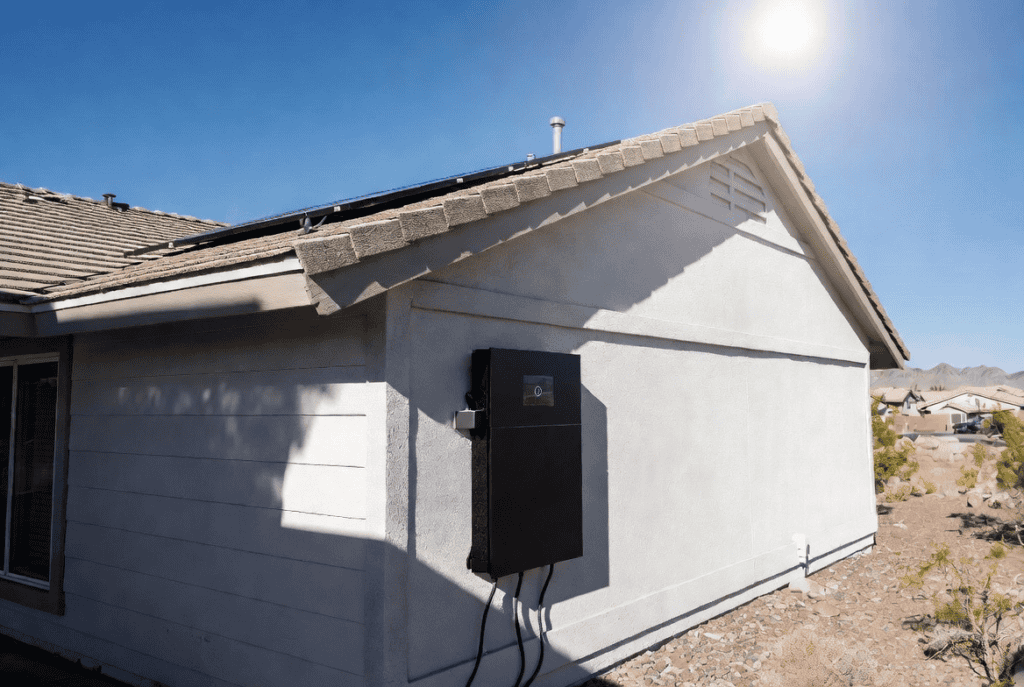
So, What is the Bottom Line?
Once you slice off that 30% federal tax credit, the numbers start looking a lot more manageable. Here is what homeowners in the Las Vegas Valley are actually looking at for a final net cost:
- Tesla Powerwall 3: Expect a final out-of-pocket cost between $9,100 and $11,550 fully installed.
- Enphase or FranklinWH Systems: A comparable setup usually lands between $10,000 and $14,000, depending on how many modular blocks or cabinets you need to match your home’s layout.
When do you break even? If you install a combined solar-and-battery system together out here, you’ll typically hit your payback point in 7 to 10 years. After that, the system is entirely paid for, and it flips into a serious cash-generator. For the next 10 to 15+ years, it will quietly save you thousands of dollars a year—all while giving you total peace of mind that your home and family stay cool through the brutal summer months.
Quick Decision Guide for North Las Vegas Homeowners
Choosing a battery in North Las Vegas mostly comes down to what is already on your roof and how much power you need to pull at once. Here is the fast track to finding your match:
- Already have Enphase solar? → Enphase IQ 5P. Keeping it in the family makes sense. It pairs perfectly with your existing microinverters, uses a single app, and features a rock-solid 15-year warranty.
- Starting fresh and want raw power? → Tesla Powerwall 3. With a massive 11.5 kW continuous output and a built-in solar inverter, a single unit can kickstart a heavy 3-ton to 5-ton central AC unit without breaking a sweat.
- Need maximum capacity or generator backup? → FranklinWH aPower 2. This is a beast of a retrofit option. It gives you 15 kWh of usable storage per cabinet and features the easiest out-of-the-box integration if you want to connect a backup generator or emergency EV charging.
Digging into the Dollars & Performance
The Budget Real-Check: Don’t just look at the upfront sticker price. Once you factor in the 30% Federal Residential Clean Energy Credit, the net costs shift. On a pure dollars-per-kWh basis, the Powerwall 3 and FranklinWH often deliver the best raw volume value, while Enphase charges a premium for its modularity.
| Feature | Tesla Powerwall 3 | FranklinWH aPower 2 | Enphase IQ 5P (Per Unit) |
| Usable Capacity | 13.5 kWh | 15.0 kWh | 5.0 kWh |
| Continuous Power | 11.5 kW | 10.0 kW | 3.84 kW |
| Warranty | 10 Years | 15 Years | 15 Years |
| Best For | New systems & heavy AC loads | Massive storage & generators | Existing Enphase solar arrays |
The Bottom Line for North Las Vegas
With NV Energy’s billing structure using daily 15-minute peak demand charges, a battery isn’t just for blackouts anymore—it’s for “peak shaving” to keep your summer AC bills from spiking.
Ultimately, all three options will dramatically lower your volumetric charges and insulate you from summer outages. For a typical local home, the Tesla Powerwall 3 edges ahead as the strongest all-around pick because of its competitive pricing and proven ability to handle desert heat.
That said, every roof and energy footprint is different. The smartest move is to get a professional load analysis and look at a long-term financial model tailored to your specific usage. Reach out to 2 or 3 local, NV-certified installers to see how the numbers look for your home.
Final Recommendation + Next Steps
For most homeowners in North Las Vegas, the Tesla Powerwall 3 is tough to beat. It packs massive power output, handles the blistering desert heat without breaking a sweat, and has a rock-solid reputation for reliability.
That said, it isn’t the only great option on the market:
- Enphase is a fantastic choice if you already have microinverters on your roof or if you highly value a modular system with an industry-leading warranty.
- FranklinWH offers incredible value if your main priority is maximizing your total storage capacity.
Adding battery storage is also a smart financial move. With NV Energy’s shift to a daily demand charge, having a battery means you can automatically “shave down” your highest 15-minute spikes of electricity use—protecting you from extra utility charges. Beyond the savings, it provides true peace of mind by keeping your lights and AC running smoothly during an outage.
Curious about what the exact numbers look like for your house?
Skip the guesswork and get a free, tailored estimate for a solar-and-battery setup right here in North Las Vegas. We’ll map out your specific roof and run the math against NV Energy’s latest 2026 rate rules so you can see exactly how much you’ll save.
A quick heads-up: Some of the links in this post are affiliate links, which means I might earn a small commission if you decide to buy, at absolutely no extra cost to you. That said, I only recommend what works—all of these picks are backed by independent testing data.


