Note: Last checked September 19th, 2026.
If a solar quote still includes a 30% federal tax credit or an NV Energy rebate, it is using outdated numbers. The federal Residential Clean Energy Credit (Section 25D) is not available for installations completed after December 31, 2025. Under the rules following Public Law 119-21, systems that were not fully installed by that date do not qualify. NV Energy’s earlier residential rebate programs also ended years ago.
What’s Left on the Table?
While the tax credits and direct rebates are no longer available, the basic case for solar in the desert remains intact:
- NMR-405 Tier 4 Net Billing Structure: Locks in a 20-year grandfathered net metering export credit rate equivalent to 75% of the local volumetric retail electricity rate, tied directly to the real property address to secure long-term utility compensation stability.
- Nevada Property Tax Abatement: Exempts the assessed value of residential solar and energy storage improvements from local property tax calculations, ensuring property tax bills do not increase following renewable infrastructure deployment.
- High-Irradiance Desert Solar Generation: Leverages exceptional Southern Nevada solar resource availability, delivering high annual photovoltaic production volumes and consistent performance across all seasonal cycles.
- Sales Tax Compliance & Contract Verification: Requires meticulous verification of invoice line items regarding qualifying hardware exemptions. Tax treatment varies by contract structure (distinguishing residential solar incentives from commercial RETA programs), necessitating explicit invoice review prior to financial savings modeling.
Solar can still make financial sense, but the calculation has changed. It no longer depends on a federal tax credit. The return now comes mainly from the kilowatt-hours you no longer have to buy from the utility each month.
Note: To keep up with fast-moving solar trends in Nevada, I use AI tools to help with research and writing. Every post is personally reviewed and edited by me.
What Is Officially Gone in 2026
The tax credits and rebates are no longer available—they ended under current rules.
The Federal 30% Tax Credit (Section 25D)
Public Law 119-21 accelerated the end of the Residential Clean Energy Credit. Under current IRS guidance, Section 25D is not available for projects completed after December 31, 2025. The credit is based on the date installation is fully completed, not the date the contract was signed, a deposit was paid, or equipment was delivered. If a system receives Permission to Operate in 2026, the federal credit for an owner-occupied system is $0. Any quote that still subtracts 30% is using outdated assumptions. Systems completed in 2025 can still be claimed on 2025 tax returns filed in 2026, including any carryforwards, but that applies only to last year’s installations.
NV Energy Residential Cash Rebates
The older utility rebate programs that offset rooftop installation costs are no longer available and standard residential systems in Las Vegas and North Las Vegas do not have a rebate line item. If a salesperson says they will check for remaining funds, ask for an active program ID. In most cases, none exists.
1-for-1 Retail Net Metering
Assembly Bill 405 replaced full retail export credits with a declining tier system. Tiers 1 through 3, which offered 95%, 88%, and 81% credit rates, are closed. New residential systems under 25 kW now fall into Tier 4, which credits exported power at 75% of the retail rate. There is no option to return to the earlier, higher rates.
Nevada State Income Tax Credits
Nevada has no state income tax, so there is no state tax credit available for solar. A generic quote that lists one is using a template from another state.
What This Doesn’t Mean
This does not mean solar is no longer viable. Net billing, the property tax exemption, and strong desert production are still in place. It also does not mean a lease automatically delivers a 30% savings. A third-party owner may be able to claim commercial tax credits, but those benefits stay with the owner unless the lease terms specifically pass them through. The 30% federal credit on owned systems, utility rebate checks, full retail export rates, and state income tax credits are no longer available. What remains is the monthly utility cost you avoid. Any proposal that depends on the old incentive stack to look attractive is using outdated numbers.
For more details about solar savings and regulations, explore our 2026 guides on NV Energy net metering, the April 2026 demand charge, and the Federal ITC and Nevada tax exemptions.
Section 25D Is Dead for New Homeowner-Owned Systems
This follows current tax rules, not marketing claims. While you should confirm details with a CPA, IRS guidance is clear enough to identify outdated line items on a quote.
What Ended
Section 25D, the federal Residential Clean Energy Credit, previously allowed homeowners to claim 30% of the cost of owned solar panels, qualifying battery storage, and related equipment. Under Public Law 119-21, that credit is no longer available for expenditures made after December 31, 2025.
What “Expenditure” Means in the Tax Code
IRS rules base the expenditure date on project completion. Under Section 25D(e)(8), an expenditure occurs when the original installation is fully completed, not when the contract was signed, a deposit was paid, or equipment was delivered. Paying in December 2025 and finishing the installation in March 2026 makes it a 2026 project, which does not qualify. Permission to Operate in 2026 means a 2026 expenditure and no federal tax credit.
Who Can Still Use Section 25D Paper
Only systems that were fully installed by December 31, 2025, can claim the credit on the 2025 tax return filed in 2026. If the credit exceeded the homeowner’s tax liability that year, the remaining balance can still carry forward under existing rules. That applies only to systems completed in 2025. It does not support listing a 30% credit on a new project today.
Leases, PPAs, and Third-Party Ownership
Third-party owners, such as lease or power purchase agreement providers, operate under commercial tax rules, including Section 48E, which follow different deadlines. The leasing company claims the tax credit, not the homeowner. If those savings are passed through, they should already appear as a lower monthly payment or a reduced prepaid price. Ask for a side-by-side comparison: a cash or loan purchase with $0 federal credit versus a lease or PPA that includes the provider’s incentives. If the salesperson cannot show where the value is passed through, assume it is not.
Battery Storage
Under the earlier Section 25D rules, qualifying battery storage installed with or after a solar array was eligible for the 30% credit. Homeowner-owned batteries installed in 2026 do not qualify for that expired residential credit while commercially owned storage follows separate commercial rules.
Quote Hygiene
If a cash or loan proposal for a 2026 completion subtracts 30% for a federal tax credit, send it back. If a representative claims the credit was extended, ask for the current IRS documentation rather than a sales sheet. For a system you plan to own, base the numbers on the actual equipment cost, any applicable sales-tax treatment, and the utility bill savings from the power you generate. Do not include a federal credit that ended for installations completed after December 31, 2025.
What Still Works: Net Metering (The Big One)
With Section 25D no longer available and residential rebates ended, net metering under Nevada rules is now the main financial mechanism for rooftop solar.
Southern Nevada Default (Las Vegas, Henderson, North Las Vegas, Summerlin)
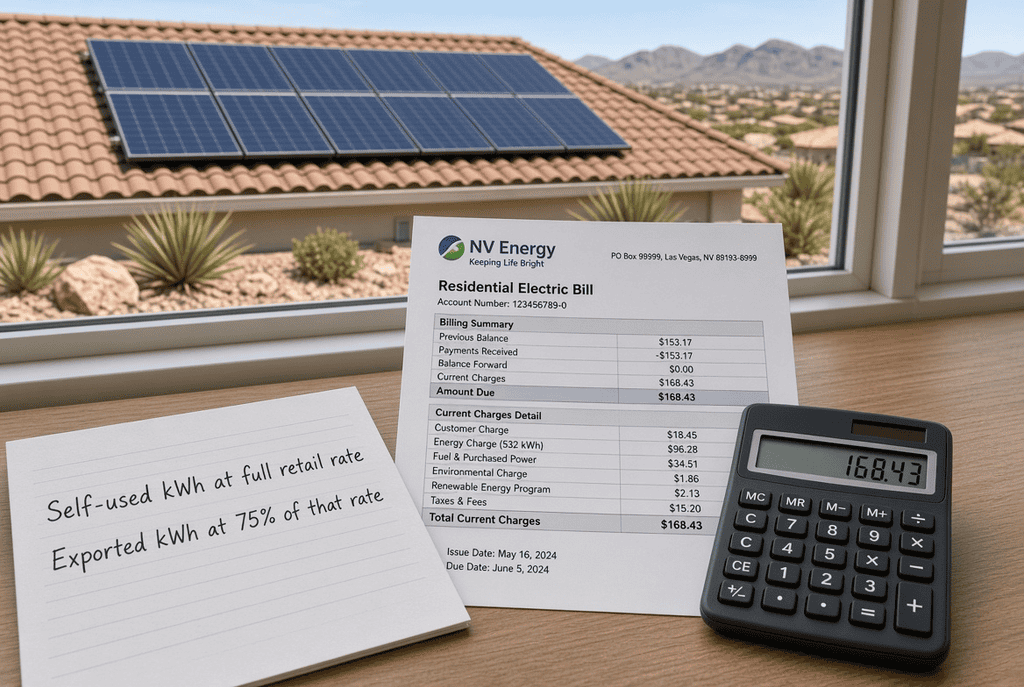
New residential systems under 25 kW fall under Tier 4. Excess electricity exported to the grid is credited at 75% of NV Energy’s retail energy rate, excluding public policy adders. That rate is locked for 20 years at the specific service address, and exports are calculated on a monthly netting basis. Power generated and used on-site in real time offsets the full utility energy charge. Rollover credits can offset future energy charges, but they do not cover the fixed monthly basic service charge, meter fees, or local government fees. If the home is sold, the 20-year schedule stays with the address for the next owner.
Why 75% Is Still a Solid Incentive
It is not the full retail credit of earlier years, but it is also not the much lower avoided-cost rates used in some other states. Locking in 75% of a rising energy rate provides a reasonable long-term hedge. Oversizing a system mainly to export power means accepting 75% of the retail rate on that excess production. For a better return, size the array closer to the household’s actual usage.
Northern Nevada Operates Differently
Systems in Sierra Pacific territory in Northern Nevada that were approved on or after October 1, 2025, operate under NMR-2025 rules. The credit rate remains 75%, but netting is calculated in 15-minute intervals rather than monthly. Midday solar production on one day does not offset evening use later in the week under interval settlement. Northern Nevada rules should not be applied to a Clark County proposal.
What Net Metering Is Not
- Bill Credit Mechanism (Non-Cash & Non-Rebate): Net billing credits operate strictly as volumetric offsets applied to future energy delivery charges rather than providing direct cash refunds or upfront utility rebates.
- Interconnection Approval Prerequisite: Program participation does not bypass regulatory or utility oversight; formal execution of an interconnection agreement and official Permission to Operate (PTO) remain mandatory prior to system commissioning.
- Time-of-Use (TOU) Rate Risks: Enrollment in TOU rate structures without accounting for high peak-hour pricing (e.g., 6:00 p.m. to 9:00 p.m. summer peak windows) can diminish total net savings unless accompanied by load shifting or battery storage.
- Exclusion of Fixed Fees & Demand Charges: Accumulated export credits apply strictly to volumetric kWh consumption charges and cannot be used to offset basic daily service fees, fixed customer charges, or separate demand charges.
Understanding the 20-Year Lock
The 75% credit percentage is locked to the property address for 20 years, but the underlying retail rate can change. If utility rates rise, 75% of the higher rate increases the credit value per kilowatt-hour. The agreement stays with the home and does not transfer if the owner moves. The main value driver for Nevada solar today is the tariff structure: full savings on power used on-site, a 75% credit on excess generation, and a 20-year schedule tied to the address. Other incentives are secondary, so system design should prioritize covering real-time household use.

What Still Works: Nevada Property-Tax Exemption
Nevada’s property tax exemption prevents the assessed value of a home from rising solely because a qualifying renewable energy system was added. The system can still increase the home’s market value—buyers often value lower utility bills—but the county assessor cannot treat that added value as a taxable improvement the way a kitchen remodel would be treated.
What It’s Worth in Planning Terms
If a solar system adds $15,000 to $25,000 in market value, a normal property tax assessment on that increase would typically cost a few hundred dollars per year. The exemption removes that added assessment for as long as the system stays on the house. It is not a large upfront payment, and it does not replace the old federal tax credit. It is a modest, ongoing savings over the years the system remains in place. It is not a reason to accept an overpriced installation.
What It Is Not
- No Guarantee of Administrative Efficiency: The property tax exemption does not simplify local government processing; municipal clerks and county assessors may not proactively provide guidance on application mechanics, filing timelines, or required documentation.
- Non-Transferable Asset Attribute: The exemption is tied exclusively to the specific parcel address and real property improvement; it cannot be transferred to a new residence if the property owner relocates.
- Regulatory Non-Waiver: The tax exemption does not bypass local building code requirements, permit obligations, or real estate disclosure rules. Unpermitted hardware installations risk significant legal liabilities, clouding title, and property inspection violations during future resale.
How It Stacks With Other Rules
Because Nevada has no state income tax, there are no state tax credits that interact with this exemption. With the federal Section 25D credit no longer available for new owner-occupied systems, net metering provides the main monthly bill savings, while the property tax exemption reduces the annual holding cost of the system. Fixed utility fees and demand charges still apply either way.
Buying or Selling a Solar Home
- Seller Considerations: The property tax exemption remains permanently bound to the physical real property improvement and the parcel address; it is non-transferable and does not follow the seller to a subsequent residence.
- Buyer Due Diligence: Prospective buyers must verify system ownership status (purchased vs. leased), confirm the applicable grandfathered net metering tier, and audit county records to ensure all building and electrical permits were properly closed. Regional real estate appraisers increasingly assign positive valuation premiums to documented, owned solar and energy storage systems.
The system can still increase the home’s market value on resale without raising the annual property tax assessment on the equipment. If a real estate agent is unsure of the details, confirm the statute with the county. For financial modeling, focus primarily on kilowatt-hour savings. The property tax exemption is a secondary benefit—it does not cover the cost of the system.
Sales Tax, No State Income Tax, and the Fine Print
The combined sales tax rate in Clark County is 8.375%. Many residential installers treat qualifying solar hardware as tax-exempt and leave sales tax off the contract. On $20,000 to $24,000 of equipment, that can save roughly $1,700 to $2,000 upfront. Check the invoice: if sales tax is listed, ask the installer why. If it is set to $0, that is fine—just don’t count the savings twice when calculating the total cost.
This is separate from RETA, the Renewable Energy Tax Abatement. RETA applies to large commercial projects, typically 10 megawatts or more, with specific workforce and abatement requirements. An 8 kW residential system does not qualify. Seeing RETA referenced on a residential bid is a sign the quote is using incorrect or template language.
The Impact of Having No State Income Tax
Nevada does not levy a personal income tax, so there is no state tax liability to offset and no state-level solar tax credit. If a proposal includes a “25% state solar credit,” it is using a template from another state. That line item should be removed. Because there is no state income tax, there is also no state credit to offset the end of the federal Section 25D credit. For an owned system, the remaining financial benefits are:
- Federal Tax Credit Status: Clarifies the current availability and statutory parameters of the Residential Clean Energy Credit (Section 25D) for homeowner-owned photovoltaic and energy storage systems under active federal tax code.
- Net Billing Tariff Classification: Establishes the governing monthly rate schedule and export compensation framework under NV Energy’s NMR-405 Tier 4 tariff structure.
- Property Tax Exemption Protection: Codifies statutory safeguards preventing local property tax assessments from increasing due to the added market valuation of qualifying renewable energy and storage improvements.
- Invoice Sales Tax Treatment & Compliance: Governs the accurate line-item calculation and exemption application for equipment sales tax at final contract sign-off and billing reconciliation.
Offerings That Look Like Incentives (But Aren’t)
- Solar Renewable Energy Certificates (SRECs): Nevada lacks an active SREC trading market or compliance credit marketplace for residential solar owners, meaning homeowners cannot monetize photovoltaic generation through certificate sales.
- Group-Buy “Discounts” vs. Utility Rebates: Marketing discounts promoted through community group-buy programs represent contractor-negotiated volume pricing strategies rather than official utility-funded rebates or cash incentives.
- Third-Party Lease Tax Credit Capture: Solar leasing providers capture federal commercial tax incentives (such as the Section 48 Investment Tax Credit) directly; any resulting financial benefit is realized only if the provider passes those savings through as reduced monthly lease payments.
- HOA Approval vs. Financial Subsidies: Homeowners Association (HOA) approval constitutes statutory compliance permitting panel placement under Nevada law, rather than a financial incentive, grant, or monetary payout.
Proposal Checklist
Before signing any agreement, review the quote for these key items:
- Sales Tax Compliance: Itemized transparently within contract pricing, reflecting qualifying hardware exemptions or explicit jurisdictional tax calculations.
- State Tax Credit Exclusion: Set to zero, recognizing the absence of a state-level residential clean energy tax credit in Nevada.
- SRECs & Commercial RETA Program Exclusion: Omitted entirely from residential financial modeling, as Nevada does not operate a residential SREC trading market or a residential RETA structure.
- Net Metering Classification: Explicitly identified as NV Energy NMR-405 Tier 4, establishing the exact 20-year grandfathered export compensation framework.
- Property Tax Exemption Statute: Formally referenced under Nevada Revised Statutes (NRS) 361.079 to protect renewable energy improvements from assessment value increases.
- Federal Section 25D Credit Applicability: Excluded or addressed in accordance with current statutory parameters for homeowner-owned cash or loan-financed solar and storage acquisitions.
The main factors in a Nevada solar financial model are the sales tax treatment on the invoice, the absence of a state income tax, the 20-year Tier 4 net billing tariff, and the property tax exemption. Other items are either expired or apply only to commercial projects. Review the tax line on the quote the same way you would remove any outdated federal credit.
Programs That Are Not “Your Rebate”
A lot of current solar marketing uses the word “incentive” for programs that do not provide a payment to a typical owner-occupant. Identifying these programs clearly helps keep them out of cash-flow projections as assumed savings.
ESAP and CBSR
NV Energy’s Expanded Solar Access Program (ESAP) and Community Based Solar Resources (CBSR) allow renters, income-eligible households, and certain host sites to access shared solar. These are real programs, but they are not a rebate for an 8 kW system installed on a homeowner’s roof. If you qualify as a subscriber or host, those options may be worth exploring separately. For a rooftop purchase, do not subtract an ESAP figure from the installation cost.
Group-Buy Programs and Bulk Purchasing
Volume pricing through a county or nonprofit bulk-purchase program can lower the installed price if you enroll and use the designated contractor. That is a group discount, not a $2,000 payment from NV Energy. Compare the all-in dollar-per-watt price of the group-buy offer against two independent bids from contractors licensed by the Nevada State Contractors Board. The group rate is not always the lowest.
Prepaid Leases and Third-Party Ownership
With Section 25D no longer available for owner-occupied systems, third-party solar leases and power purchase agreements are being marketed more heavily. The leasing company may still qualify for commercial tax incentives under its own rules. The homeowner typically receives a monthly payment, a fixed contract term, possible annual escalators, and a buyout schedule. Review the contract on its actual terms rather than marketing that claims a “federal incentive included.” A lease is a different financial arrangement, not a replacement for the expired 30% residential credit.
Utility Tools and Comparison Calculators
Time-of-use comparison tools, demand-charge calculators, and free home energy audits can be useful for planning, but they are not monetary rebates. A free utility audit provides information, not a credit toward equipment.
Manufacturer Cash-Back Offers
Direct manufacturer cash-back offers are uncommon, tied to specific equipment, and usually handled through the installer. If one applies, it should already be reflected in the quoted price—do not count it again as an extra incentive. The benefits that still apply to an owned system are the 75% net billing export credit, the property tax exemption, and the sales tax treatment of the equipment. Shared solar programs, bulk-buy offers, and third-party leases are separate arrangements. Treat them as distinct options rather than adding them to an owned-system quote as if utility rebates have returned.

How to Read a 2026 Solar Quote
Treat a solar quote like a financial document, not a marketing brochure. If any of the following items appear on a 2026 proposal for an owner-occupied home, the quote is using outdated or incorrect information:
- Prohibited Federal Section 25D Credit Claim: References to claiming a 30% Federal ITC or Section 25D credit for homeowner-owned systems reaching Permission to Operate (PTO) or completion after December 31, 2025.
- Prohibited Utility Cash Grant Claims: Statements advertising generic utility cash grants, direct rebates, or lump-sum check payouts under “NV Energy Rebate $X” line items.
- Prohibited State Tax Credit Claims: Citations offering a “Nevada State Income Tax Credit,” given that Nevada levies no personal state income tax.
- Prohibited Grandfathered Rate Claims: Marketing promises of historical 95% net metering rates (Tiers 1–3), which are permanently closed to new applicants.
- Prohibited Commercial Incentive Misclassifications: Inclusions of “RETA Abatement” incentives, which govern large commercial or utility-scale energy projects rather than residential applications.
- Prohibited SREC Revenue Projections: Financial models incorporating Solar Renewable Energy Certificate (SREC) monetization, as Nevada lacks an active residential SREC trading market.
- Prohibited Lease Incentive Misrepresentations: Presentations of third-party lease or PPA proposals that portray commercial tax credit captures (Section 48/48E) as personal Section 25D tax claims by the homeowner.
What Should Be Explicitly Included
A transparent 2026 proposal should contain these verified terms:
- Net Metering Interconnection Framework: Formally categorized under NV Energy’s NMR-405 Tier 4 tariff structure in Southern Nevada, securing excess solar generation exports at 75% of the volumetric retail rate with monthly net billing and a 20-year grandfathered rate lock tied directly to the property parcel. (Note: Northern Nevada Sierra Pacific territory operates under the NMR-2025 tariff utilizing 15-minute interval settlement).
- Statutory Property Tax Protection: Explicitly references Nevada Revised Statutes (NRS) 361.079 to safeguard the property against increased real estate tax assessments, presented purely as long-term equity protection rather than an upfront cash incentive or Year 1 operational savings check.
- Transparent Sales Tax Documentation: Itemized clearly within the financial contract as $0 or line-itemed based on specific hardware supplier billing structures and applicable state equipment tax exemptions.
- Empirical Production & Load Modeling: Calculated through high-resolution modeling of the site’s actual 8,760 hourly interval consumption data exported directly from NV Energy, replacing generalized regional or national production estimates with precise localized load-matching analysis.
Details to Add if Applicable to Your System
- Time-of-Use (TOU) Rate Modeling: Calculated around NV Energy’s high-cost summer peak window (6:01 p.m. to 9:00 p.m., June 1 through September 30), establishing targeted battery discharge strategies to displace premium grid power during maximum tariff rates.
- Demand Charge Itemization: Isolated in a dedicated analytical column capturing peak daily instantaneous load (kW). Highlights the operational rule that volumetric net billing credits offset total energy consumption (kWh) but cannot absorb separate demand or basic customer service charges.
- Battery Dispatch Profiles: Configured for automated peak-shaving and daily self-consumption cycles to maximize TOU arbitrage, moving beyond static passive backup configurations during grid-tied operation.
- Hardware SKU Specification: Explicitly itemized using current-generation tier-one bill of materials (BOM), ensuring modern hardware architecture rather than end-of-life or legacy distributor inventory.
- Inverter & Power Electronics Placement: Specified for shaded exterior locations, garage interiors, or north/east elevation mountings—actively isolating inverter and power conversion electronics from direct south- or west-facing solar radiation to prevent extreme desert heat degradation and thermal derating.
Pricing and Finance Hygiene
- True All-In Cost Per Watt ($/W): Calculated strictly on net system capital expenditure after stripping out expired, non-applicable, or speculative incentives, providing an accurate baseline for equipment and installation efficiency.
- Financing Terms & Debt Cost Analysis: Evaluates loan APRs, upfront dealer fees, and cumulative long-term payout against an outright cash purchase baseline. Explicitly audits loan structures that rely on obsolete federal tax credit assumptions to verify whether projected monthly energy savings hold up against 2026 utility rate structures.
Contractor Hygiene
- Contractor Licensing & Bond Verification: Verification of an active C-2 (Electrical Contracting) license through the Nevada State Contractors Board (NSCB), confirming compliant monetary limits, active worker’s compensation coverage, and mandatory state surety bonding.
- Warranty Governance & Claim Administration: Comprehensive written documentation detailing installer workmanship coverage alongside explicit contractual delegation identifying the entity responsible for registering module, inverter, and battery manufacturer warranties.
- Interconnection Administration & Compliance: Explicit written assignment of responsibility designating the contractor to manage NV Energy PowerClerk utility filings, municipal permit closeouts, and end-to-end tracking through final Permission to Operate (PTO) issuance.
A Financial Breakdown for an 8 kW Las Vegas Roof
This is a planning sketch, not a binding bid. Your actual hourly usage data and current utility rate schedule will give the more accurate numbers.
What an 8 kW Valley Roof Is
On a good south- or west-facing roof in the Las Vegas Valley, an 8 kW system is a typical size for offsetting summer air-conditioning use—not a large commercial export array. Solar production in the Mojave climate is strong, and high summer output is the main goal. Extreme heat and blowing dust still reduce panel efficiency. System design should account for realistic temperature derating and regular cleaning rather than relying on production estimates made for cloudier climates.
Cash Out the Door (2026 Homeowner-Owned)
The quoted installation price is your actual out-of-pocket cost. There is no 30% federal Section 25D credit and no utility cash rebate. Equipment sales tax often appears as $0 on qualifying hardware when the installer invoices it correctly under Nevada practice—confirm this on the itemized bill. If you finance, loan interest and dealer fees increase the total cost; they are not incentives.
Every Year You Stay
Power generated and used on-site in real time offsets the full volumetric energy charge. Excess electricity exported to the grid is credited at 75% under NMR-405 Tier 4. Those credits can offset volumetric energy charges, but they cannot cover the fixed monthly basic service charge (around $18). Under NRS 361.079, the added value of the solar system is exempt from increasing the home’s property tax assessment. If you switch to Time-of-Use rates, savings depend heavily on usage between 6:01 p.m. and 9:00 p.m. Daily demand charges, which are billed in kilowatts, cannot be offset by kilowatt-hour solar credits.
2026 Financial Overview (Planning Sketch)
| Line Item | 2026 Treatment |
| 8 kW Installed System | Full cost (no 30% federal tax credit) |
| Equipment Sales Tax | Often $0 (confirm on the itemized invoice) |
| Year 1 Federal Tax Credit | $0 |
| Utility Cash Rebate | $0 |
| Self-Consumed Energy | Avoids 100% of retail energy charges |
| Exported Credit Rate | 75% of volumetric rate (NMR-405 Tier 4) |
| Monthly Customer Charge | Still due (~$18/month) |
| Property Tax on Added Value | Exempt under NRS 361.079 |
| Daily Demand Charges | Billed separately; cannot be paid with energy credits |
| Battery Storage | Optional; clips evening peak draw and daily demand spikes |
Payback Timelines
Without the 30% federal credit, simple payback for a well-designed, homeowner-owned system typically falls in the high single digits to low teens in years. The exact timeline depends on household energy use, future utility rate changes, and whether battery storage is added. The payback is longer than many 2023 marketing materials suggested, but it can still be a reasonable investment for homes with higher electric bills and a suitable roof.
Factors That Undermine System ROI
- Uneconomic Array Oversizing: Sizing the photovoltaic system to produce excessive excess generation that yields low financial returns within the 75% volumetric export credit structure under Tier 4 net billing.
- Misaligned Storage Dispatch Strategy: Marketing a high-cost emergency backup battery configuration purely as an operational savings asset without implementing active Time-of-Use (TOU) arbitrage or daily peak-shaving dispatch modes.
- Suboptimal Power Electronics Placement: Mounting string inverters or power conversion hardware on unshaded, south- or west-facing exterior walls where extreme desert ambient temperatures trigger thermal throttling, reducing system efficiency and shortening component service life.
- Soiling & Maintenance Neglect: Permitting heavy desert particulate, dust, and mineral accumulation on panel surfaces to persist, inducing significant soiling losses and permanently degrading annual energy production.
- Flawed Pro Forma Financial Modeling: Utilizing sales projections or cash flow models that rely on obsolete tax credit assumptions to claim immediate parity against present monthly utility expenditures.
Thank you for reading! If you have any feedback or a specific Nevada solar topic you’d like us to cover next, please reach out directly at admin@nevadasolarguide.com.