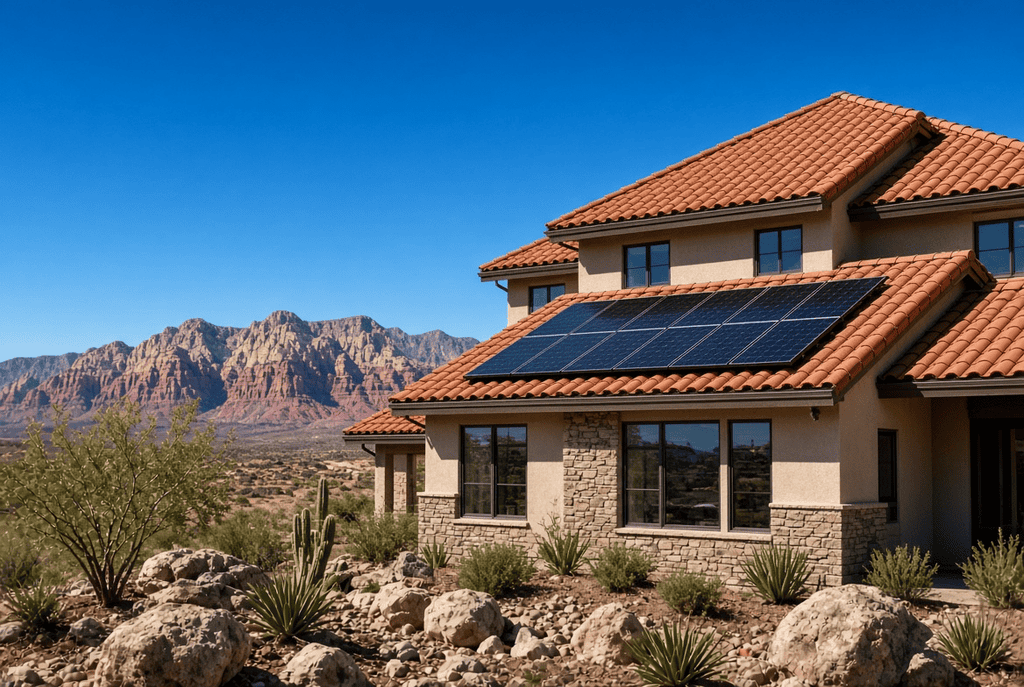
Homeowners evaluating solar in Las Vegas or North Las Vegas frequently encounter proposals that emphasize leases or Power Purchase Agreements (PPAs). A primary decision is whether to purchase the system or enter a lease or PPA. Lease and PPA options are often presented with low or zero upfront costs. This analysis examines the financial outcomes of each approach under current NV Energy rates, net metering provisions, and applicable property tax treatment to determine the relative merits of ownership versus a lease or PPA in Nevada.
Note: To keep up with fast-moving solar trends in Nevada, I use AI tools to help with research and writing. Every post is personally reviewed and edited by me.
How Solar Leases and PPAs Work
Before examining the financial comparison, the following section describes how third-party solar arrangements operate under current Nevada rules.
1. The Solar Lease (Renting the Equipment)
Think of this like leasing a car. A solar company puts panels on your roof, and you pay them a fixed monthly rent to use them for the next 20 to 25 years.
- The Escalator Vulnerability: Third-party lease payments are rarely static over time. The vast majority of solar lease agreements incorporate an annual rate escalator—typically ranging from 2.9% to 3.9% annually—which steadily inflates your monthly lease liability and degrades long-term utility savings over the 20-to-25-year term.
- Forfeiture of Tax Incentives and Maintenance Caveats: Because the third-party solar provider retains legal ownership of the equipment, they absorb any applicable accelerated depreciation benefits. While the provider typically covers basic system maintenance, mid-contract roof repairs or replacements require you to pay thousands out of pocket for their technicians to temporarily detach and re-install the array.
2. The Power Purchase Agreement / PPA (Buying the Power)
This is similar to a lease, but instead of renting the equipment, you’re letting a solar company turn your roof into a mini power plant. You don’t pay “rent” for the panels; instead, you agree to buy every single kilowatt-hour (kWh) of electricity the panels produce at a set rate.
- Long-Term Tariff Escalation Risks: While initial Power Purchase Agreement (PPA) rates—typically starting between 8¢ and 12¢ per kilowatt-hour—appear significantly lower than NV Energy’s baseline retail tariffs, most contracts incorporate an embedded 2.9% to 3.9% annual escalator. Over time, this compounding adjustment steadily narrows the spread between your contract rate and utility power.
- Forfeiture of System Equity and Federal Credits: Under a PPA structure, the third-party provider retains sole legal ownership of the equipment and associated environmental attributes. Ultimately, the homeowner substitutes a variable utility power bill for a long-term contractual payment to a solar financier without building tangible home equity or capital asset ownership.
The Fine Print: What Both Models Share
Lease and PPA contracts typically include the following provisions:
- Deceptive Upfront Value Proposition: $0-down promotional marketing masks long-term financing liabilities, as the absence of upfront capital expenditure is offset by embedded, compounding annual rate escalators that steadily erode total financial returns.
- Decadal Contractual Commitments: Standard third-party agreements bind homeowners to 20-to-25-year financial obligations. Terminating these contracts prematurely incurs substantial penalty assessments, stringent buyout clauses, and early termination liabilities.
- Transactional Friction During Escrow: Property resale requires prospective buyers to submit to credit re-qualification and formally assume all ongoing contractual terms. Should a buyer reject these terms, the seller must liquidate the full remaining contract balance out of pocket to clear title and execute the conveyance.
The Nevada Reality Check
Nevada utility regulations introduce specific considerations for third-party ownership arrangements:
- Ambiguity Surrounding Statutory Property Tax Exemptions: While Nevada law explicitly protects owned residential photovoltaic systems from property tax re-assessments, third-party lease and PPA arrangements exist in a regulatory grey area. Because legal title to the equipment is held by a corporate entity rather than the property owner, tax exemption benefits may not pass through to the homeowner unless explicitly stipulated within the contract terms.
- Administrative Friction Under NV Energy Tier 4 Net Metering: NV Energy’s Net Metering (NEM 3.0/Tier 4) framework credits excess rooftop generation exported to the utility grid at 75% of the prevailing retail rate. Under third-party ownership structures, aligning utility billing credits with contractual generation payments creates accounting complexity, as the generation asset is legally registered to a third-party entity rather than the account holder.
- Financial Risk of Unutilized Generation Under PPAs: Under a Power Purchase Agreement structure, homeowners are contractually obligated to purchase 100% of the kilowatt-hours generated by the array in real time—regardless of whether that energy is consumed on-site or exported to the grid during low-demand daytime hours.
Leases and PPAs exist because they are highly profitable for solar companies. They get to monetize your federal tax perks and secure a guaranteed revenue stream from your roof for 20+ years. While it gets you into solar for zero dollars today, it usually means you’ll save significantly less money over time compared to buying your system outright.
For more details about saving money when buying solar, explore our 2026 guides on secured vs. unsecured solar loans in Nevada, 20 questions to ask a Nevada solar installer, and the Nevada State Contractors Board (NSCB) Registry.
Where Leases and PPAs Make Sense
Look, despite the long-term financial drawbacks, solar leases and PPAs aren’t inherently evil. They wouldn’t be so popular if they didn’t offer some legitimate perks. If you’re trying to figure out if the “zero down” route makes sense for your situation, here is where these models work.
Why Some Homeowners Choose to Lease
- Minimal Capital Expenditure Requirement: Third-party solar agreements eliminate the substantial upfront capital reserves or formal debt underwriting traditionally required for direct system purchases, enabling zero-down equipment installation and grid interconnection.
- Enhanced Expense Predictability: Replacing volatile seasonal utility spikes with structured monthly payment schedules simplifies household cash flow management and shields consumers from sudden NV Energy rate adjustments, even when taking annual contract escalators into account.
- Comprehensive Operation and Maintenance (O&M) Protections: Because asset ownership remains with the third-party provider, hardware liabilities are fully transferred. In the event of inverter fault, thermal failure, or physical component damage, the financing entity maintains statutory and contractual obligations to restore system performance at no direct expense to the homeowner.
- Streamlined Credit Underwriting Protocols: Third-party lease and PPA qualification criteria feature lower baseline credit thresholds compared to traditional prime solar financing loans, expediting approval timelines for a broader spectrum of homeowners.
Who Benefits Most from a Lease or PPA?
While buying your panels outright almost always saves you the most money in Nevada, a lease or PPA might be your best bet if you fall into one of these categories:
- Capital Conservation and Credit Protection: Suited for homeowners wishing to avoid adding significant installment debt to their credit bureau reports, or those whose current credit profiles would make traditional secured or unsecured solar financing cost-prohibitive.
- Fully Outsourced Operations and Maintenance: Designed for property owners who prefer to delegate all long-term asset management responsibilities—including real-time performance monitoring, component failure liability, and warranty administration—entirely to a third-party corporate provider.
- Short-Horizon Occupancy (Subject to Transfer Constraints): Attractive to residents anticipating a home sale within a 5-to-7-year window who prioritize immediate, lower-cost monthly energy relief over long-term equity accumulation, provided they are prepared to navigate mandatory buyer contract assumption requirements during escrow.
Even if these perks sound great, Nevada’s specific utility setups—like our high sunshine hours and NV Energy’s net metering structure—mean that ownership still offers a vastly superior return on investment. If you can make ownership work, it’s usually worth the extra effort.

Why Buying Your Panels Wins Every Single Time
A direct comparison shows that purchasing a solar system outright or financing it with a conventional solar loan generally produces greater long-term value than a third-party lease or PPA. For homeowners prioritizing return on investment under Nevada conditions, ownership remains the more advantageous option.
Why Ownership Wins in the Long Run
- Accelerated Capital Amortization and Post-Payback Dividend: A purchased photovoltaic system typically achieves full capital payback within 9 to 11 years through cumulative utility bill offsets and tax credits. Following this breakeven threshold, the asset produces unencumbered, virtually cost-free electricity for the remainder of its 25-to-30-year operational lifespan.
- Tangible Real Estate Equity Appreciation: Outright system ownership establishes a permanent physical fixture that enhances property valuation and market liquidity. Unlike third-party leases that can encumber title during escrow, owned arrays add direct, transferable equity that increases buyer appeal and resale velocity across competitive Southern Nevada housing markets.
- Complete Operational and Architectural Autonomy: Direct ownership grants homeowners absolute flexibility to optimize against evolving NV Energy Time-of-Use (TOU) rate structures, expand generation capacity, or integrate auxiliary hardware—such as lithium iron phosphate (LiFePO4) battery storage—without third-party administrative hurdles or contractual restrictions.
Real Numbers: Side-by-Side Comparison (8kW System)
The following comparison examines 2026 cost outcomes for a typical home in Las Vegas or North Las Vegas. It evaluates a standard 8 kW roof-mounted system over a 25-year period under current NV Energy rates and Tier 4 net metering provisions.
1. Ownership (Recommended for Most Homeowners)
You choose to buy the system outright or through a standard solar loan.
- Substantial Upfront Capital Investment: Requires an initial gross capital expenditure of approximately $22,000, establishing the baseline acquisition cost for a standard residential photovoltaic system.
- Substantial Annual Utility Reductions: Delivers recurring annual electricity savings ranging from $2,800 to $3,600 by directly offsetting high-tariff grid consumption, particularly during peak summer cooling cycles in Southern Nevada.
- Accelerated Capital Amortization Period: Achieves complete financial payback within a rapid 5.5-to-7.5-year window, following which the fully amortized asset produces unencumbered, virtually cost-free electricity for the remainder of its 25-plus-year operational lifespan.
- Long-Term Net Financial Return: Yields an estimated 25-year cumulative net profit of $55,000 to $75,000+ in avoided utility expenditures, factoring in local net metering credit structures and standard panel degradation rates.
- Immediate Real Estate Equity Enhancement: Appends an estimated $22,000 to $32,000 in direct, transferable property valuation uplift, securely backed by Nevada’s statutory permanent property tax exemption for renewable energy installations.
2. Solar Lease
You sign a contract to rent the equipment for zero dollars down.
- Zero Upfront Capital Expenditure: Eliminates initial out-of-pocket acquisition costs, enabling immediate system installation without depleting household liquidity or requiring secured loan financing.
- Escalating Monthly Lease Obligations: Initial monthly lease payments range from $140 to $180, subject to an embedded annual rate escalator of approximately 2.5% that progressively increases long-term outlays over the 20-to-25-year contract term.
- Net Annual Utility Savings: Yields recurring annual net savings of $1,200 to $1,900 after factoring in the deduction of monthly lease liabilities from baseline utility bill offsets.
- Long-Term Cumulative Net Savings: Generates an estimated 25-year cumulative net financial benefit of $18,000 to $32,000 in reduced electricity expenditures, reflecting the net difference between utility offsets and rising lease costs.
- Negligible Equity Addition and Escrow Friction: Contributes virtually no tangible long-term property equity and can introduce transaction delays during future home sales by requiring prospective buyers to formally qualify for and assume the underlying lease agreement.
3. Power Purchase Agreement (PPA)
Under a PPA, you do not lease the equipment but instead purchases the electricity it produces.
- Zero Upfront Capital Requirement: Eliminates initial equipment acquisition and installation expenses, enabling immediate system deployment without requiring out-of-pocket capital reserves or traditional loan financing.
- Escalating Per-Kilowatt-Hour Tariffs: Establishes an initial generation rate of approximately 10¢ to 12¢ per kWh—undercutting baseline utility rates on day one—while incorporating a compounding 2.5% annual escalation clause that steadily increases energy costs over the duration of the agreement.
- Net Annual Utility Cost Reductions: Yields estimated annual net savings of $1,400 to $2,100 by offsetting traditional utility consumption with contracted PPA generation.
- Cumulative Long-Term Net Savings: Generates an estimated 25-year net financial benefit of $22,000 to $38,000 in lifetime energy cost savings, factoring in both baseline utility offsets and the impact of annual PPA tariff increases.
- Absence of Terminal Asset Equity: Leaves the homeowner with zero capital ownership or property equity at the end of the contract term, as the third-party financier retains permanent legal title to the generation hardware occupying the roof real estate.
Summarized Comparison
| Solar Track | Upfront Cost | 25-Year Savings | Does It Add Home Equity? |
| Ownership | ~$14,500 (Net) | $55,000 – $75,000+ | Yes ($22k – $32k) |
| Solar Lease | $0 Down | $18,000 – $32,000 | No (Can complicate sales) |
| Solar PPA | $0 Down | $22,000 – $38,000 | No (You own nothing) |
Note: These numbers are realistic, conservative estimates modeled on typical Southern Nevada sunshine and NV Energy structures. Your actual savings will shift depending on your home’s roof angle, shading, and how much power your family uses during peak summer hours.
Thank you for reading! If you have any feedback or a specific Nevada solar topic you’d like us to cover next, please reach out directly at admin@nevadasolarguide.com.