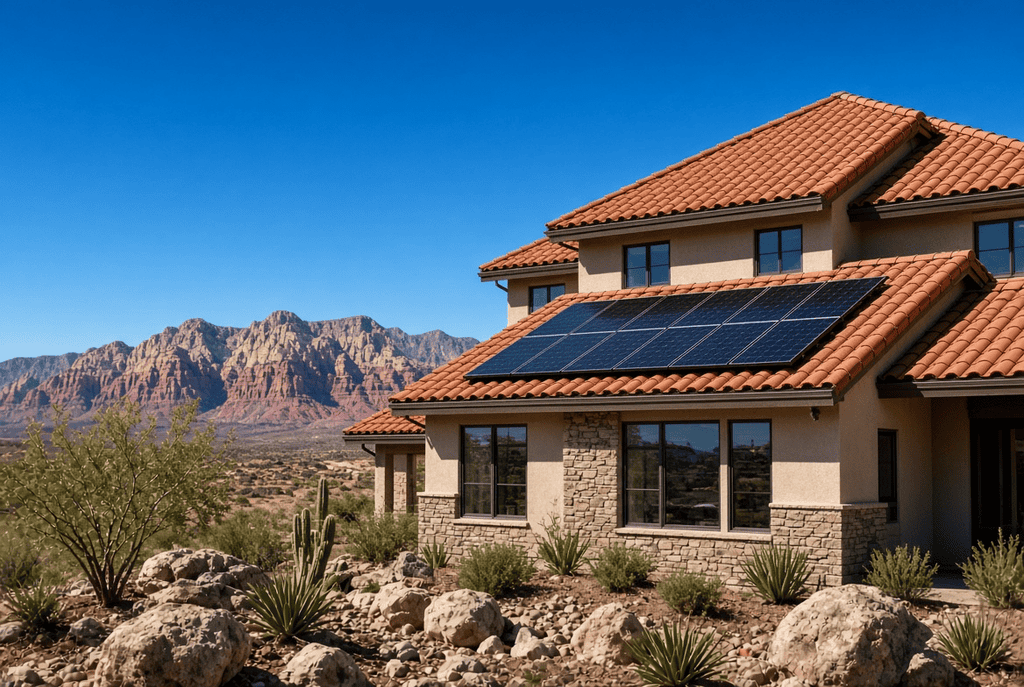
Solar real estate investing in Nevada is not a single strategy. Depending on capital, timeline, and risk tolerance, investors generally choose among three approaches: leasing land to a utility-scale developer, installing solar on a residential rental property, or buying shares in a renewable-energy REIT. Each captures value from the state’s solar resource in a different way. Here is how the three compare.
Note: To keep up with fast-moving solar trends in Nevada, I use AI tools to help with research and writing. Every post is personally reviewed and edited by me.
Important Disclaimer
Before pursuing a land lease, a rental-property solar upgrade, or a renewable-energy REIT, consider the following:
- Educational & Information Intent: The technical breakdowns, regulatory frameworks, and market analyses provided in this guide are strictly for informational and educational purposes and do not constitute formal financial, tax, or legal advice.
- Inherent Sector & Real Estate Risks: Land lease structures, site improvements, and public market equity investments carry distinct operational, regulatory, and market risks that can directly impact capital values and financial returns.
- Dynamic Regulatory & Policy Environment: Nevada utility tariff structures, regional lease valuations, federal clean energy tax credits, net-metering schedules, and commercial REIT holdings are subject to ongoing statutory and economic revisions over time.
- Professional Advisory Requirement: Readers should consult a licensed Nevada real estate attorney, a Certified Public Accountant (CPA), and an accredited fiduciary financial advisor to evaluate specific contractual terms, tax strategies, and capital allocations prior to executing agreements or committing funds.
For more details about solar investing, explore our 2026 guides on Solar Stocks with Nevada Ties, and Solar & Clean-Energy ETFs.
Navigating Utility-Scale Solar Land Leases in Nevada
Utility-scale solar projects require large areas of relatively flat land with transmission access. In Nevada, developers typically secure this land through long-term leases with private owners, local governments, or the Bureau of Land Management rather than outright purchase. The following outlines how these leases operate, what determines their value, and who receives the economic benefit.
Private Ground Leases: Structure & Earnings
Private land leases usually follow a two-stage contract structure:
- Option Period (Development & Feasibility Phase): The developer pays a reduced, per-acre annual fee (typically lasting 3 to 7 years) to lock up site rights while conducting environmental impact studies, securing land-use permits, and securing utility interconnection approvals. During this period, the property owner is bound by an exclusivity agreement prohibiting negotiations with competing developers.
- Operating Phase (Commercial Operation Phase): Once the project achieves commercial operation, ground lease payments increase substantially. Nationwide, utility-scale solar ground rents generally range from $500 to $1,500+ per acre annually, depending on regional transmission access and land quality, and routinely include structured annual lease rate escalators (typically 1.5% to 3.0%) to offset inflation.
Lease terms typically run 20 to 40 years, including extension options. A 2026 public-district lease in northern Nevada, for example, set rent at approximately $1,100 per acre per year once construction began. That figure is a local reference point, not a statewide standard.
Municipal and BLM Land
Many of Nevada’s largest solar arrays are located on city or federal property rather than private ranches:
- Municipal Land Leasing: Municipalities like Boulder City manage dedicated energy resource zones, leasing public land to utility-scale solar developers with historical lease rates reaching approximately $1,600 per acre annually on major installations.
- Federal Acreage & Public Lands (BLM): The Bureau of Land Management administers vast expanses of Southern Nevada’s public land. Developers compete in competitive auctions for priority development rights within designated Solar Energy Zones (SEZs)—paying upfront bid premiums before navigating environmental impact reviews, tribal consultations, and interconnection studies. Inclusive of pending applications, federal solar leases and rights-of-way across Nevada encompass hundreds of thousands of acres.
What Drives Land Value?
High solar irradiance alone does not determine lease value. A site’s economic potential depends on specific physical and infrastructure conditions:
- Transmission & Grid Interconnection Proximity: Access to an existing high-voltage utility substation or transmission line with available grid capacity is often more critical to project viability than total solar irradiance. Site viability drops sharply if high-voltage interconnect points require expensive transmission line extensions.
- Site Topography & Environmental Constraints: Ground slope, flood risk in desert dry washes, proximity to protected wildlife habitats (such as desert tortoise range), and title or mineral rights encumbrances can stall or terminate project development during early permitting.
- Critical Contractual Protections: Landowners must explicitly define long-term obligations in the lease agreement, ensuring the developer assumes full responsibility for property tax adjustments, liability insurance, ongoing site maintenance, and complete post-operational decommissioning and land restoration.
Evaluating Fit for Your Situation
Solar land leases apply to owners of large rural parcels with transmission access, not typical residential lots in Las Vegas or Reno, and for most investors, this segment provides market context rather than a direct investment vehicle. Owners of suitable acreage should not sign an option or exclusivity agreement without review by a real-estate attorney.
Residential Rentals with Solar: Strategy and Ownership
For most Nevada real-estate investors, solar investing does not involve leasing rural acreage to a utility. The practical question is whether a Las Vegas or Reno rental should include solar, and whether ownership of the system is preferable to a lease.
Why System Ownership Is Preferable
If you add solar to a residential rental, owning the system (or financing it conventionally) provides structural advantages over a lease:
- Marketing Advantage: In hot desert markets like Las Vegas, high summer air conditioning bills are a major concern for tenants. Owning a solar system allows you to advertise a property with significantly lower monthly power costs, making your listing stand out from the competition.
- Rent Premiums: Landlords who can show prospective tenants real, documented energy savings on past utility bills can often charge higher monthly rent, backed by proof of lower out-of-pocket costs rather than rough estimates.
- Property Value & Resale: Homebuyers and appraisers view fully owned solar panels as valuable property upgrades. While the exact value boost varies based on system age, roof quality, and overall output, owned equipment adds clear equity to the property without complicated lease transfers during a sale.
The Split-Incentive Problem with Leases and PPAs
Signing a third-party solar lease or Power Purchase Agreement (PPA) introduces operational complications for rental properties:
- Payment Mismatch: The monthly lease payment remains the landlord’s financial obligation. Meanwhile, the tenant—who holds the NV Energy account—receives the bill credits.
- Lost Value: Unless your lease agreement accounts for this difference (e.g., keeping utilities in your name and charging a flat monthly fee), you end up paying for equipment that only reduces your tenant’s electric bill.
- Resale Obstacles: Many home buyers refuse to assume 20-year solar contracts or property liens (UCC filings). Furthermore, real estate appraisers typically do not add property value for hardware you don’t own.
Critical Steps Before Installing Solar
- Payment & Benefit Mismatch: The monthly equipment payment remains the landlord’s personal debt obligation. Meanwhile, the tenant—who holds the NV Energy account—receives all the power production credits directly on their electric bill.
- Unrecaptured Investment Costs: Unless your lease agreement accounts for this imbalance—such as keeping power accounts in your name and offering a flat-rate utility fee—you end up paying monthly equipment costs while your tenant gets all the savings.
- Resale & Financing Friction: Many home buyers refuse to assume 20-to-25-year contract terms or personal property liens (UCC-1 filings). Additionally, licensed real estate appraisers generally assign zero added value to third-party leased panels during property valuations.
Nevada’s Solar Property-Tax
One key reason adding solar can make financial sense for a Nevada rental property or a personal residence is how state tax law treats renewable energy upgrades. In Nevada, qualifying solar equipment is handled differently than most other property improvements—a detail that directly impacts your overall real estate returns.
What the Property Tax Exemption Does
Under Nevada Revised Statutes (NRS 701A.200), qualifying solar energy systems receive a 100% property tax exemption on the value the system adds to the property.
- Exemption from Property Tax Reassessments: Installing an owned solar power system will not trigger an automatic increase in your home’s assessed taxable value—unlike major structural capital improvements such as adding an in-ground pool, attached garage, or square-footage addition.
- Targeted Renewable Energy Carve-Out: Your underlying residential land and primary housing structure are assessed at standard market valuation, while the qualifying renewable energy equipment is explicitly excluded from the taxable assessment under state property tax regulations.
Why Rental Landlords Care
As a real estate investor, keeping local property tax overhead low is crucial:
- Preserving Operating Cash Flow: Without the property tax exemption, a $15,000 to $25,000 system installation would trigger a higher assessed property valuation, allowing increased annual county tax bills to erode the homeowner’s net utility bill savings.
- Net-Positive Financial Impact: Shielding added system value from annual assessment rolls ensures property owners can lower ongoing utility overhead or boost tenant appeal without facing a recurring property tax penalty.
What the Exemption Does Not Cover
To avoid miscalculations in your deal underwriting, keep these limitations in mind:
- Not a Direct Financial Rebate: The statutory exemption does not issue cash refunds, lower state sales taxes, or provide credits on monthly NV Energy power bills; it simply prevents county property taxes from rising due to the system.
- Independent of Market Appraisal Valuations: Shielding equipment from tax assessment rolls does not guarantee that a licensed real estate appraiser will increase a home’s market valuation by the exact total cost of installation.
- Inapplicable to Third-Party Leased Equipment: If a system is installed under a solar lease or Power Purchase Agreement (PPA), the third-party developer retains equipment ownership. These lease arrangements build no property equity and do not qualify as a landlord-owned capital improvement.
Documentation and Administrative Rules
Tax exemptions require proper county-level filing and documentation:
- County Registration Requirements: Property owners must file the required renewable energy exemption documentation with their local jurisdiction (such as the Clark County or Washoe County Assessor’s Office) to ensure the system is correctly classified on the property record card.
- Filing Deadlines & Verification: Incomplete paperwork or missed submission windows can delay the property tax carve-out or disrupt assessment cycles. Property owners should verify current documentation rules and annual filing deadlines directly with their local county assessor prior to system activation.
Combining System Ownership with the Tax Advantage
The tax benefit works best when paired with direct equipment ownership. Owning your solar array outright gives you a clean strategy for long-term holding:
- Full Asset Ownership: You retain complete legal title and equity in the solar hardware, eliminating third-party lease encumbrances and contract transfers.
- Transparent Production & Billing Records: You control all NV Energy bill credits and direct performance monitoring data, providing clear documentation of historical energy savings.
- Statutory Property Tax Protection: Nevada’s renewable energy exemption shields your installation from county property tax reassessments, protecting your net utility savings from tax erosion.

Public REITs and Yield-Style Vehicles
Most individual investors will not lease large tracts of desert land to a utility. Public markets provide a more liquid route to solar-asset exposure through shares of companies that own, finance, or operate clean-energy infrastructure. Ownership takes the form of publicly traded securities rather than a physical property interest in Clark County.
Key Players in the Space
- HA Sustainable Infrastructure Capital (NYSE: HASI): HASI invests capital directly into sustainable infrastructure, including utility-scale solar, distributed rooftop generation, and energy storage. They operate as a specialized infrastructure finance provider rather than a traditional apartment or office REIT, generating returns from loan yields, structured equity, and long-term asset management.
- Clearway Energy (NYSE: CWEN): Clearway owns and operates contracted renewable energy assets. Cash flow comes from long-term Power Purchase Agreements (PPAs) with utility buyers, not ground leases from private landowners. (Note: While Clearway holds projects across the U.S., check their active SEC filings directly rather than assuming a specific yield vehicle owns a given Nevada plant).
How Public Vehicles Differ from Physical Real Estate
- Instant Market Liquidity: Publicly traded shares can be bought or sold immediately during regular market trading hours, offering high flexibility compared to illiquid physical real estate.
- Elimination of Operational Overhead: Equity investors avoid the ongoing administrative burden of land contracts, site maintenance, tenant lease management, and complex decommissioning negotiations.
- Market-Based Risk Profile: Investors trade physical site risks—such as tenant vacancies or roof repairs—for broader public market risks, including equity market volatility, interest-rate sensitivities, and corporate credit risks.
- Broad Geographic Diversification: Clean-energy exchange-traded funds pool revenues across national and global markets, meaning specific Nevada solar installations account for only a small fraction of a fund’s total underlying earnings.
How the Three Paths Compare
The three forms of solar real-estate exposure in Nevada appear similar in headlines but operate differently in practice. A side-by-side comparison clarifies why a residential-rental approach does not transfer to a land lease, and why a publicly traded security does not perform like either.
| Attribute | Utility-Scale Land Leases | Rental Properties (Owned Solar) | Public REITs & Infrastructure Vehicles |
| Ideal Investor | Owners of large, rural desert acreage near power grid lines. | Residential landlords in the Las Vegas or Reno metro areas. | Investors seeking clean-energy exposure with complete liquidity. |
| Capital Requirement | Existing land ownership; low setup costs, high legal/study fees. | Cost of real estate plus outright solar array purchase. | Minimum purchase price of a single share on a stock exchange. |
| Liquidity | Very Low (20–40 year binding contracts/exclusivity periods). | Low (tied to traditional real estate sale timelines). | High (traded daily during standard stock market hours). |
| Nevada Focus | Highly site-specific (requires proximity to NV transmission lines). | Localized (NV Energy 75% export credit, local property-tax rules). | Low-to-Moderate (national portfolios with minimal single-site focus). |
| Primary Risks | Option cancellation, zoning, interconnection delays, long-term tie-ups. | Tenant turnover, roof maintenance, shifting utility rate rules. | Stock market volatility, corporate credit, interest rate changes. |
A Quick Decision Filter
- For Large Acreage Near Utility Infrastructure: Focus on negotiating long-term utility-scale ground leases, ensuring strong legal protections for option periods, rent escalators, and post-operational decommissioning obligations.
- For Residential Rental Property Owners: Evaluate direct equipment ownership paired with structured tenant utility agreements to maximize property equity and protect net cash flow under Nevada’s property tax exemption.
- For Portfolio & Equity Investors: Focus on publicly traded clean-energy ETFs and infrastructure securities to gain clean-tech exposure with instant liquidity, avoiding the capital lockup and physical oversight of local land leases.

Risks and Due Diligence
Each solar real-estate strategy carries distinct points of failure. Due diligence must therefore address the specific contract type rather than rely on a generic checklist.
Land Lease Risks
The principal failure point in land leases arises during the option period. A developer may control the parcel for years at a low rate while conducting feasibility studies, then decline to proceed.
- Infrastructure & Site Viability Barriers: A parcel that appears ideal on paper can fail during feasibility testing if the nearest utility substation lacks available transmission headroom, active desert dry washes cut across the buildable footprint, or protected desert tortoise habitats restrict development scope.
- Land Lease Contract Pitfalls: Landowners frequently face legal exposures, including vague post-operational decommissioning terms, unassigned property tax liabilities, unaddressed mineral rights conflicts, and loose assignment clauses that allow developers to sell or assign lease rights to third parties without landowner approval.
- Essential Legal & Technical Due Diligence: Landowners should engage a Nevada-licensed real estate attorney to review title encumbrances, survey site boundaries, verify documented transmission capacity with the utility, and draft binding site restoration and bonding requirements prior to signing.
Rental Property Solar Risks
Leased or PPA equipment on a rental can require the owner to pay ongoing hardware fees while the tenant captures the utility savings.
- Operational & Title Friction: Installing solar hardware on an aging roof risks substantial removal and reinstallation expenses when roof repairs or replacements become necessary. Furthermore, third-party solar leases often involve personal property liens (UCC-1 filings) that cloud title records, stall real estate closings, and deter prospective buyers.
- Essential Due Diligence for Landlords: Prioritize direct equipment ownership over third-party lease contracts, confirm the underlying roof has significant remaining service life, register the renewable energy exemption with the county assessor’s office, and incorporate precise tenant lease provisions that clearly govern utility account management and bill credit allocations.
Public REIT & Infrastructure Vehicle Risks
Yield vehicles and infrastructure stocks are subject to market risk rather than physical-property issues.
- Macroeconomic & Market Exposure: Share prices for yield-oriented public equities (such as Clearway Energy or HASI) can experience multiple compression during persistent high interest rate environments, shifts in counterparty credit ratings, or broader market sell-offs—even while physical power purchase agreements (PPAs) and underlying solar assets generate uninterrupted cash flows.
- Essential Legal & Financial Due Diligence: Investors must rigorously review active SEC filings (Forms 10-K and 10-Q), evaluate Cash Available for Distribution (CAFD) dividend payout ratios, and assess power purchase agreement counterparty durability—recognizing that public equity positions confer indirect, liquid financial exposure rather than direct property title or physical site control.
Common Pitfalls to Avoid
- Relying on Generic National Benchmarks: Treating national land-rent averages as a guaranteed Nevada baseline ignores localized desert topography, regional utility interconnection costs, and specific transmission capacity limits.
- Assuming Automatic Statutory Benefits: Expecting county property tax exemptions to apply automatically without filing proper registration and compliance documentation with the local assessor’s office (such as Clark or Washoe County).
- Confusing Specific Asset Exposure with Portfolio Diversification: Overlapping locally held solar rental properties with clean-energy equity funds, incorrectly treating the combined holdings as a fully diversified real estate portfolio.
- Foregoing Qualified Professional Oversight: Omitting specialized real estate legal counsel or CPA tax reviews to reduce upfront costs, which exposes project owners to long-term legal and financial liabilities.
Thank you for reading! If you have any feedback or a specific Nevada solar topic you’d like us to cover next, please reach out directly at admin@nevadasolarguide.com.