

Nevada’s Renewable Portfolio Standard (RPS) requires NV Energy and other electricity providers in the state to supply at least 50 percent of the retail electricity they sell from renewable resources by 2030. Both state statute and voter approval of Ballot Question 6 place this target in the Nevada Constitution, giving it a stronger legal foundation than ordinary legislative policy. For homeowners in Las Vegas and North Las Vegas, the practical questions center on three points: whether NV Energy is on track to meet the 50 percent requirement, whether compliance will raise monthly electric bills, and whether the mandate changes the financial case for installing rooftop solar.
The short answer is that NV Energy has consistently met and, in some cases, exceeded its statutory targets to date. The next several years are expected to be more challenging because of rapid large-load growth. The RPS itself is not the primary driver of monthly electric bills. In any given year, what customers pay is shaped more directly by general rate-case decisions, quarterly fuel and purchased-power adjustments, and structural billing changes such as daily demand charges.
Note: To keep up with fast-moving solar trends in Nevada, I use AI tools to help with research and writing. Every post is personally reviewed and edited by me.
What the 50% by 2030 Standard Requires
Nevada’s Renewable Portfolio Standard (RPS) requires NV Energy to steadily increase the share of renewable energy delivered to retail customers, reaching a legally binding target of 50 percent by 2030. Under state rules, this obligation applies separately to NV Energy’s two operating utilities—Nevada Power Company in the south and Sierra Pacific Power Company in the north. The two entities routinely pool and trade renewable energy credits (RECs) to meet their combined statutory requirements.
Under Nevada’s Renewable Portfolio Standard, eligible resources include solar, geothermal, wind, certain hydroelectric facilities, and qualifying biomass. In practice, utility-scale solar paired with battery storage has accounted for the large majority of new capacity added in recent years, reflecting Nevada’s strong solar resource and declining project costs. Nevada no longer maintains a dedicated solar carve-out that requires utilities to procure a specific percentage of power from solar. Solar now dominates NV Energy’s procurement because it is competitive on cost and well matched to the state’s resource conditions.
Compliance is tracked through Portfolio Energy Credits (PECs), Nevada’s version of renewable energy credits. One credit generally represents one megawatt-hour (MWh) of eligible renewable electricity generated. Each year, NV Energy must permanently retire enough credits to cover the required percentage of its retail electricity sales. Because weather, project construction timelines, and customer demand do not always align within a single calendar year, Nevada allows the utility to bank excess credits for future compliance periods. The Public Utilities Commission of Nevada (PUCN) audits the annual compliance filings to verify that the required volumes have been met.
Under Nevada law, the utility’s renewable-energy requirement increases in three stages over the remainder of the decade:
- Through 2026: At least 34% of retail electricity sales from renewable resources
- 2027 – 2029: Jumps to 42% of retail electricity sales
- 2030 and beyond: Reaches the permanent constitutional floor of 50% annually
Nevada policy also includes an aspirational goal of 100 percent carbon-free electricity by 2050. That target is non-binding; it sits outside the enforceable Renewable Portfolio Standard and imposes no additional credit requirements in 2030. By contrast, the 50 percent by 2030 mandate is legally binding. It was enacted in statute through Senate Bill 358 (2019) and placed in the Nevada Constitution when voters approved Question 6 (2020). The constitutional amendment establishes the 2030 endpoint as a firm floor while leaving the Legislature the ability to adjust intermediate step-up percentages and implementation rules.
Nevada’s Renewable Portfolio Standard is calculated as a percentage of retail electricity sales rather than a fixed megawatt target. As overall electricity demand rises—whether from population growth, electrification of transportation and homes, or large new commercial loads such as data centers—the absolute volume of renewable energy credits NV Energy must acquire increases accordingly. This relationship becomes more significant later in the decade, when projected load growth is expected to accelerate.
To meet these rising requirements, NV Energy relies primarily on utility-scale power-purchase agreements (PPAs) and utility-owned solar and storage plants rather than residential rooftop systems. While homeowner solar adds clean generation to the grid, the Portfolio Energy Credits from most net-metered rooftop systems are governed by the state’s net-metering tariff, and homeowners do not separately sell those credits into the utility’s RPS market.
How Nevada Got Here
Nevada was an early adopter of clean-energy policy. When the Legislature enacted the state’s first Renewable Portfolio Standard in 1997, Nevada became the second state in the nation to adopt one. The initial requirement began at a modest percentage, and over the following two decades lawmakers repeatedly raised the renewable target, refined which generation technologies qualified, and phased out provisions that had allowed utilities to meet part of the mandate with energy-efficiency credits rather than renewable electricity.
By the mid-2010s, Nevada’s statutory target stood at 25 percent by 2025. An effort to raise the standard further stalled in 2017, when the Legislature passed a bill to set a 40 percent target by 2030 and the governor vetoed it. The veto prompted a citizen initiative. In 2018, Nevada voters approved Question 6, a ballot measure proposing a constitutional amendment to require 50 percent renewable electricity by 2030. Under Nevada’s rules, voter-initiated constitutional amendments must pass in two consecutive general elections. Question 6 returned to the ballot in 2020, passed again, and placed the 50 percent requirement in the Nevada Constitution.
Between the two statewide ballot votes, the 2019 Nevada Legislature converted the voter initiative into enforceable statute. Sponsored by State Senator Chris Brooks, Senate Bill 358 established a binding ramp-up to 50 percent renewables by 2030, with intermediate benchmarks that include a 34 percent threshold through 2026 and a 42 percent step-up for 2027–2029, along with a non-binding goal of 100 percent carbon-free electricity by 2050. The bill passed both chambers unanimously and was signed into law by Governor Steve Sisolak on April 22, 2019. That statutory schedule remains the compliance roadmap NV Energy follows and reports against today.
Nevada’s constitutional amendment and state statute both establish a 50 percent renewable requirement by 2030, but they serve different legal functions. The constitutional provision acts as a floor: it prevents the 2030 mandate from being repealed or weakened by ordinary legislation while still allowing the Legislature to set intermediate ramp-up percentages and adjust implementation rules, provided those changes do not undercut the constitutional baseline. In practice, the detailed statutory schedule enacted in SB 358 governs NV Energy’s resource planning and annual compliance filings.
Earlier versions of Nevada’s Renewable Portfolio Standard included a dedicated solar carve-out and credit multiplier—provisions that either required utilities to procure a minimum share of power from solar or awarded additional compliance credits for solar generation. Lawmakers later phased out or allowed those special incentives to expire, so the current standard is technology-neutral across all eligible renewable resources. Solar has nevertheless continued to account for most of NV Energy’s new clean-energy additions, not because of a regulatory preference but because declining photovoltaic costs and Nevada’s strong solar resource make it the most economical option.
Current Compliance and the 2026–2030 Climb
NV Energy has met its Renewable Portfolio Standard requirement every year since 2010, often by a comfortable margin. In its most recent annual compliance filing covering calendar year 2025, both operating companies exceeded the 34 percent statutory benchmark: Nevada Power reached 44.6 percent in the south, and Sierra Pacific Power reached 54.7 percent in the north. Earlier compliance cycles showed a similar cushion, with both utilities exceeding the 29 percent threshold that applied in 2023. Because Nevada allows surplus Portfolio Energy Credits to be banked and carried forward, these over-compliance margins provide NV Energy with a buffer if project delays or lower generation tighten results in any single year.
That compliance margin faces a more demanding period beginning in 2027, when Nevada’s statutory schedule rises from 34 percent to 42 percent for 2027–2029 and then to 50 percent in 2030. Because the requirement is calculated as a percentage of total retail electricity sales, any increase in customer demand raises the absolute volume of renewable energy credits NV Energy must deliver, even in years when the target percentage remains unchanged. According to NV Energy’s 2026 Integrated Resource Plan (IRP), the utility is projecting substantial load growth driven primarily by hyperscale data centers and other large commercial projects. The combination of a higher statutory percentage and rising electricity demand produces a larger compliance obligation than earlier planning cycles anticipated.
In its 2026 Integrated Resource Plan (IRP), NV Energy projects that without the new clean-energy projects it is proposing, both Nevada Power and Sierra Pacific Power face renewable compliance shortfalls beginning as early as 2027. Even if regulators approve the utility’s proposed additions—primarily utility-scale solar paired with battery storage, along with continued geothermal development in northern Nevada—the compliance margin improves in some scenarios and years but remains narrow, particularly for Nevada Power in the south. Year-to-year results depend heavily on transmission constraints, project permitting or supply-chain delays, and the online dates of large new commercial loads. NV Energy also notes that not every megawatt of requested data-center capacity is certain to materialize and incorporates that demand uncertainty into its planning scenarios.
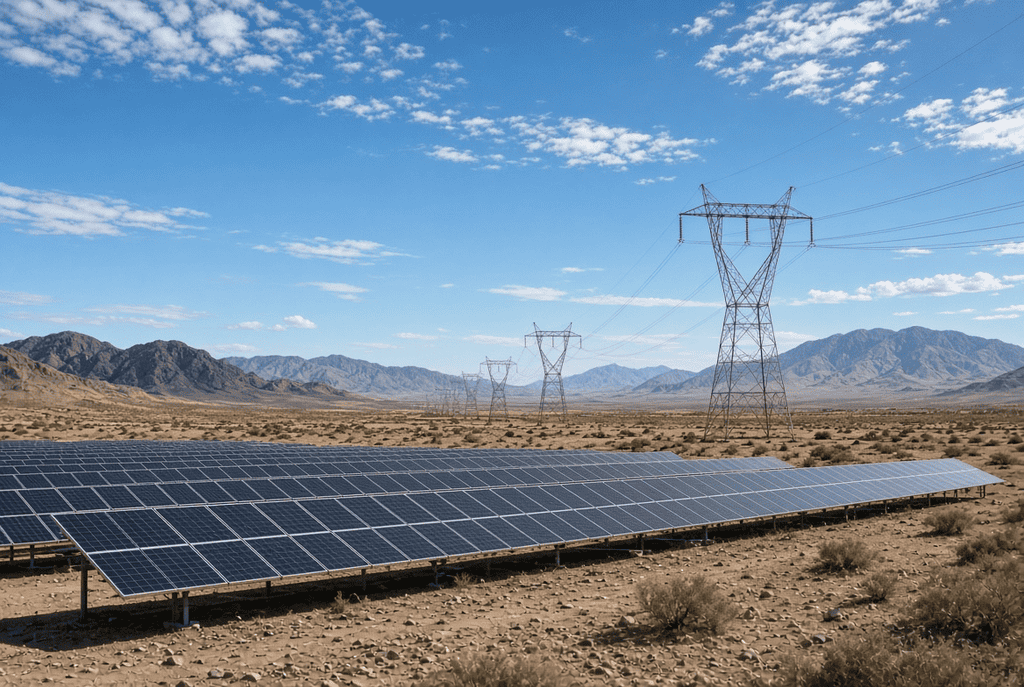
As of early 2026, Nevada Power had roughly 2,700 MW of contracted renewable energy and about 165 MW of utility-owned renewable capacity, along with a substantial pipeline of new solar-plus-storage projects in development. In northern Nevada, Sierra Pacific Power’s operating renewable fleet was smaller in absolute megawatts but, when combined with banked Portfolio Energy Credits, was sufficient to meet the 34 percent compliance requirement with a margin. Converting contracted projects into actual compliance depends on transmission capacity. The Greenlink transmission projects are intended to deliver new desert solar generation to Nevada’s major population and load centers, which is necessary for those contracts to produce delivered compliance credits on schedule.
Data-Center Demand and the Compliance Challenge
The largest uncertainty in Nevada’s RPS outlook is an unprecedented volume of large-load interconnection requests, driven primarily by hyperscale data centers. In filings supporting its 2026 Integrated Resource Plan (IRP), NV Energy reported roughly 22,000 MW in early-stage interest inquiries and formal interconnection requests from dozens of prospective customers totaling well over 16,000 MW, with a substantial majority of signed interconnection agreements located in northern Nevada. Data centers currently account for only a small single-digit share of NV Energy’s retail electricity sales. Certain 2026 IRP scenarios indicate that this share could expand substantially over the next two decades if a significant portion of the requested capacity is ultimately built.
Because Nevada’s Renewable Portfolio Standard is calculated as a percentage of total retail electricity sales, rising power demand increases the absolute volume of renewable credits NV Energy must acquire. A utility that comfortably exceeded a 34 percent benchmark can face tighter compliance conditions when rapid sales growth coincides with the scheduled increases to 42 percent in 2027 and 50 percent in 2030. NV Energy’s planning scenarios indicate compliance shortfalls beginning in 2027 unless regulators approve the new clean-energy additions it has proposed. Even with those resources included, the outlook depends on how much of the requested commercial load is ultimately built and how quickly new solar-plus-storage plants and transmission lines enter service.
To limit the cost impact of large new loads on residential and small-business customers, NV Energy has stated that large-load customers will be required to pay for the new generation and transmission infrastructure needed to serve them, using contractual frameworks such as its proposed Large Load Electric Service Agreement. The objective is to avoid spreading major grid-upgrade costs across the broader rate base. Some data-center operators have used behind-the-meter or temporary natural-gas generation as an interim solution while awaiting permanent utility interconnections. Those on-site gas systems can address near-term power and reliability constraints, but they generate no renewable energy credits and therefore do not contribute to NV Energy’s Renewable Portfolio Standard compliance once the facilities connect to the grid.
To meet rising demand while satisfying Nevada’s increasing renewable targets, NV Energy’s preferred resource plan in the 2026 Integrated Resource Plan (IRP) relies primarily on several thousand megawatts each of new utility-scale solar and battery storage, continued geothermal development, major transmission upgrades centered on Greenlink, and a smaller amount of new gas-fired capacity for reliability. The plan remains subject to change. Construction delays, project cancellations, or lower-than-expected customer load growth could alter the year-by-year credit balance. NV Energy has noted that not every megawatt of early interconnection interest will become operating load and incorporates that uncertainty into its planning scenarios.
How RPS Costs Show Up (or Don’t) on Residential Bills
A monthly NV Energy bill does not contain a separate line item labeled “Renewable Portfolio Standard” or “RPS fee.” The costs of building, contracting, and operating the renewable projects that supply the state are not recovered through a standalone surcharge. Instead, those expenses are included in the standard rate components used to recover fuel and power-purchase costs, primarily the base tariff general rate and the deferred energy adjustment—the periodic fuel and purchased-power clause that changes over time.
Because renewable energy contracts are incorporated into NV Energy’s broader power portfolio, their effect on customer bills appears only in the aggregate. When a new solar-plus-storage power-purchase agreement (PPA) is lower-cost than the fossil-fuel resource it displaces, it can reduce the purchased-power portion of rates. When a project is more expensive, or when construction delays require the utility to rely on higher-cost spot-market power or temporary gas-fired generation, rates can experience upward pressure. Recent utility-scale solar-plus-storage agreements in Nevada have secured competitive levelized prices, which has helped keep the cost of meeting the Renewable Portfolio Standard relatively stable to date.
Even as renewable targets have increased, Nevada residential electricity rates have historically remained below the national average. Quarterly fuel and purchased-power adjustments have at times produced modest bill reductions when natural gas and wholesale market costs declined. The most significant near-term rate change for southern Nevada customers is not a renewable-energy surcharge but the mandatory daily demand charge scheduled to take effect in January 2027. This change originates from a recent general rate case rather than the Renewable Portfolio Standard and will alter bill calculation for both rooftop solar and non-solar customers. It is independent of NV Energy’s renewable credit obligations.
Along with rate-design changes, large-load cost allocation is the main mechanism intended to limit the impact of major new loads on residential bills. Under the contractual frameworks NV Energy has proposed, including its Large Load Electric Service Agreement (LLESA), data centers and other large commercial customers are required to pay directly for the new generation and transmission infrastructure built to serve them. When approved and enforced by regulators, these provisions are designed to keep the capital and operating costs of serving those loads from being recovered through residential rates. Residential customers continue to contribute to the costs of the shared grid and the renewable energy needed to meet the RPS percentage on standard retail sales, while the dedicated infrastructure for large loads remains separately allocated.
Beyond the near-term transition, the cost of meeting Nevada’s 50 percent renewable target depends primarily on the relative cost of new renewable power, the timely completion of transmission projects such as Greenlink, and the extent to which projected data-center load actually materializes. These factors will influence future rate cases and fuel-adjustment filings. They will not, however, produce a new standalone “RPS surcharge” that appears on monthly bills solely because the statutory percentage increases.
What This Means for Rooftop Solar Customers
Statewide renewable targets and rooftop solar rules are separate. The Renewable Portfolio Standard is a utility-level obligation and does not modify the net-metering tariffs that apply to residential solar systems in Nevada. Under the current rules for southern Nevada (NMR-405), excess solar energy exported to the grid receives a credit equal to 75 percent of the retail rate, with billing netting calculated on a monthly basis. These compensation terms are set by state statute and Public Utilities Commission orders; they do not automatically change when NV Energy’s required RPS percentage increases.
Residential solar systems generate clean energy, but the renewable credits associated with them are either retained by the utility or accounted for under the state’s net-metering framework. Homeowners cannot sell those credits separately. A rooftop solar owner does not receive an additional cash payment or a higher export credit solely because NV Energy’s RPS requirement increases to 42 percent or 50 percent. The financial value of a home solar system remains based on two elements: the retail rate avoided by consuming solar power on-site, and the 75 percent retail credit applied to surplus energy exported to the grid.
The RPS does not provide direct payments to solar owners, but it contributes to broader changes in the grid that affect how household energy is used. As Nevada adds thousands of megawatts of utility-scale solar, midday generation increases and the cost of power during peak solar hours declines. In that environment, the value of self-consumption—running air conditioning, charging an electric vehicle, or operating major appliances while solar production is high—can exceed the value of exporting surplus energy for a 75 percent retail credit. A home battery can extend those savings into the evening. The RPS itself does not create a new revenue stream for batteries; a battery’s financial return continues to depend on existing time-of-use (TOU) rates and the demand-charge structures that are scheduled to take effect.
The Renewable Portfolio Standard does not affect several rules that apply to residential solar. It does not change Nevada’s property-tax exemptions for residential solar, modify the utility interconnection process, or alter the requirement that solar contractors hold a valid C-2 license in Nevada. Those provisions operate independently of the utility’s compliance calculations.
What the RPS does influence is the state’s overall power mix and, over time, the utility rates against which home solar savings are measured. If NV Energy meets its targets with low-cost utility-scale solar-plus-storage contracts, upward pressure on base rates is more likely to remain limited. If project delays require the utility to rely on higher-cost interim power, customer rates could rise for reasons related to procurement timing rather than the RPS requirement itself.
Thank you for reading! If you have any feedback or a specific Nevada solar topic you’d like us to cover next, please reach out directly at admin@nevadasolarguide.com.


