Nevada Senate Bill 379 creates no new state rebates and does not alter existing net metering frameworks. Instead, SB 379 is a comprehensive consumer-protection statute that restructures the legal guidelines governing how residential solar and energy storage systems are marketed, financed, leased, and contracted statewide. Enacted on June 5, 2025 (Chapter 338, Statutes of Nevada 2025), the statute’s primary compliance requirements and disclosure mandates apply to all residential solar and storage agreements executed on or after October 1, 2025.
For homeowners executing a residential solar purchase, loan, lease, or power purchase agreement (PPA) in 2026, Nevada Senate Bill 379 is fully in effect. The statute imposes strict obligations across the entire sales chain, enforcing targeted compliance duties on solar installation companies, system financiers, and lead-generation entities. Key consumer safeguards include extended cancellation windows for older adults, mandatory post-survey rescission rights, upfront deposit caps, delayed payout schedules for financiers until permission to operate is granted, explicit prohibitions against system disconnections for disputed billing, and standardized disclosure mandates.
Note: To keep up with fast-moving solar trends in Nevada, I use AI tools to help with research and writing. Every post is personally reviewed and edited by me.
What SB 379 Is and When It Applies
Signed by the Governor on June 5, 2025, it became Chapter 338 of the 2025 Statutes of Nevada. Its formal title is “An Act relating to commerce; imposing various requirements upon a distributed generation system financier who finances the purchase of or leases a distributed generation system or contracts for a power purchase agreement; revising requirements for solar installation companies… and providing other matters properly relating thereto.”
In statutory terms, Nevada Senate Bill 379 updates the regulatory framework governing the sale, financing, leasing, and contracting of residential and small commercial distributed generation systems across the state. The legislation establishes binding legal obligations across the clean energy supply chain, imposing explicit compliance duties on third-party capital providers (classified in statute as “distributed generation system financiers”), licensed solar installation contractors, and lead-generation brokers. Its overarching objective is to enforce standardized disclosure rules, mandate verified contractor licensing, restrict premature disbursement of capital, and expand statutory rescission rights for consumers.
The statutory threshold for applicability is October 1, 2025. Under Senate Bill 379, the expanded consumer-protection requirements apply to all residential distributed generation system loans, direct purchase contracts, equipment leases, and power purchase agreements (PPAs) executed on or after that date. Agreements executed prior to October 1, 2025, remain grandfathered under previous guidelines, while those signed on or after that date are subject to the statute’s heightened disclosure, financing, and cancellation mandates.
Nevada Senate Bill 379 establishes no new financial subsidies, does not restore the federal residential clean energy tax credit, and leaves NV Energy’s net metering framework entirely untouched. The statute leaves the key mechanics of Nevada’s net metering structure fully in place, including the 75% export credit tier under Rate Schedule NMR-405, the 20-year premise lock-in provision, and monthly volumetric netting across Southern Nevada. Functionally, SB 379 operates strictly as a contracting and consumer-finance statute.
Who Is Covered: Financiers, Installers, and Lead Generators
To enforce compliance across the sales pipeline, Senate Bill 379 establishes distinct statutory duties for three principal market participants: capital providers (classified in statute as “distributed generation system financiers”), licensed solar installation contractors, and lead-generation brokers. Delineating these roles is essential for consumers, as each category is subject to specific regulatory obligations, payout restrictions, and disclosure mandates under Nevada law.
Distributed Generation System Financiers
Under Nevada law, “distributed generation system financiers” are broadly defined as any person or entity providing a loan specifically dedicated to purchasing a solar or battery storage system, offering equipment leases, or executing power purchase agreements (PPAs) within the state. Senate Bill 379 subjects these capital providers to direct state oversight, requiring them to obtain an installment lender license from the Nevada Commissioner of Financial Institutions.
Financiers face strict compliance duties before disbursing capital. They must independently verify that the installation firm holds an active, properly classified contractor’s license under NRS Chapter 624 and is operating within its state-approved monetary license limit. Failure to complete this verification grants the property owner statutory grounds to rescind the contract. The statute further prohibits financiers from releasing final funds or progress payments to installers—outside of narrowly defined exceptions—until the system receives formal utility Permission to Operate (PTO) or successfully passes final municipal building inspection and achieves operational status.
Solar Installation Companies
Solar installation companies are defined under Nevada statute as businesses holding an active contractor’s license issued under NRS Chapter 624 that authorizes work on residential clean energy systems and that engage in the sale or installation of distributed generation equipment. Under Senate Bill 379, these contractors must operate strictly within the state-approved monetary ceiling of their license while adhering to heightened operational mandates.
The law requires installers to conduct a physical site survey before contract execution, perform and record a standardized verbal identity and contract confirmation call (retained for at least five years), and observe strict caps on pre-operational customer deposits. Contractors also face statutory liability if a system fails to achieve its first-year projected energy output and are prohibited from accepting final project disbursements until the installation receives formal utility Permission to Operate (PTO) or passes final municipal building inspection.
Lead Generators
Under Nevada law, “lead generators” are defined as any person or entity generating prospective sales leads or customer referrals for residential clean energy installations. Senate Bill 379 subjects these marketing intermediaries to strict consumer-protection boundaries. The statute restricts referral compensation—generally capping payments at $2,000 per lead or referral—and explicitly prohibits selling lead data to unlicensed contractors or unauthorized entities.
All commercial solicitations conducted by lead generators must prominently include a standardized legal notice stating that the communication is a commercial advertisement not affiliated with, endorsed by, or representing any government agency or public utility. To protect consumer privacy, the law also restricts the scope of personal and financial information lead generators may collect, as well as the advertising mediums and promotional tactics they may employ.

Key Protections for the Homeowner
For residential solar, lease, and financing agreements executed on or after October 1, 2025, Senate Bill 379 establishes several enforceable statutory rights. These concrete consumer safeguards provide key benchmarks for property owners conducting contract reviews before execution—or seeking legal remedies following a transaction.
Immediate copy of the agreement. Financiers and contracting entities are legally obligated to provide the consumer with a complete, fully executed copy of the solar loan, lease, or power purchase agreement immediately upon execution. Property owners should ensure they receive a physical copy or an electronic file directly to their inbox before concluding an in-person sales presentation or ending a remote consultation.
Verbal confirmation and recording. Before initiating installation work, both the distributed generation system financier and the installation contractor are legally required to verify the property owner’s identity and verbally detail the core commercial terms of the transaction — whether conducted in person, by phone, or by videoconference. This interaction must be audio-recorded and preserved in company archives for at least five years.
Physical site survey. Senate Bill 379 requires solar installation contractors to perform an on-site physical survey of the property. If this evaluation occurs after the agreement has been executed and reveals structural, electrical, or design modifications that increase the total price or materially alter equipment specifications—excluding narrow exceptions for upgraded hardware installed at no additional cost—the property owner has an explicit statutory right to rescind the contract within three business days of receiving the updated disclosures.
First-year production shortfall. If an operational clean energy system fails to deliver the total first-year kilowatt-hour output projected in the agreement, Senate Bill 379 obligates the solar installation contractor to undertake affirmative corrective actions during the subsequent 12-month period. If the generation deficit persists despite initial remediation efforts, the contractor must issue formal written notice to the property owner detailing secondary corrective measures or monetary compensation protocols.
Language. If pre-contract negotiations or sales presentations were conducted in a language other than English, Senate Bill 379 requires the financier or installation contractor to provide a complete, translated copy of the agreement in that primary negotiation language upon the consumer’s request. This requirement ensures that non-English-speaking property owners receive fully accessible, legally binding contract documentation that accurately reflects all verbal representations made during sales solicitations before execution.
Deceptive practices. Under Senate Bill 379, specific violations of the statute’s contracting, disclosure, and financing mandates explicitly constitute deceptive trade practices under Nevada Revised Statutes Chapter 598. This statutory designation elevates regulatory oversight, providing property owners with a clear administrative path to file formal complaints with the Nevada Attorney General’s Consumer Protection Division or the Nevada State Contractors Board, while establishing concrete legal grounds to pursue civil remedies and statutory damages if industry participants disregard state rules.
Rescission Rights and the Senior Window
Nevada Senate Bill 379 establishes enhanced statutory rescission protections for residential clean energy contracts. Under Chapter 338, property owners may cancel solar purchase, lease, or loan agreements without penalty according to clear statutory timelines:
- Standard window. Baseline statutory cooling-off rights under Senate Bill 379 grant property owners under 60 years of age a mandatory three-business-day window to rescind a clean energy contract without financial penalty. This right of cancellation applies to all major transaction types executed on or after October 1, 2025, including direct purchase contracts, equipment leases, power purchase agreements (PPAs), and specialized solar financing loans. Notice of rescission must be honored by financiers and contractors without liquidated damages or administrative fees.
- Senior window. Heightened consumer protections under Senate Bill 379 establish an extended 10-business-day statutory cancellation window for older property owners. For consumers aged 60 or older who execute a residential clean energy purchase, loan, lease, or power purchase agreement (PPA) on or after October 1, 2025, the law grants more than triple the standard rescission period. State lawmakers structured this expanded 10-day window to mitigate door-to-door and high-pressure sales tactics, giving senior homeowners additional time to review complex contractual terms, verify long-term financial calculations against historical utility statements, and consult with family members or legal advisors before financial commitment.
- Additional survey-based window. Under Nevada Senate Bill 379, property owners gain a separate three-business-day cancellation right if a post-signing physical site survey requires price increases or material equipment changes. This statutory right to rescind takes effect upon the consumer’s receipt of the survey findings and applies to all solar loans, direct purchases, leases, and power purchase agreements (PPAs). Cancellation rights are exempted only when contractors substitute hardware with equivalent or higher-performing components at no added expense to the homeowner.
Under Nevada Senate Bill 379, contract rescission must be executed in writing and transmitted to the address or email specified in the agreement before midnight on the last day of the designated statutory window. Consumers should preserve copies of all written cancellation notices and delivery confirmations. Upon proper delivery, the contract is fully canceled, releasing the property owner from all financial and performance obligations. State lawmakers structured these statutory protections as non-waivable rights that supplement existing state contract laws, rendering any salesperson statements or contractual clauses that attempt to shorten the cancellation period legally unenforceable.
Payment Timing and Disconnection Rules
Nevada Senate Bill 379 introduces key statutory protections that restrict payment collection and prohibit system disconnections in residential solar transactions. Under Chapter 338, financiers and installers cannot require final payment disbursements until a system receives formal grid interconnection approval or passes final inspection, and upfront deposits are limited to $1,000 or 10 percent of total project costs. The statute also makes it illegal for financiers to cause a system to be disconnected or rendered unusable following a missed payment or contractual default.
Policy analysts view the milestone disbursement restrictions in Senate Bill 379 as a vital structural reform designed to eliminate abandoned-project financial losses in Nevada’s residential solar market. The statute enforces capital controls and lender liability through a two-stage framework:
- Mandatory Disbursement Preconditions: Financiers are legally barred from releasing final project funds until the system achieves utility Permission to Operate (PTO) or, in off-grid applications, passes final municipal building inspection and reaches operational status.
- Statutory Down Payment Ceiling: Pre-construction financial collections are limited under state contracting statutes to $1,000 or 10 percent of the total agreement price, whichever is less.
- Lender Statutory Assumption of Risk: If a financier violates capital timing rules by releasing funds to a contractor prematurely, full statutory compliance duties shift to the financier. The lender then becomes legally obligated to remediate installation deficiencies, satisfy municipal inspections, and secure utility grid interconnection approvals.
Policy analysts view the disconnection restrictions in Senate Bill 379 as a vital balance between creditor remedies and essential home energy access. The statutory framework enforces two distinct principles governing default and shut-off procedures:
- Strict Three-Month Default Rule: Financiers are legally barred from disabling a distributed generation system or rendering it unusable unless a customer misses three full, consecutive monthly payments. Shut-offs triggered by a single-month delinquency or non-consecutive missed payments constitute a direct violation of state law.
- Preservation of Debt Remedies: The statutory threshold regulates equipment access rather than financial liability. While a financier cannot shut down power generation during the cure period, the homeowner remains legally responsible for the outstanding debt, accrued interest, and any potential credit reporting consequences authorized under the underlying agreement.

Disclosures You Should See in the Agreement
Senate Bill 379 mandates standardized written disclosures across all Nevada residential solar financing, lease, purchase, and power purchase agreements finalized on or after October 1, 2025. Designed to eliminate discrepancies between verbal sales promises and binding contractual obligations, the law requires these terms to be fully articulated within the executed contract documentation rather than conveyed orally.
Term length and death. Residential clean energy contracts must feature conspicuous disclosures specifying the exact agreement term and the legal disposition of the system upon a customer’s death. Applicable to all financing, lease, purchase, and PPA contracts signed on or after October 1, 2025, the law mandates clear contractual terms explaining how outstanding financial liabilities, property liens, and equipment ownership are handled within the homeowner’s estate.
Transfer and payoff on sale. Residential clean energy agreements must include standardized, detailed disclosures outlining contract transfer and debt payoff procedures during real estate sales. Effective for all contracts executed on or after October 1, 2025, the law mandates clear contractual terms explaining how a buyer qualifies for and assumes a lease or PPA, as well as the specific procedures for obtaining payoff demands and releasing property liens at escrow closing.
Production estimates and warranties. Residential solar contracts must feature standardized written disclosures detailing first-year energy output projections and system warranty terms. Applicable to all agreements finalized on or after October 1, 2025, the law establishes the contract’s first-year kilowatt-hour estimate as the binding benchmark for statutory underperformance remedies. Contracts must also clearly delineate warranty coverage parameters, specifying exact term lengths, covered components, and the respective liabilities of equipment manufacturers versus installation contractors.
Lead and referral costs. Residential clean energy agreements must feature prominent disclosures itemizing third-party lead generation and referral costs. Applicable to all financing, lease, purchase, and PPA contracts finalized on or after October 1, 2025, the law requires contractors and financiers to reveal the exact monetary fee paid to referral sources or lead aggregators. The provision ensures full transparency regarding whether customer acquisition expenses have been factored into overall project pricing.
Commercial-solicitation statement. Lead generators and marketing affiliates soliciting clean energy agreements must explicitly disclose that their outreach is a commercial advertisement unaffiliated with public utilities or government bodies. Enforceable across all media formats, the statute requires written or digital marketing materials to display prominent non-affiliation notices. For telephone and in-person solicitations, sales agents must state the commercial nature of the call or visit and disclaim any government or utility affiliation at the very beginning of the interaction.
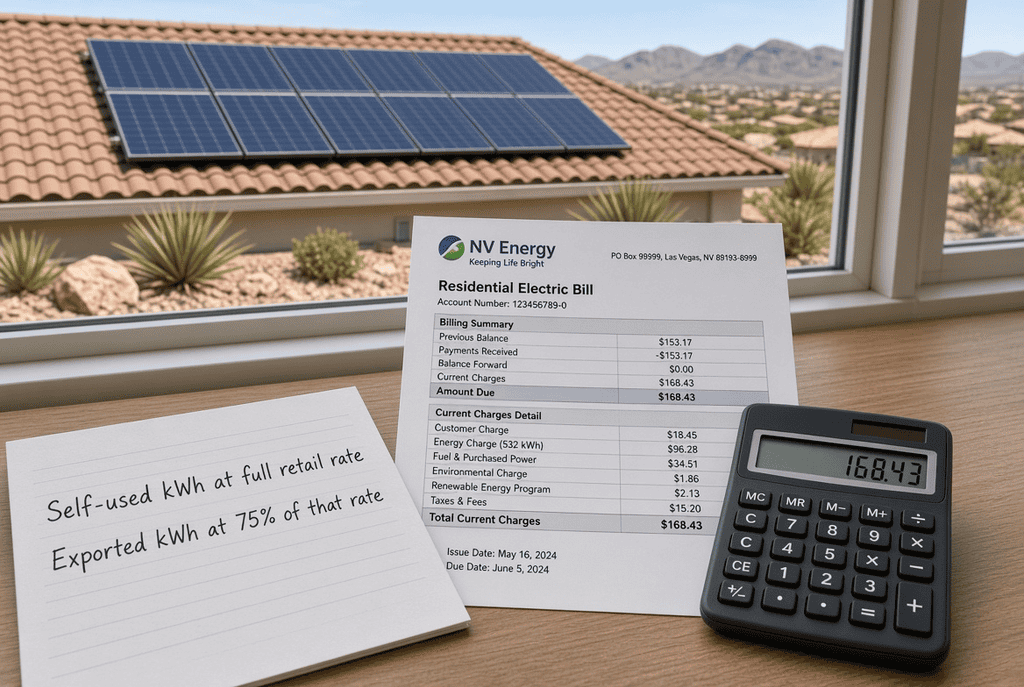
No false utility-rate claims. Clean energy financiers and contractors are strictly prohibited from making false or deceptive claims regarding utility electricity rates and export credit compensation. The law explicitly bans sales assertions claiming that NV Energy purchases surplus residential solar power at full retail value. To maintain regulatory compliance, all marketing and verbal representations must accurately portray Nevada’s statutory net-billing tariffs, which cap solar export credits at 75 percent of the prevailing retail rate.
Immediate copy. Contractors and financiers are legally obligated to furnish property owners with an exact, complete copy of the signed agreement immediately after execution. Effective for all clean energy contracts finalized on or after October 1, 2025, the law mandates that all required statutory disclosures appear within the executed document provided at the point of sale, explicitly barring the practice of deferring essential disclosures for post-execution delivery.
What SB 379 Does Not Change
To prevent consumer confusion, state regulators highlight what Senate Bill 379 does not do within Nevada’s broader energy landscape:
- Utility Tariffs (NMR-405): Maintains Southern Nevada’s 75% export compensation rate, monthly netting rules, and 20-year premise lock, alongside Northern Nevada’s 15-minute interval netting.
- Federal Incentive Rules: Establishes no state tax credits and does not reinstate the expired federal Section 25D tax credit ($0 credit for owner-occupied installations completed after December 31, 2025).
- Bill Structure & Fees: Preserves all fixed customer charges, TOU rate windows, and daily demand charge mechanics.
- Licensing & Tax Statutes: Retains existing property tax exemptions under NRS 361.079 and core installer licensing rules under NRS Chapter 624, focusing solely on lender verification duties and consumer disclosure mandates.
How to Use These Rules When You Sign
Enforceable for all residential distributed generation contracts executed on or after October 1, 2025, Nevada Senate Bill 379 shifts the legal standard for clean energy transactions. Regulators advise homeowners to view the agreement as a strictly governed compliance document rather than a routine form to initial, ensuring all statutory disclosures, production baselines, and cancellation rights are fully integrated into the paperwork before execution.
Confirm the parties and the licenses. Valid clean energy transactions require explicit identification and licensing verification for all participating entities, including financiers, installation contractors, and lead generation sources. Property owners are advised to obtain the financier’s state installment-lender license details and the contractor’s NRS Chapter 624 license number and monetary limit. Because SB 379 legally mandates that financiers verify installer credentials prior to funding, a lender’s failure to prove license verification constitutes a regulatory violation. Installer licensing statuses can be verified directly via the Nevada State Contractors Board website.
Read the rescission language. Prospective clean energy buyers are advised to verify that all statutory cancellation rights are clearly printed in contract paperwork prior to signing. Agreements executed on or after October 1, 2025, must explicitly disclose the standard three-business-day rescission window, the extended ten-business-day period for senior citizens aged 60 and older, and the additional three-business-day right following material post-survey modifications. If an agreement omits these disclosures or asserts truncated timelines, consumers should refuse execution until a legally compliant contract is issued.
Look for the verbal-confirmation and recording requirement. Clean energy installations cannot be scheduled until the financier or contractor completes a recorded verbal confirmation with the property owner. Applicable to all agreements finalized on or after October 1, 2025, the law mandates an audio-recorded verification of the customer’s identity and key contractual obligations. Regulators advise consumers to ensure the contract references this recorded-call requirement, clarify when the verification will take place, and obtain instructions for accessing the archived audio record.
Check the payment-timing clause. Clean energy financiers and contractors are legally barred from releasing or collecting bulk project funds prior to utility interconnection. Effective for all agreements executed on or after October 1, 2025, the law mandates that the vast majority of contract funds be held until the public utility issues formal Permission to Operate (PTO) or an off-grid system passes final inspection. Initial deposits are strictly capped at $1,000 or 10 percent of the total contract value, rendering upfront full-payment terms unlawful.
Review the production estimate and shortfall language. Residential clean energy agreements must feature prominent written disclosures specifying the system’s projected first-year kilowatt-hour output and the installer’s legal duties in the event of a generation shortfall. Applicable to all financing, lease, purchase, and power purchase agreements signed on or after October 1, 2025, the law establishes the contract’s first-year figure as the binding legal benchmark for underperformance remedies. Consumers are urged to preserve copy-of-record paperwork to cross-reference real-world system yield against contractually guaranteed performance figures.
Get the immediate copy. Clean energy providers are legally required to provide property owners with an exact, fully executed copy of their contract immediately following signature. Regulators advise consumers to refuse completion of sales meetings or digital consultations until the final document is in hand. Immediate receipt ensures that key statutory disclosures—such as agreement duration, estate succession terms, property transfer protocols, warranty coverage, and referral markups—can be thoroughly audited within statutory rescission windows.
Thank you for reading! If you have any feedback or a specific Nevada solar topic you’d like us to cover next, please reach out directly at admin@nevadasolarguide.com.