For many Las Vegas homeowners pursuing solar installations, municipal permitting remains a primary bottleneck. While equipment procurement, physical installation, and utility interconnection often proceed smoothly, city and county permit approvals frequently stall. Compounded by variable field inspection schedules, these administrative delays can extend project timelines by weeks or months—directly delaying utility bill savings during peak summer production months when residential power demand reaches its annual high.
Introduced on January 8, 2026, by Rep. Susie Lee (D-NV-3) alongside bipartisan cosponsors Reps. Juan Ciscomani (R-AZ), Paul Tonko (D-NY), and Mike Lawler (R-NY), the Streamlining Home Installation of New Energies (SHINE) Act of 2026 (H.R. 6981) targets administrative bottlenecks in local energy permitting. The proposed legislation directs the U.S. Department of Energy to assist municipal governments in adopting voluntary, standardized permitting and inspection workflows for residential distributed energy systems. The measure currently awaits consideration before the House Committee on Energy and Commerce.
Note: To keep up with fast-moving solar trends in Nevada, I use AI tools to help with research and writing. Every post is personally reviewed and edited by me.
What the SHINE Act Is
At its core, the legislation directs the Secretary of Energy to establish a federal program aimed at expanding and accelerating the adoption of voluntary, streamlined permitting and inspection workflows. Within 180 days of enactment, the Department of Energy—consulting with industry trade associations alongside state, local, and Tribal government organizations—must provide municipal permitting departments with standardized tools to fast-track residential clean energy approvals.
Crucially, participation in the program is entirely voluntary. The legislation places no federal mandates on Clark County, Las Vegas, Henderson, North Las Vegas, or any other Nevada jurisdiction to alter local building codes. Rather than forcing compliance, the bill offers technical assistance, educational resources, and modest financial incentives, leaving municipal building departments to decide if and when to adopt the streamlined framework.
The core mechanism of the legislation is a standardized online platform designed to enable municipal governments to receive, review, and issue residential energy permits digitally. The initiative builds directly upon the National Renewable Energy Laboratory’s SolarAPP+ software, which can automatically approve code-compliant solar and battery storage applications. With fewer than 500 of the nation’s more than 20,000 local building departments having automated their permitting workflows, the bill seeks to address this widespread digital adoption gap.
Expanding beyond software deployment, the program requires the Department of Energy to establish measurable adoption targets, deliver technical support, and train municipal staff—including guidance on necessary building code updates. The legislation also introduces a voluntary inspection framework to modernize field reviews. This protocol incorporates remote verification pathways, sample-based auditing for contractors with proven track records, and seamless integration into existing municipal permitting software.
Rather than relying on unfunded federal mandates, the legislation uses financial incentives to encourage municipal participation. The Secretary of Energy receives authority to grant official certification to compliant jurisdictions, run competitive prize programs, and issue direct financial grants to cover local transition costs. To fund these efforts, the bill authorizes $20 million annually across fiscal years 2027 through 2030.
Qualifying Systems: Solar, Batteries, Chargers
Under the bill’s provisions, a “qualifying distributed energy system” is defined as any equipment or materials installed in, on, or near a residential property to support onsite or local energy consumption. The statutory language is tailored specifically to residential installations common among Nevada homeowners, explicitly excluding utility-scale energy projects.
It specifically includes four categories:
- Solar photovoltaic systems or similar solar energy technologies. This covers conventional rooftop arrays, whether on composition shingle or tile, and the inverters or microinverters that go with them. It also covers systems installed near a residential building, such as a ground-mounted array serving a home on the same property. It does not cover commercial carports or large desert solar farms.
- Wind power systems. Small residential or near-home wind turbines fall inside the definition. Utility-scale wind does not.
- Batteries with a capacity of at least 2 kilowatt-hours. This threshold is low enough to include most residential storage products currently sold in Nevada — Tesla Powerwall 3, Enphase IQ Battery, FranklinWH, and smaller modular units. A 2 kWh minimum keeps out tiny backup packs that are not intended as whole-home or significant load-shifting storage. Paired solar-plus-storage systems qualify.
- Equipment to charge a plug-in electric vehicle at a power rate of at least 2 kilowatts. This captures standard Level 2 wall chargers (typically 7.2 kW or higher in practice) while excluding Level 1 trickle chargers that plug into a regular household outlet. Hydrogen fuel-cell vehicle refueling equipment is also listed, though it is rare in residential Nevada settings.
The statutory focus centers strictly on residential, localized energy production. To qualify, a system must be installed in, on, or adjacent to a residential property and serve primary energy consumption at that site. A residential system that exports excess generation back to the electrical grid remains eligible under the bill, whereas systems serving commercial or multi-tenant commercial properties are explicitly excluded.
For local homeowners, the bill’s scope encompasses the full suite of residential clean energy upgrades, including standard 6–10 kW rooftop solar arrays, 10–20+ kWh battery storage units, and Level 2 EV chargers. While the streamlined workflow focuses exclusively on accelerating municipal building and electrical permit approvals, it leaves NV Energy’s separate utility interconnection process untouched.
Because statutory eligibility is tied strictly to residential structures and onsite energy generation, the tools developed by the Department of Energy under the SHINE Act target municipal building departments handling home solar and storage applications—rather than federal agencies, such as the Bureau of Land Management, or utility-scale siting authorities.

What DOE Would Build (Platform, Inspections, Training)
Rather than offering high-level recommendations, the SHINE Act mandates concrete deliverables. Within 180 days of enactment, the Department of Energy must establish a formal program to supply local permitting offices with actionable, voluntary tools for immediate implementation.
Beyond tool development, the SHINE Act mandates that the Department of Energy establish measurable adoption targets. Rather than prescribing federal mandates, these goals create a framework for tracking national progress. They offer local building departments a benchmark for modernization while providing installers and solar advocates a tangible standard to reference when encouraging municipal adoption.
Technical assistance and staff training serve as central pillars of the program. Under the bill, the Department of Energy would deliver guidance directly or through partner organizations to ensure local officials are fully versed in the online platform, revised inspection protocols, and necessary building code updates. Crucially, the initiative provides upfront education on residential solar systems, battery storage, and Level 2 EV chargers, ensuring permit reviewers do not encounter the technology for the first time on an active application. The legislation specifically targets jurisdictions where local building codes have lagged behind current market hardware.
Streamlining physical site inspections forms a second major workstream under the bill. The Department of Energy is tasked with developing voluntary inspection protocols and technical tools designed to reduce backlogs. Specifically, the legislation directs the agency to evaluate remote verification—such as photo or video documentation—and sample-based auditing for installers with proven track records of quality work. The program also prioritizes integrating these pathways into existing municipal software, allowing local authorities to reduce routine site visits while shifting inspector resources toward higher-risk or more complex projects.
To drive municipal adoption, the legislation authorizes the Secretary of Energy to certify participating jurisdictions and distribute competitive prize awards. Funded through the bill’s $20 million annual authorization, the certification framework is designed to leverage existing Department of Energy programs rather than establish a new administrative bureaucracy.
Funding and Timeline
The SHINE Act authorizes $20 million annually across fiscal years 2027 through 2030, representing up to $80 million in total funding over four years. In federal budgeting, however, statutory authorization creates the legal mechanism for program spending but does not guarantee funding. Actual disbursement will depend on whether future sessions of Congress formally appropriate the capital in annual spending legislation.
The authorized funding is earmarked specifically for operational and technical implementation: building and expanding the digital permitting platform, providing technical assistance and staff training to municipal offices, supporting software integration with legacy local government systems, administering the certification framework, and funding prize competitions to drive adoption. The legislation does not establish a homeowner rebate program or provide direct equipment subsidies for solar hardware; rather, it supplies administrative and technical resources exclusively to participating local jurisdictions.
Upon enactment, the legislation mandates a 180-day deadline for the Department of Energy to establish the core program framework. That statutory timeline begins on the date the bill is signed into law—not its date of introduction. While the 180-day window sets an outer bound for the agency to deploy the initial online platform, educational materials, and voluntary inspection protocols, widespread local adoption will follow a longer trajectory. Participating municipal building departments will still require additional time to integrate software platforms, train permit counter personnel, and formally opt into the program.
As of late October 2026, H.R. 6981 remains before the House Committee on Energy and Commerce, where it awaits a formal committee hearing or markup session. Passage in the 119th Congress is far from guaranteed given tight legislative calendars. Even if the measure advances or is reintroduced and enacted in 2027, the earliest the Department of Energy’s software and guidelines could be deployed to Nevada jurisdictions would follow the mandatory 180-day administrative startup period, with local municipal adoption adding a secondary layer to the timeline.
For homeowners planning a solar or storage installation in 2026, the SHINE Act’s legislative timeline means the proposed bill should not delay investment decisions. Any project contracted or submitted in 2026 will proceed under existing municipal permitting and inspection workflows. While future enactment and local adoption of the platform could eventually streamline approvals, current applicants must navigate the local administrative processes in place today.

How This Differs from Other 2026 Energy Bills
By design, the SHINE Act remains strictly focused on residential, localized energy systems. It is distinct from the comprehensive, macro-level Senate permitting overhaul introduced in late October 2026—the Bipartisan American Affordability and Jobs Act of 2026 (BAAJA). That sweeping Senate package targets federal environmental and regulatory frameworks, modifying National Environmental Policy Act (NEPA) timelines, Clean Water Act and Endangered Species Act consultation procedures, 150-day judicial review windows, and Federal Energy Regulatory Commission (FERC) backstop authority for interstate transmission. While BAAJA addresses utility-scale generation, major pipelines, mining, and interstate grid infrastructure, the SHINE Act omits federal land and grid regulations entirely, focusing exclusively on streamlining municipal building permit counters for rooftop solar and home battery systems.
The SHINE Act is also distinct from legislative proposals targeting plug-in or balcony-style solar energy systems. For instance, the Socket Full of Sunshine Act—introduced in the House in October 2026—seeks to compel states to evaluate removing interconnection barriers for small-scale plug-in kits that connect via standard household outlets, while authorizing Department of Energy rebate funding for low- and moderate-income households. While plug-in kits are engineered to bypass traditional rooftop permitting and utility interconnection procedures, the SHINE Act addresses conventional residential infrastructure: rooftop solar arrays, battery storage systems, and Level 2 electric vehicle chargers that require formal municipal building and electrical permits. The SHINE Act establishes no consumer rebates and leaves utility interconnection frameworks intact.
For Southern Nevada homeowners, the practical distinction among these federal proposals comes down to regulatory jurisdiction. Federal legislation designed to compress NEPA review timelines for a 200-megawatt desert array or expand FERC siting authority for high-voltage transmission lines has no direct impact on Clark County’s residential permit processing times. Similarly, legislation establishing rebates for small plug-in solar kits provides little utility for residents installing standard rooftop arrays paired with home battery storage. Among current federal proposals, the SHINE Act uniquely targets the local municipal permitting and inspection counter—the specific regulatory checkpoint every traditional residential solar and battery installation in Las Vegas, Henderson, and North Las Vegas must pass.
What It Does Not Change for NV Energy Customers
While the SHINE Act addresses administrative efficiency at the local permit counter, it does not alter utility rate structures or net metering policies. The legislation focuses strictly on accelerating municipal building reviews and site inspections; it leaves untouched the utility regulations and tariff designs that govern post-installation compensation and long-term financial return for solar systems.
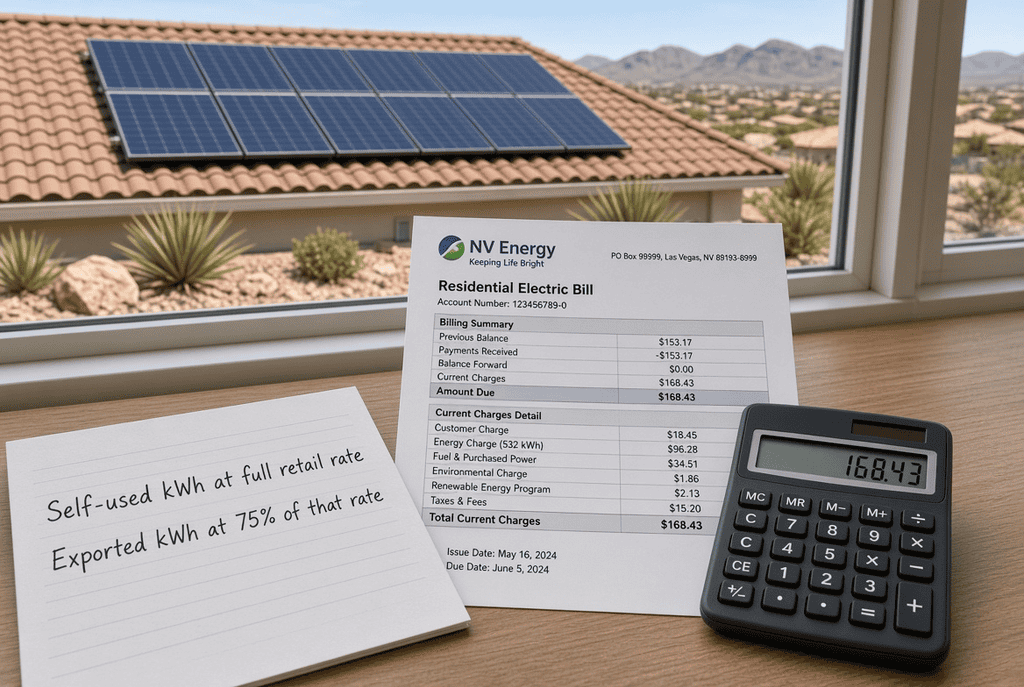
The legislation leaves NV Energy’s existing net metering rules entirely intact across Southern Nevada. Under the current Northern and Southern Nevada Net Metering Rider (NMR-405) Tier 4 framework, new residential solar systems continue to receive a 75% credit based on the prevailing volumetric energy rate for excess generation. This export credit rate remains locked to the property premises for 20 years, with netting calculated on a monthly basis across NV Energy’s southern territory. Similarly, Northern Nevada’s 15-minute export netting structure under NMR-2025 remains unaltered.
The legislation also contains no tax provisions and does not reinstate the federal residential clean energy credit under Section 25D of the Internal Revenue Code. Under current tax law, owner-occupied systems completed after December 31, 2025, remain ineligible for federal residential tax credits. Because the SHINE Act focuses exclusively on municipal permitting workflows rather than fiscal policy, homeowners postponing installation in hopes that the bill will revive the 30% federal tax credit will find no tax relief in the measure.
Crucially, the legislation does not alter utility grid interconnection protocols. Interconnection filings submitted to NV Energy, the utility’s PowerClerk portal workflows, engineering review stages, and the issuance of the formal Permission to Operate (PTO) letter remain entirely separate from municipal jurisdiction. While an automated local permitting counter might approve a building plan in a single day, it does not accelerate NV Energy’s independent engineering review of the interconnection package. Municipal building code enforcement and utility grid interconnection operate in distinct regulatory queues.
The legislation similarly leaves NV Energy’s underlying rate structures and fixed billing components entirely unchanged. It does not modify demand charge calculations, optional Time-of-Use (TOU) rate schedules, or monthly basic service charges. In Southern Nevada, where optional residential demand tariffs apply, net metering credits remain strictly limited to volumetric energy charges and cannot offset daily demand fees. Likewise, the peak pricing window—such as the 6:01 p.m. to 9:00 p.m. summer TOU period—and the fixed customer service charge remain fully intact.
The SHINE Act also leaves Nevada tax treatment entirely unchanged. The state property tax exemption under NRS 361.079—which prevents the added value of a qualifying renewable energy system from increasing a home’s property tax assessment—and the established exemption of qualifying solar hardware from sales tax under state law remain fully intact. Because the proposed federal legislation contains no tax provisions, it neither alters nor expands existing state-level tax policies governing residential solar installations.
The legislation similarly has no bearing on state contractor licensing or professional credentialing requirements. Solar energy installers in Nevada must still maintain an active, bonded C-2 (Electrical Contracting) license issued by the Nevada State Contractors Board (NSCB). The SHINE Act contains no provisions establishing a federal solar installer credential, nor does it override, relax, or alter state trade licensing standards governing electrical contractors.
Practical Takeaways for Las Vegas Homeowners
Should the SHINE Act achieve federal enactment and secure voluntary local adoption, its tangible benefits for homeowners will manifest primarily as operational efficiencies rather than sweeping structural transformations.
The most direct consumer benefit is a substantial reduction in initial permit turnaround times. For routine residential solar or paired solar-plus-storage systems that conform to local building and electrical codes, an automated online platform can replace manual paper filings and multi-day completeness reviews with instant, rule-based verification. This capability enables same-day or next-day permit issuance—a critical efficiency in Southern Nevada, where capturing peak summer generation is paramount and installer schedules are tightly linked to municipal permit and inspection windows.
Increased predictability in post-installation inspection scheduling represents a second major operational gain. Under the SHINE Act, the Department of Energy’s voluntary inspection protocol incorporates modernized compliance tools, including remote video verification and sample-based auditing for contractors with proven safety records. Local jurisdictions adopting these options can reduce physical site visits for routine, code-compliant installations — significantly compressing the time between physical mounting and final municipal sign-off.
A less visible but highly consequential operational efficiency is the reduction of administrative back-and-forth caused by incomplete filings. By embedding automated completeness checks into the intake software, the system flags missing single-line diagrams, missing spec sheets, or omitted structural documentation prior to formal queue entry. Eliminating these common intake errors prevents applications from being rejected or returned, saving contractors and property owners from tedious resubmission cycles and avoiding preventable processing delays.
These operational benefits remain strictly conditional, contingent upon voluntary adoption by local municipal building authorities. Until local governing bodies—such as Clark County or the cities of Las Vegas, Henderson, and North Las Vegas—elect to integrate the federal software framework and adopt its inspection protocols, current permitting procedures remain unchanged. Industry advisors recommend that prospective solar customers ask their installation contractor two key questions prior to executing a contract: whether the local jurisdiction currently utilizes SolarAPP+ or equivalent automated permitting software, and whether SHINE Act tools are expected to be active for their specific project. For contracts signed in 2026, the realistic assessment across Southern Nevada remains no.
Thank you for reading! If you have any feedback or a specific Nevada solar topic you’d like us to cover next, please reach out directly at admin@nevadasolarguide.com.