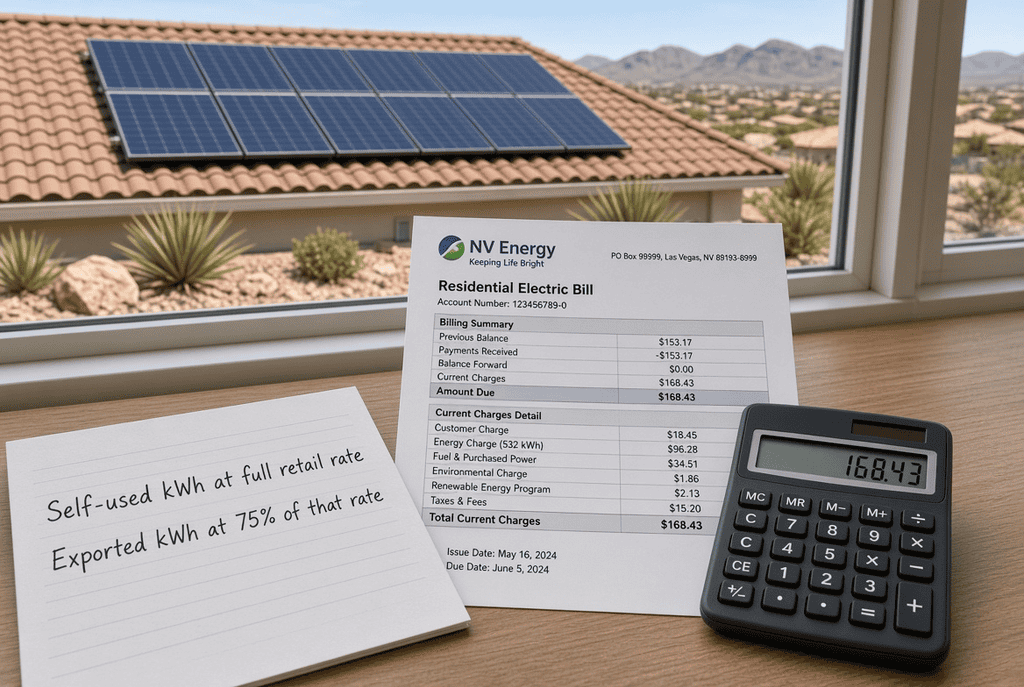
The NV GreenEnergy Rider (NGR) is a voluntary utility tariff that allows NV Energy customers to match a selected percentage of their electricity consumption with dedicated renewable generation. Approved by the Public Utilities Commission of Nevada (PUCN), the program is available in both the Nevada Power (southern Nevada) and Sierra Pacific Power (northern Nevada) service territories.
Note: To keep up with fast-moving solar trends in Nevada, I use AI tools to help with research and writing. Every post is personally reviewed and edited by me.
The Two Participation Options
The NV GreenEnergy Rider (NGR) is divided into two distinct participation tracks. Eligibility for each track depends on customer class—residential or commercial—and, for the second track, on the size of the customer’s electricity demand. See below for more details:
Existing Renewable Resources
The Existing Renewable Resources track is open to all customer classes—including residential households, small businesses, and large industrial accounts—with no minimum demand requirement. Under this option, a customer selects a match of either 50 percent or 100 percent of monthly electricity usage with generation from renewable facilities already under contract with NV Energy and in operation. NV Energy retires the corresponding Portfolio Energy Credits on the customer’s behalf.
Contract terms differ by account type. Commercial and industrial customers typically enroll for one-year terms that are renewed during NV Energy’s annual open season. Residential participation continues on a month-to-month basis until the customer cancels. This track requires no project development or site identification by the customer; it allocates a share of clean energy attributes from renewable assets already in the utility’s portfolio.
New Renewable Resources
The New Renewable Resources track is available only to qualifying large commercial and industrial customers. To qualify, a business must maintain an average annual demand of 1 megawatt (MW) or greater. Companies with multiple facilities under the same ownership may aggregate their loads across different premises to meet that threshold.
Unlike the existing-resource option, participants in this track work directly with NV Energy to identify and assign a dedicated new renewable project to serve their load. This requires a special contract with the utility, which must be filed with the Public Utilities Commission of Nevada (PUCN) along with the underlying generation project if it has not already been approved. Regulators will approve the agreement only if it is found to be in the public interest and provides clear financial or system benefits to non-participating ratepayers. This pathway is intended to support the development of new renewable generation in Nevada rather than draw solely from the utility’s existing portfolio.
How Matching and Credits Work
The NV GreenEnergy Rider (NGR) operates as an environmental credit-retirement program rather than a physical power-delivery arrangement. Because electricity on the shared grid cannot be physically routed from a specific renewable facility to an individual customer, enrollment does not change the electricity delivered to the home or business. When a customer enrolls and selects a matching percentage—most commonly 50 percent or 100 percent—NV Energy tracks the customer’s total kilowatt-hour usage each month and permanently retires an equivalent volume of Portfolio Energy Credits (PECs) on the customer’s behalf. That retirement ensures the clean energy attributes associated with the selected usage level are claimed exclusively for the account and cannot be double-counted.
The sequence of credit retirement is intentional. NV Energy first retires the Portfolio Energy Credits (PECs) required by state law to meet Nevada’s Renewable Portfolio Standard (RPS)—currently 34 percent in 2026, rising to 50 percent by 2030. Only after that statutory obligation is fully met does the utility retire the separate pool of credits reserved for NV GreenEnergy Rider subscribers. Because Rider credits are retired in addition to standard compliance and are not double-counted toward the state quota, participation creates incremental renewable demand. A subscriber can claim that the selected percentage of electricity usage is matched with renewable generation, supported by the permanent retirement of those dedicated credits.
NV Energy’s tariff and customer agreements state that the utility retains ownership of the underlying energy and generating capacity from the renewable facilities. The Rider is an accounting and environmental-attribute transaction: the customer pays the supplemental Rider fee, and NV Energy permanently retires the matching renewable credits on the customer’s behalf.
Because monthly credit retirement is calculated from actual electricity consumption, the number of credits retired rises and falls with seasonal power use. For example, a customer on a 100 percent matching tier will trigger more credit retirements in a high-usage summer month than in a mild spring or fall month. The subscription is subject to a ceiling. Annual or contract subscription volume is capped at the level the customer specifies. Renewable matching therefore cannot automatically exceed the subscribed volume, even if electricity consumption rises above that level during a heatwave.

Costs and How the Rate Is Set
Enrollment in the NV GreenEnergy Rider (NGR) does not replace the regular utility bill; it adds a supplemental charge. Enrolled customers continue to pay every charge that appears on their normal rate schedule, including the basic service charge, base energy rates, and standard surcharges. In addition to those ordinary charges, the customer pays the GreenEnergy Rider rate—a small per-kilowatt-hour adder applied only to the matched percentage of monthly electricity usage (50 percent or 100 percent). The Rider rate is not a substitute for NV Energy’s base tariff energy rate. It is an incremental cost that covers the retirement of dedicated renewable energy credits on the customer’s behalf.
The rate is calculated from the average cost of the renewable resources used to support the program. In simplified terms, the utility determines the average cost per kilowatt-hour of the relevant renewable contracts, then subtracts certain base energy and temporary renewable charges so that participants are not charged twice for the same attributes. The resulting figure becomes the Rider rate. The tariff states that this rate cannot be zero or negative. Because the underlying contract costs change over time, the Rider rate is updated on a periodic cycle—historically quarterly or annually—and is published in NV Energy’s rate schedules.
In practice, enrollment in the NV GreenEnergy Rider (NGR) typically adds a fraction of a cent per kilowatt-hour to the electricity bill. Recent northern Nevada residential rate inserts have listed the Existing Renewable Resource Rate at $0.00241 per kWh. At that rate, a household using 1,000 kWh in a month would pay less than $2.50 extra to match 100 percent of its usage with renewable energy credits. Exact pricing depends on the service territory (southern or northern Nevada) and the specific renewable contracts assigned during a given program year. Customers should verify the current figure in the applicable rate schedule or on the monthly utility bill after enrollment. NV Energy establishes annual program pricing and megawatt capacity limits through a regulatory filing due on or before April 15. Updated rates and caps take effect around July 1 and remain in place through the following June 30.
Enrollment Process and Capacity Limits
NV Energy holds an annual open season for the NV GreenEnergy Rider (NGR) that normally runs from November 1 through November 30 for the upcoming program year. During that window, interested customers must submit a signed letter of intent to secure participation. This typically requires completing a form, signing it, and emailing it as a PDF to the utility’s designated program address (commonly GreenEnergy@nvenergy.com or the contact listed on NV Energy’s open-season web page). The submission must include basic account details, total annual energy consumption, and the specific matching percentage or kilowatt-hour volume the customer wishes to commit.
Submitting a letter of intent does not automatically guarantee a place in the NV GreenEnergy Rider (NGR). NV Energy generally approves applications when total customer demand remains within the program’s available capacity for the service territory, but capacity is limited. If total applicant volume exceeds the available megawatt-hours in either the Nevada Power (southern Nevada) or Sierra Pacific Power (northern Nevada) territory, the utility allocates the finite capacity according to established program rules, which may include a lottery. Because program caps are set by annual regulatory filings, enrollment is first-come, first-served up to the capacity limit. Timely submission during the November open season is therefore important.
Recent open seasons have offered roughly 45,000 to 50,000 megawatt-hours (MWh) in northern Nevada and 100,000 to 140,000 MWh in southern Nevada—enough combined capacity to serve approximately 50 to 60 megawatts (MW) of demand. Exact capacity figures are established through NV Energy’s annual regulatory filing and can change from year to year.
Once an application is accepted, NV Energy issues a formal Renewable Energy Agreement that specifies the applicable tariff rules, the chosen matching percentage (50 percent or 100 percent), the subscribed kilowatt-hour volume, and the active Rider rate. The duration of the commitment depends on account type. Residential agreements typically continue automatically until the customer cancels. Commercial and industrial agreements are usually structured as one-year terms that must be renewed during a subsequent November open season.
Thank you for reading! If you have any feedback or a specific Nevada solar topic you’d like us to cover next, please reach out directly at admin@nevadasolarguide.com