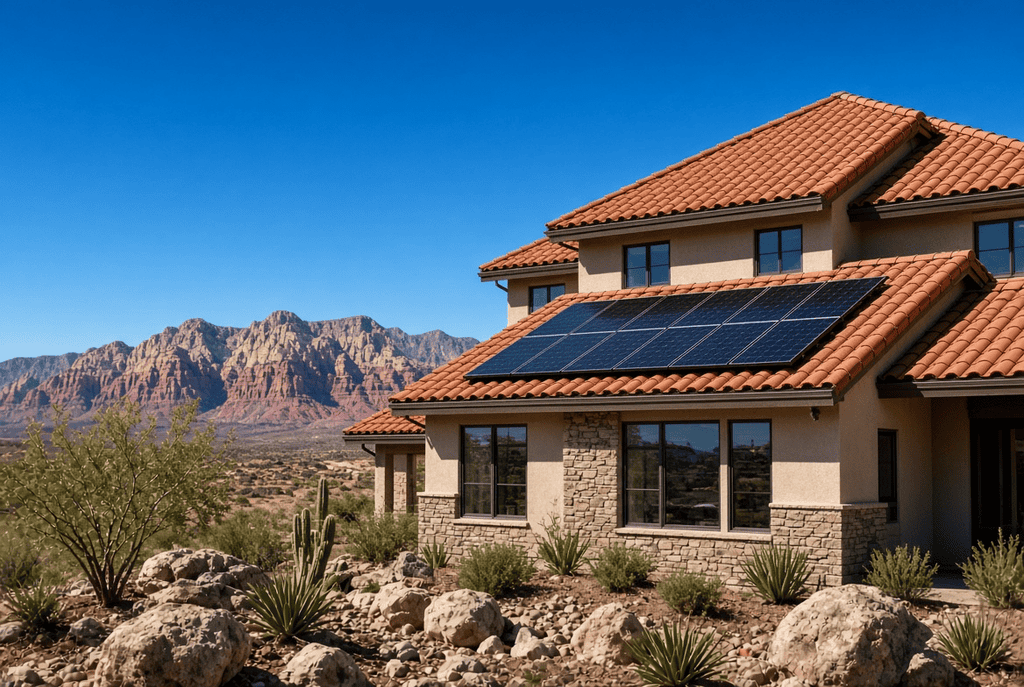
Which lasts longer in Clark County heat is not a number on the box. It is how many kilowatt-hours the panel still makes in a 115°F July, how many watts it promises in year 25, and whether anyone answers if a module yellows in ten years. For a fair 2026 comparison, leave the old Q.PEAK DUO PERC bids out. The matchup is Qcells Q.TRON, a TOPCon panel, against the REC Alpha Pure-RX, a heterojunction (HJT) panel. Both are current n -type top-tier panels, and both beat leftover p-type PERC once the roof hits 65°C. They are not the same panel. This is a datasheet-meets-desert reality check, not a sterile lab test. Before you sign anything, double-check the stock keeping unit (SKU) on your installer’s quote to make sure you’re getting these newer N-type panels.
Note: To keep up with fast-moving solar trends in Nevada, I use AI tools to help with research and writing. Every post is personally reviewed and edited by me.
The Nevada Desert Solar Battle: It All Comes Down to the SKU
Seeing just “Qcells” or “REC” on a solar quote is like buying a car listed only as “Toyota.” You need the exact SKU and model string. In the Mojave, thermal performance is dictated by cell type, not marketing. Vague labels like “Qcells 400W” frequently disguise aging p-type PERC inventory—older panels that degrade quicker and bleed efficiency when your roof hits 150°F. If an installer balks at handing over the precise datasheet with the full model number, walk away. You can’t buy what you can’t verify.
To compare your bids, line up the specs side by side: the full model number, the heat loss rating (gamma), the 25-year output floor, and whether the installer tier affects the warranty. A 430W panel and a 460W panel have different physical footprints and starting outputs, so look at expected annual kilowatt-hours (kWh) and roof space efficiency—not just which brand sounds better. The SKU is the only honest way to shop. Until you have the full product string on paper, you don’t know what panel you’re putting on your roof.
Heat: The Afternoon That Ages the Array
Standard testing rates panels at 77°F (25°C). But on a hot July afternoon, flush-mounted roof panels easily reach internal cell temperatures between 140°F and 158°F (60°C to 70°C). Using a realistic 149°F (65°C) spike—which is 40°C hotter than standard test conditions—here is what the heat takes from each panel:
- REC Alpha Pure-RX (-0.24%/°C): Loses 9.6% of its rated power.
- Qcells Q.TRON BLK M-G2+ (-0.30%/°C): Loses 12.0% of its rated power.
- Older Q.PEAK DUO PERC (-0.34% to -0.35%/°C): Loses 13.6% to 14.0% of its rated power.
On an 8 kW system, that thermal penalty means you lose about 770 watts on the REC system, 960 watts on the Q.TRON, and over 1,120 watts on an older PERC system. That isn’t a loss measured over 25 years—that is a loss in a single hour.
For more details on solar panels, explore our 2026 guides on top budget solar panels for Nevada, best solar panel mounting systems, and a solar panel cost guide.
Degradation Warranties vs. Real-World Aging
A 25-year performance rating is not a picture of your roof in 2051. It is the lowest output the company will stand behind, if you can file the claim.
What the Spec Sheets Guarantee
| Warranty Metric | REC Alpha Pure-RX | Qcells Q.TRON BLK M-G2+ |
| Year 1 Output Floor | 98.0% | 98.5% |
| Annual Degradation (Years 2–25) | 0.25% / year | 0.33% / year |
| Year 25 Guaranteed Floor | 92.0% | 90.58% |
On paper, REC guarantees more remaining wattage at year 25. However, Qcells starts with a minor advantage in year one but degrades slightly faster over time. However, neither of these facts measures how well the panel types hold up against Mojave dust, wind, and heat.
What Ages a Panel in the Desert
A warranty sheet doesn’t list the factors that degrade hardware in Nevada. Real degradation comes from:
- UV damage bleaching the protective backsheet.
- Extreme thermal cycling from 45°F desert nights to 110°F summer days.
- Rapid humidity spikes when a quick monsoon rain is immediately followed by a 105°F bake.
- Hot spots caused by baked-on bird droppings or cracked cells.
- Micro-cracks in the glass caused by mounting rails expanding and bending in the heat.
When these issues happen, it does not show up on a lab chart. It shows up as one weak panel in the monitoring app.
How Warranty Claims Work in Practice
To use a warranty, you need a monitoring system that tracks individual panels, a properly registered installation, and a contractor willing to swap out hardware.
- REC’s 92% guarantee is only useful if your installer activated the ProTrust Warranty program. Skip that registration, and your product coverage drops.
- Qcells’ 90.58% guarantee relies on Hanwha’s massive manufacturing scale staying intact—which is a strong bet given their heavy US investments, but it still requires dealing with corporate warranty claims.

Durability Beyond the Cell
REC’s Alpha Pure-RX claims heavy-duty front-load specs up to 7,000 pascals with four-point clamping, while Qcells’ Q.TRON hits between 5,400 and 8,100 pascals based on mounting geometry. For context, 5,400 pascals can handle over 110 lbs/sq.ft which far exceeds Clark County’s wind load codes. Those high-pressure numbers come with a massive asterisk: they only hold true if the rails and mid-clamps match the engineering manual specifications. Cut corners with improvised mounting, and those certified load ratings disappear. Always ask for the racking brand and layout map from your contractor. A spec sheet rating is laboratory theory; how it’s bolted to your rafters is desert reality.
Glass, Backsheets, and Frames
Both brands offer sleek, all-black designs that satisfy strict HOA guidelines. But physical builds vary by exact model:
- REC’s HJT design utilizes specialized polymer backsheet construction engineered for thermal stability.
- Qcells’ Q.TRON series relies on reinforced frames designed for high structural rigidity.
Details like junction box design and bypass diode count are what keep your system running when a vent pipe shades a row of cells. Neither brand is immune to a cracked roof tile or a bad seal if the mechanical installation is sloppy.
What Fails First in the Valley
Service calls in southern Nevada are rarely about heterojunction versus TOPCon. They start with something else:
- Weathered electrical connectors degraded by intense UV exposure.
- Disturbed roof flashing around pipes that the install crew bumped while walking the roof.
- Microinverters or optimizers damaged during a rush-job installation.
- Heavy dirt buildup that looks like serious panel degradation on your monitoring app.
Company Backing & Labor Coverage
A 25-year performance floor holds only if the company behind it can pay a claim, and if a contractor will service the array.
Warranty & Backing at a Glance
- Qcells Q.TRON (N-type TOPCon):
- Base Product Term: 25 Years (Standard)
- Enhanced Product Term: N/A (Included by default)
- Labor Coverage: Capped Reimbursement via Q.PARTNER
- Parent Conglomerate: Hanwha Group
- REC Alpha Pure-RX (HJT):
- Base Product Term: 20 Years (Unregistered)
- Enhanced Product Term: 25 Years (REC ProTrust Only)
- Labor Coverage: 25 Years (REC ProTrust, systems under 25 kW)
- Parent Conglomerate: Reliance Industries
Qcells / Hanwha: The High-Volume Workhorse
Hanwha is a massive South Korean industrial conglomerate. That scale gives them strong financial stability, reducing the risk of a brand disappearing mid-warranty.
- The Standard Warranty: The Q.TRON comes with a straight 25-year product and 25-year performance warranty as standard—no special installer tiers required.
- The Labor Coverage: While installer network programs (like Q.PARTNER) offer labor support, it functions primarily as a capped reimbursement per warranty claim rather than a blank check for full truck-roll costs.
- The Supply Chain Factor: U.S. assembly on several Q.TRON product lines provides strong domestic availability. It doesn’t change the heat performance of the cell, but it does mean local installation crews are far more likely to carry matching replacement SKUs in stock.
REC / Reliance: Premium Protection with Fine Print
REC operates as a high-end specialty brand under its parent conglomerate, Reliance Industries.
- The Standard Warranty: The base product term on the Alpha Pure-RX is 20 years if installed by a non-certified installer.
- The ProTrust Upgrade: To get the full 25-year product warranty and up to 25 years of labor coverage (on residential systems under 25 kW), the system must be installed and registered by an REC ProTrust Certified Installer.
- The Fine Print: If your installer forgets to register the system or drops their certification, you end up with the shorter 20-year product term and zero direct labor coverage. That detail can get skipped when salespeople pitch a “25/25/25” package.
Labor in the Desert
Replacing a failed module on a Summerlin tile roof is not free. The permit, the lift, the HOA access rules, two technicians, and the chance of a cracked tile all land on the bill.
- REC’s ProTrust program offers a comprehensive labor —provided your contractor is actively certified and registers every serial number.
- Qcells’ labor coverage is more limited on paper, but because Q.TRON panels are everywhere, finding a local installer with stock to complete a quick warranty swap is often much easier in practice.
Neither company is a struggling startup; both are built to exist well into the 2030s. That corporate stability matters more than a 1.4% gap on a 25-year spec sheet.
What to Ask for in Your Solar Contract
Before signing a proposal, make sure the following items are explicitly listed:
- Installer NSCB License Number: Ensures the contractor is properly licensed in Nevada.
- Exact Model SKU: Confirms you are getting modern N-type hardware (e.g., Q.TRON or Alpha Pure-RX), not legacy inventory.
- Warranty Program Name: Explicitly states whether REC ProTrust or Q.PARTNER coverage applies.
- Registration Deadlines: Defines who is responsible for registering the array with the manufacturer.
- Labor Responsibility: Spells out who covers the truck-roll and labor costs if a module fails in year 11.

Head-to-Head Snapshot
Use this guide to evaluate your options. Always open the manufacturer’s official spec sheet for the exact model number before signing a contract.
Qcells vs. REC: Specification Comparison
| Specification | REC Alpha Pure-RX | Qcells Q.TRON BLK M-G2+ |
| Cell Tech | Heterojunction (HJT) | N-type TOPCon |
| Residential Output Bins | 450W–475W | 415W–440W |
| Temperature Coefficient (Pmax) | -0.24% / °C | -0.30% / °C |
| 65°C Cell Power Loss | ~9.6% | ~12.0% |
| Year 1 Output Floor | 98.0% | 98.5% |
| Annual Degradation (Years 2–25) | 0.25% / yr | 0.33% / yr |
| Year 25 Output Floor | 92.0% | 90.58% |
| Product Warranty | 20 yrs standard / 25 yrs ProTrust | 25 yrs standard |
| Labor Warranty | 25 yrs (ProTrust, systems <25 kW) | Capped reimbursement (Q.PARTNER) |
| Las Vegas Supply Stock | Limited / Specialty | High / Readily Available |
| Heat kWh Yield | Winner | Strong (Beats PERC; trails REC) |
| Warranty Paperwork | Requires certified installer registration | Winner (Standard out of the box) |
| Fine-Print Risk | Unregistered install drops product warranty to 20 yrs | Accidentally bidding legacy Q.PEAK DUO inventory |
Key Takeaways
- Peak Heat Performance: REC takes the top spot for minimizing power loss during high-temperature summer afternoons.
- Availability & Logistics: Qcells leads in local warehouse stock, keeping project start dates on schedule.
- Warranty Protection: REC offers superior 25-year labor coverage if your contractor is ProTrust certified; Qcells provides straightforward 25-year hardware coverage straight from the factory.
- Company Backing: Both Reliance Industries (REC) and the Hanwha Group (Qcells) offer massive corporate backing built to handle long-term warranty support.
Thank you for reading! If you have any feedback or a specific Nevada solar topic you’d like us to cover next, please reach out directly at admin@nevadasolarguide.com.