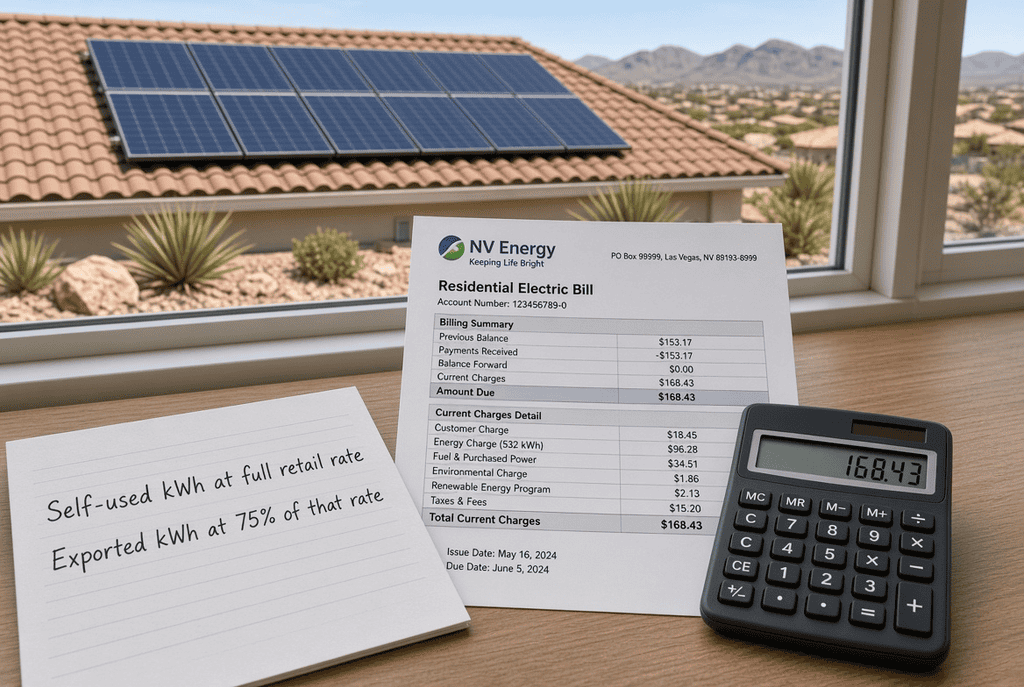
Putting solar on a Las Vegas, Henderson, or Summerlin roof today doesn’t mean getting the old 1-to-1 net metering of the 1990s. Instead, you get placed on NMR-405, Tier 4. Under this plan, any extra power your panels send back to the grid earns a credit worth 75% of the retail rate (minus public-policy fees), locked in for 20 years at your address. That’s still a decent export rate compared to the rest of the country, but it means using your power at home pays off much more than sending it away:
- Power used at home: Saves you 100% of the energy charge.
- Power exported: Returns as a 75% bill credit, which can’t be used to cover the basic monthly service fee.
What About 15-Minute Netting?
You may hear talk of 15-minute netting, but that rule mostly applies to Northern Nevada Sierra Pacific customers whose applications were approved on or after October 1, 2025. If you are a Southern Nevada Power customer under NMR-405, your bill is still calculated on a monthly netting basis. Installers sometimes mix up these rules and alarm Summerlin homeowners with requirements meant for Reno. Here is the real picture for Las Vegas: how the 75% rate works, what changed, and what stayed the same.
Note: To keep up with fast-moving solar trends in Nevada, I use AI tools to help with research and writing. Every post is personally reviewed and edited by me.
What Net Metering Means on an NV Energy Bill
Whenever the sun is up, your panels power your home first. Only the extra power you don’t use gets pushed out to the grid as an export. After sunset—or when your air conditioner outpaces your system—your house pulls power from the grid. The meter tracks both directions, and your net metering plan determines how those two numbers are compared.
The Comparison Window
In Southern Nevada, NMR-405 calculates your power use by comparing total imports and exports over the entire month. That means a surplus on a Tuesday afternoon can help offset energy used on a Friday night. In Northern Nevada, the NMR-2025 plan (for new Sierra Pacific applications filed after October 1, 2025) compares imports and exports in 15-minute intervals. While the 75% credit rate remains the same, there is far less wiggle room if your generation and energy use don’t match up within those short timeframes.
When You Still Owe Energy Charges
If your imports exceed your exports during the billing window, you pay the difference at the standard energy rate—the same rate a house without solar pays—plus any mandatory fees that credits can’t cover.
When You Bank a Credit
If you export more than you import, the extra kilowatt-hours turn into a dollar credit calculated at your plan’s specific tier rate. For a new system in Las Vegas, that’s 75% of the standard retail energy rate, excluding public-policy fees. This credit rolls over to help pay for future energy use. However, it cannot be applied to your basic service charge, extra meter fees, local taxes, or gas service. Even if you completely offset your energy charges, you will still receive a monthly bill for these fixed costs.
What This Is Not
- It isn’t a 1-to-1 retail swap for every single kWh your array produces.
- It isn’t a check in the mail. Power used inside your house never becomes an “export credit”—it simply avoids grid imports entirely, which gives you 100% of its value.
- It isn’t a free pass to skip proper utility interconnection or PowerClerk approval.
Ultimately, your bill comes down to three power streams: the energy you use directly at home (100% savings by preventing grid imports), the energy you pull from the grid (which you pay for), and the leftover surplus you export for a 75% credit coupon. That 75% credit helps bring down your bill, but keeping the power inside your house in the first place is always the most valuable move.
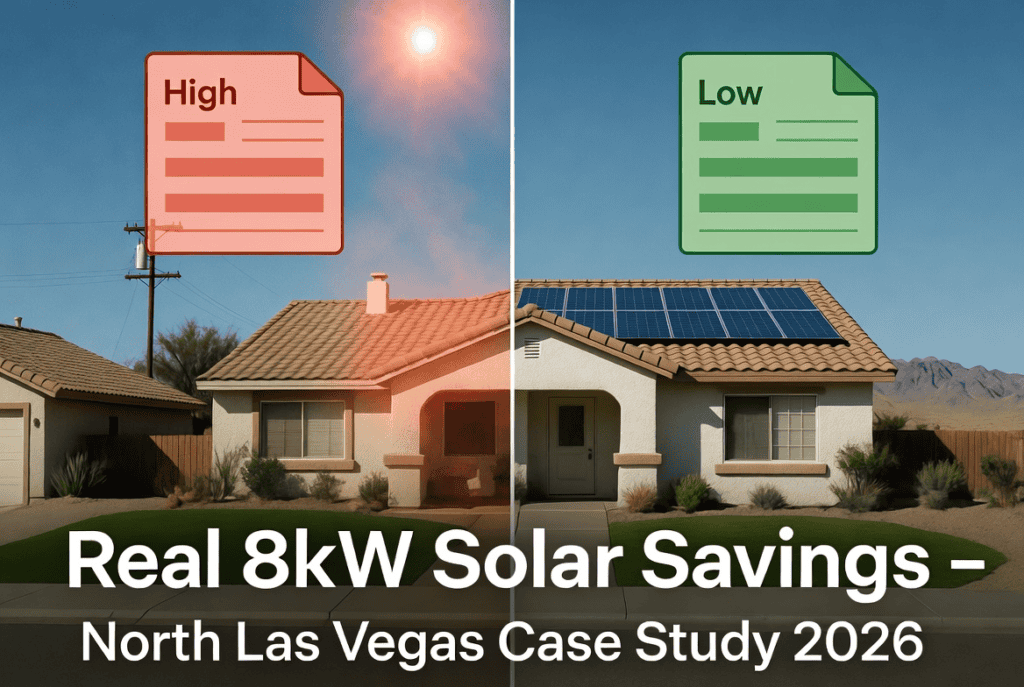
For more details on solar savings and incentives, explore our 2026 guides on the April 2026 demand charge, Federal ITC and Nevada tax exemptions, and the case study before & after an 8kW system.
NMR-405 Tier 4: The Las Vegas Default
If you are applying for a typical rooftop system (25 kW or smaller) in Nevada Power territory today, the program name on your paperwork will be Net Metering Rider-405, Tier 4. This isn’t a special promotional deal—it’s simply the final, permanent tier created by Nevada’s Assembly Bill 405.
How We Got to Tier 4
Following the net-metering debates of the mid-2010s, state lawmakers replaced full 1-to-1 retail credits with a series of declining tiers for residential solar. Each tier stayed open until combined capacity reached 80 megawatts:
- Tier 1 (95% credit rate): Closed around 2018
- Tier 2 (88% credit rate): Closed
- Tier 3 (81% credit rate): Closed
- Tier 4 (75% credit rate): Open permanently (no capacity cap)
Tiers 1 through 3 are long gone. If an installer promises you can “sign today to lock in 95%,” walk away—that ship sailed years ago.
What “Locked for 20 Years” Really Means
The 75% credit rate is locked for 20 years, but that guarantee is tied to the physical property, not to you personally. It won’t follow you if you move to a new house. It’s also worth noting that the dollar value of your credits isn’t frozen in time. Because the credit is set at 75% of the retail rate, if utility rates go up, your 75% credit increases alongside them. What the 20-year lock actually guarantees is that NV Energy cannot bump you down to a lower tier down the road.
Who Isn’t on Tier 4?
- Older Solar Homes: Houses with solar installed between January 2016 and June 2017 (under NMR-A) or during Tiers 1–3 retain their original, higher credit rates. Buying a home with a 2018 solar array means inheriting a different rate than someone installing panels today.
The 25 kW Size Limit
Tier 4 only applies to systems up to 25 kW. Since the average Las Vegas home installs around 8 kW, most residential roofs qualify. Keep in mind that maxing out system size just to generate mass exports is usually a poor financial move—75% credits will never be as valuable as the power you use directly at home. When setting up a system in Las Vegas, your baseline target is NMR-405 Tier 4: a guaranteed 75% export credit locked for 20 years on that specific roof. Just make sure to double-check your paperwork to ensure “NMR-405 / Tier 4” is explicitly written out on your interconnection application instead of a vague “net metering” label.
The 75% Credit in Plain Math
The 75% credit applies specifically to the standard energy rate, not your entire bill, and it leaves out public-policy fees. While exact rates shift over time, the math remains straightforward: if your basic energy rate is around 12¢ per kilowatt-hour (kWh), your Tier 4 export credit comes out to roughly 9¢. Importing that same kWh from the grid later means paying the full rate plus any additional charges the credit cannot cover.
How Southern Nevada Monthly Netting Works
Because Southern Nevada uses monthly netting, your total imports and exports are balanced across the whole billing cycle. That structure gives you two typical monthly scenarios:
- When you import more than you export: If you pull 800 kWh from the grid and send back 200 kWh, you are billed for a net 600 kWh at the standard energy rate. The 200 kWh you sent out directly offsets 200 kWh of grid energy at full value inside that month. This is why monthly netting is much more forgiving than 15-minute intervals.
- When you export more than you import: If you pull 200 kWh from the grid and export 800 kWh, your net energy charge drops to zero. The remaining 600 kWh surplus is multiplied by 75% of the volumetric energy rate to generate a dollar credit for future bills.
How Northern Nevada 15-Minute Netting Works
In Northern Nevada, NMR-2025 is now the default for new applications approved on or after October 1, 2025. Instead of monthly balancing, energy is calculated in 15-minute intervals. If your panels outproduce your home during a single quarter-hour, that excess immediately gets logged as a 75% export credit. If your home uses more power than the panels produce in the next quarter-hour, you buy grid power at full price. Tuesday’s sunshine can no longer offset Friday night’s electricity use.
Why On-Site Power Is Worth More
Power consumed inside your home never touches the 75% rule. When your solar runs your air conditioner or appliances during the day, those kilowatt-hours prevent a 100% full-price power purchase. That direct savings is far more valuable than exporting energy. Any quote focusing solely on what NV Energy “pays you back” is highlighting the less profitable side of solar.
What Your Credit Bank Can and Cannot Do
Your accrued dollar credits roll over to help offset future energy use, but they have distinct limits:
- They cannot cover fixed monthly service charges, local taxes, or extra meter fees.
- They cannot move with you if you relocate to a new address.
- They cannot be cashed out as a check at the end of the season just because you generated extra power in the spring.
The Time-of-Use (TOU) Angle
If you opt into a Time-of-Use rate plan, your retail rate changes depending on the clock. Both your imports and exports inherit the pricing of whatever time slot they fall into. In this scenario, pairing solar with a battery to avoid high-cost peak hours (like 6:00 p.m. to 9:00 p.m.) yields much better returns than simply banking noon surplus at the 75% credit rate.

What Else Changed (or Didn’t) in 2026
It helps to separate what is actually written in your contract from the headlines popping up online.
What Hasn’t Changed for Las Vegas Homes (Under 25 kW)
- NMR-405 Tier 4 remains open: The export credit rate stays at 75% of the retail volumetric energy rate (excluding policy adders).
- The 20-year lock applies: The rate stays locked at your specific address for two decades.
- No capacity cap: Tier 4 remains open without an upper limit on enrollment.
- Credit limits remain the same: Export credits still cannot cover fixed basic service charges.
- Self-consumption is king: Energy used directly at home continues to yield 100% full savings.
- Older tiers stay closed: Tiers 1 through 3 are permanently closed to new applicants.
What Has Changed in Nevada
- The North vs. South Netting Divide: New Sierra Pacific applications approved in Northern Nevada after October 1, 2025, default to NMR-2025 and 15-minute netting. This is the primary structural change for 2026, and it does not automatically apply to Southern Nevada Power customers in Summerlin or Las Vegas.
- Optional Time-of-Use (TOU) Windows: Summer peak hours in Southern Nevada remain 6:01 p.m. to 9:00 p.m. daily from June through September. Enrolling in TOU remains optional for solar homes. Using a battery to cover energy needs during this peak window is an operational choice rather than a change to your baseline export rate.
- Peak Demand Charges: Recent rate cases have introduced optional or experimental demand-style riders that charge for high usage during peak 15-minute windows. While separate from net-metering credits, using a battery to shave down a 7:00 p.m. usage spike can help lower these specific charges.
How to Size and Operate Under 75% Net Metering
The 25% discount on exported energy is a design parameter, not a reason to avoid solar altogether. It simply means you can no longer treat the power grid like a free, 1-to-1 battery.
Size for Your Actual Power Needs, Not Your Roof Size
Every excess kilowatt-hour (kWh) generated at noon that isn’t used at home turns into a reduced 75% credit. A well-sized 8 kW array that matches your summer air conditioning and winter shoulder usage will deliver far better financial returns than a 12 kW array installed just to max out the system cap. Ask your installer for a detailed self-consumption estimate based on your real energy usage, rather than relying on a general annual production figure.
Shift Flexible Household Loads to Daytime
Running heavy appliances while your panels are actively producing power lets you capture 100% of their value:
- Schedule heavy appliances: Run your pool pump, laundry, dishwasher, and electric vehicle charging during peak daylight hours rather than in the evening.
- Pre-cool your home: If you are on a Time-of-Use (TOU) plan, lower your thermostat between 3:00 p.m. and 5:00 p.m. so your air conditioner runs less during the expensive 6:01 p.m. to 9:00 p.m. peak window.
Use Battery Storage to Close the Timing Gap
Adding a home battery converts what would have been a 75% export credit into a 100% avoided power purchase later in the day.
In Las Vegas, storage works best when targeted at peak TOU hours and emergency backup. In Northern Nevada’s 15-minute netting territory, a battery also helps smooth out quarter-hour production gaps. Keep in mind that a standard 13.5 kWh battery won’t power a large air conditioner indefinitely, but it will easily cover a typical three-hour peak window if configured for daily TOU management rather than backup-only mode.
Evaluate Time-of-Use Plans Carefully
Pairing a solar-only setup with heavy evening air conditioning under a TOU rate plan can inadvertently expose you to peak power pricing. However, pairing solar with a battery scheduled to cover those peak hours can yield significant savings. Always ask to see financial models for both standard and TOU rate structures before making a decision.
Mind Your System Maintenance and Panel Efficiency
Nevada’s desert environment presents specific operating challenges:
- Dust accumulation: Dirty panels in the summer reduce both direct power consumption and export credits. Keep panels clean using a regular maintenance schedule suited for local dust conditions.
- Heat loss: Solar panels lose efficiency as temperatures rise. Choosing panels with lower temperature coefficients helps maintain higher energy production during hot Nevada summers.
Verify Your Paperwork
Ensure your installation goes smoothly by confirming key administrative details up front:
- Work with a licensed Nevada State Contractors Board (NSCB) installer.
- Complete all necessary PowerClerk applications and obtain Permission to Operate (PTO).
- Confirm NMR-405 Tier 4 is explicitly listed on your interconnection paperwork.
System sizing that exceeds utility limits won’t qualify for higher credit rates—it will only delay your interconnection approval.
Smart Tier 4 operation comes down to prioritizing 100% direct consumption first, taking the 75% credit on any remaining surplus, and adding battery storage when evening power prices or short netting intervals warrant the extra investment.

Buying or Selling a House with Solar Credits
When buying or selling a solar-equipped home, remember that both the 20-year locked rate and the accumulated credit balance stay with the physical property, not the homeowner. Real estate transactions need to account for this distinction directly.
What Sellers Should Provide in a Listing Packet
- Specific rider name and tier
- Original application and Permission to Operate (PTO) dates
- System size (kW) and ownership structure (owned vs. leased/PPA)
- Account monitoring login details
- Workmanship warranty and solar module model details
- Nevada State Contractors Board (NSCB) license number for the installer
- Status of any open HOA or utility interconnection paperwork
- Documentation of current credit balances on recent utility bills
What Buyers Should Verify Before Closing
- How many years remain on the 20-year rate guarantee?
- Is the system on an older, higher tier (like Tier 1) or current Tier 4 paper?
- Is the array fully owned, or will a lease require a formal contract transfer?
- Do actual production numbers match listing claims after accounting for current utility rates and the 75% export credit?
Appraisals and Property Taxes
Nevada offers a separate statutory property-tax exemption for residential solar installations. When listing or evaluating a home, present the system based on its actual production history and tariff status rather than making broad claims about 1-to-1 net metering. A fully documented, operational system adds clear property value, while missing paperwork creates unnecessary friction during appraisal.
Real estate transactions should evaluate solar setups based on the exact terms of the existing contract. The variance between an older 95% credit rate and a current 75% rate adds up over 20 years, but verifying that the system hardware and inverter are functioning properly remains the top operational priority. Always review the most recent 12 months of NV Energy bills rather than relying on informal estimates of banked credits.
Common Solar Quote Traps
While the 75% net metering rules are straightforward, sales presentations often cloud the details. Here are the most common misleading sales claims and what you need to know instead:
- “NV Energy buys your solar back at full retail price.” New Las Vegas systems receive a 75% credit on the standard energy rate for excess power sent back to the grid. Only the solar power you use directly inside your home offsets 100% of your energy costs.
- “Las Vegas has switched to 15-minute netting.” 15-minute interval netting under NMR-2025 applies to Northern Nevada installations approved after October 1, 2025. Southern Nevada Power customers on NMR-405 continue to operate on monthly netting. If a proposal applies Northern Nevada rules to a Clark County home, request an updated quote.
- “Solar credits will completely eliminate your power bill.” Credits apply to energy charges, but they cannot cover fixed monthly basic service charges, meter fees, or local government taxes. Even if you offset all of your energy use, you will still receive a small monthly bill to cover these fixed fees.
- “Sign this week to lock in the 95% credit tier.” Tiers 1 through 3 are permanently closed. Tier 4 (75%) is the active, uncapped program. Sales tactics offering access to older, expired credit tiers are inaccurate.
- “We’ll deduct the 30% federal tax credit from your total cost.” Tax laws have shifted, and many owner-occupied residential purchases no longer qualify for the previous 30% federal Investment Tax Credit (ITC). Any financial projection that automatically deducts 30% without reviewing your specific tax eligibility is relying on outdated numbers.
- “Max out system size to 25 kW to earn more credit.” Exported power receives a 25% discount under Tier 4. Installing extra solar panels solely to generate excess export credits yields diminishing returns compared to sizing a system for direct home consumption.
- “Switching to Time-of-Use rates will boost your solar returns.” Time-of-Use (TOU) rates only increase savings if your home energy usage—or a battery system—avoids expensive peak hours (6:01 p.m. to 9:00 p.m.). Running heavy air conditioning during peak hours without battery support can significantly increase monthly costs.
- Quotes using generic “net metering” labels without a rider name: Require installers to specify the exact program on your contract: NMR-405 Tier 4 with monthly netting for Southern Nevada, or NMR-2025 with 15-minute netting for new Northern Nevada setups.
- Comparing solar leases or PPAs directly to system ownership: Third-party leases and Power Purchase Agreements (PPAs) involve separate contract terms, price escalators, and buyout clauses. They should not be treated as identical to direct ownership under NMR-405.
Evaluating a solar proposal requires verifying three basic items: the specific rider name, the netting interval, and a production estimate that clearly separates direct home usage from exported power.
Thank you for reading! If you have any feedback or a specific Nevada solar topic you’d like us to cover next, please reach out directly at admin@nevadasolarguide.com.