Group-buy programs aggregate local demand to obtain pricing and process support from participating installers. Clark County partners with Switch Together and Solar United Neighbors under the All-In Clark County initiative which is a program that covers rooftop solar, battery storage, and EV chargers for homeowners and small businesses. This guide covers program structure, pricing, and fit.
Note: To keep up with fast-moving solar trends in Nevada, I use AI tools to help with research and writing. Every post is personally reviewed and edited by me.
What Is a Solar Group-Buy Program?
A group-buy program combines multiple household projects into one purchase. An organizer brings participants together and negotiates pricing with installers which reduces the need for each homeowner to negotiate separately.
How Group-Buy Programs Work
An organizer (local government, nonprofit, or company) brings people together, holds information sessions, and invites installers to bid for the group. The selected installers offer group pricing, and each household gets its own system design and signs its own contract. Participation remains optional after the offer is presented.
Typical Elements
Most group-buy programs follow a similar process:
- Zero-Cost, No-Obligation Enrollment: Joining the group-buy program is completely free, allowing homeowners to explore collective purchasing power without any financial commitment or upfront risk.
- Consumer Education & Workshops: Access free educational sessions, webinars, and clear guidebooks designed to walk you through solar technology, equipment options, and utility rate structures before making any decisions.
- Competitive Installer Bidding: The program runs a transparent, competitive selection process—often a reverse auction—where qualified local installers compete for the group’s business on price, equipment quality, and warranty terms.
- Tailored Property Quotes: Receive a customized design proposal engineered specifically for your home’s roof layout, energy usage history, and long-term electricity needs.
- Structured Decision Timeline: Work within a clear, defined enrollment period that gives you ample time to evaluate your custom quote, ask questions, and decide without high-pressure sales tactics.
- Expanded Hardware Discounts: Take advantage of negotiated bulk pricing on complementary clean energy tech, such as home battery storage systems and level-2 EV chargers.
- Independent Non-Profit Guidance: Benefit from unbiased support and expert oversight from non-profit consumer advocates whose sole focus is helping you make an informed choice.
Participant Autonomy
Participation does not require accepting the group offer. You retain these decisions:
- Personalized Feasibility Analysis: Evaluate clear, tailored data to determine if solar fits your home’s roof orientation, energy consumption habits, and financial goals.
- Transparent Proposal Review: Examine a customized, line-item proposal detailing system size, equipment specifications, warranty coverage, and expected utility bill savings.
- Full Decision Autonomy: Retain complete control over your choice—you decide whether to proceed, sign a contract, or walk away, with zero pressure.
The group purchasing model simply secures pre-negotiated bulk pricing, vetted installer quality, and a streamlined path to help you make an informed decision.
For more details about solar savings & incentives, explore our 2026 guides on Selling Solar Excess Power, Community Based Solar Resources, and Nevada’s Expanded Solar Access Program.
Clark County’s Switch Together Program Explained
In July 2026, Clark County’s Department of Environment & Sustainability launched a new initiative to make going solar easier and more affordable for Southern Nevada residents. The program brings together three key players: Clark County, Switch Together (a group-buying campaign organizer), and Solar United Neighbors (a national nonprofit focused on solar education and consumer advocacy).
Part of All-In Clark County
The partnership is rolled out under the county’s broader All-In Clark County climate and sustainability campaign. Local officials see it as a practical way to help residents transition to clean energy using group-buying leverage to get lower prices. It isn’t a government subsidy or funded by taxpayer dollars; instead, it aggregates customer demand to negotiate better rates from installers.
Roles and Responsibilities
- Clark County: Serves as the official government partner, leading regional public outreach and integrating the program into countywide sustainability and clean energy initiatives.
- Switch Together: Manages program administration and group-purchasing logistics, organizing the competitive reverse auction where pre-vetted, licensed installers bid to deliver the lowest hardware and installation rates.
- Solar United Neighbors (SUN): Provides independent consumer advocacy, delivering neutral guidance, hosting public educational workshops, and walking participants through proposals without sales pressure.
What Is Offered
Participants can obtain group pricing on:
- Rooftop Solar Photovoltaic (PV) Systems: Custom-engineered solar panel arrays designed to maximize home energy generation and offset utility grid dependence.
- Integrated Home Battery Storage: Optional residential energy storage solutions (like the Tesla Powerwall or Enphase IQ Battery) that provide emergency backup power during outages and optimize energy use under time-of-use utility rates.
- Level 2 EV Charging Stations: Optional high-speed electric vehicle charging equipment installed directly alongside your solar system for efficient, home-based vehicle powering.
Batteries and EV chargers are included because some homeowners want backup during extreme heat or want to manage usage under current net metering rules.
Clark County’s Switch Together program gives local homeowners and small businesses a clear, low-risk way to explore clean energy. Through collective buying power and nonprofit support, residents get competitive rates on solar, batteries, and EV chargers without having to shop the market alone.

How the Program Works
Solar group-buy initiatives follow a transparent sequence designed to educate homeowners, lock in bulk savings, and leave the final decision entirely in your hands. Here is how the Clark County Switch Together program moves from initial sign-up to finished installation:
1. Registration
Registration takes only a few minutes online. Signing up simply adds your household or small business to the collective buying pool so you can receive educational materials, roof assessments, and group offers. You can withdraw from the group at any point with no penalty.
2. Education and Site Review
Before any prices are discussed, Solar United Neighbors hosts free educational events, webinars, and open houses across Nevada. They review how net metering works, how shading affects generation, and how battery backup operates. A preliminary satellite check also verifies if your roof gets enough sunlight to make solar worthwhile.
3. Installer Selection
Pre-vetted, licensed solar installers participate in a competitive reverse auction organized by Switch Together. Contractors bid against each other to win the group’s business, competing on equipment quality, warranties, labor standards, and price. The winning bid establishes the discounted group rate—often cutting standard market installation costs by roughly 20%.
4. Individual Proposal
You receive a customized solar recommendation tailored specifically to your home’s roof layout, electrical setup, and historical energy usage. The offer incorporates the group’s discounted rate and clearly outlines the costs for any optional add-ons you requested, like home battery storage or an EV charger.
5. Site Visit
If you like the initial numbers, you can place a small, refundable $150 deposit to schedule an in-person site visit with the winning installer. The contractor inspects your roof and electrical panel, confirms production estimates, and answers specific questions about your custom layout.
6. Review Period
After your installer consultation, you have over a month to review the final contract details, explore financing or payment plans, and decide if you want to proceed. There is zero pressure to buy, and you are free to walk away if the proposal doesn’t fit your budget.
7. Installation and Activation
If you accept the proposal, you sign an individual contract with the installer. The contractor handles all permitting, utility interconnection requests with NV Energy, and physical equipment installation, backed by standard manufacturer and labor warranties.
What Discounts and Options Are Available
The main draw of a solar group-buy program is accessing bulk pricing that individual households rarely get on their own. In the Clark County Switch Together campaign, group purchasing helps shave significant costs off standard installation prices while offering negotiated rates on popular add-ons.
Typical Solar Discounts
Group-buy campaigns often deliver average discounts of roughly 20%, frequently saving homeowners around $6,500 on a standard residential installation compared to retail quotes. Because the final price is determined through a reverse auction among pre-vetted contractors, the savings come from real bidding rather than marketing markups. Actual figures will vary depending on your roof layout, system size, and chosen equipment.
Battery Storage
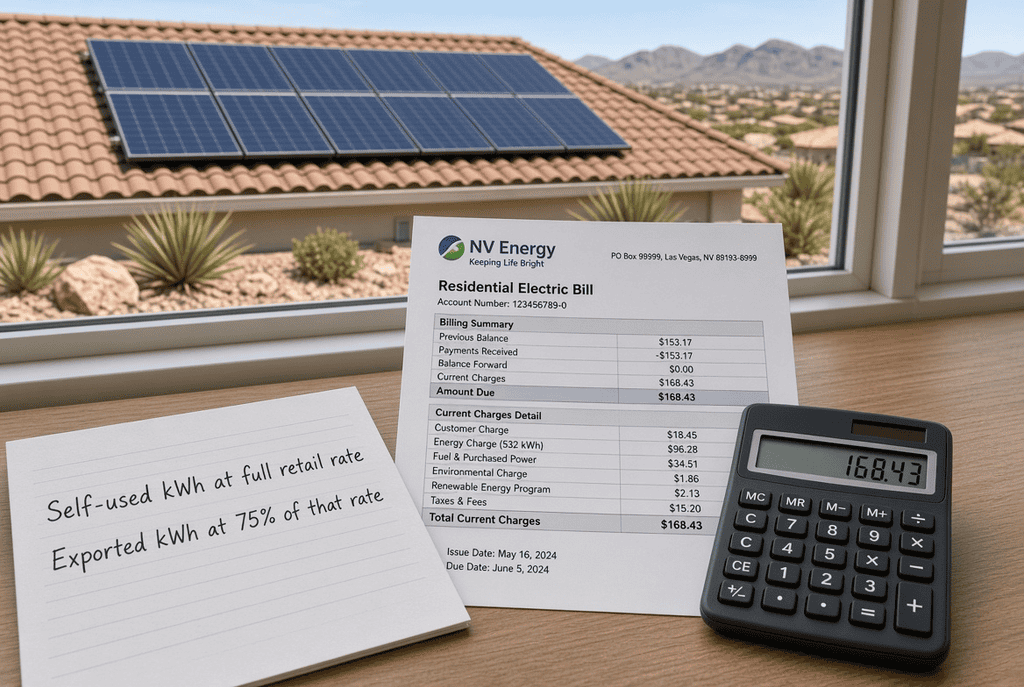
Home battery storage is available as an optional add-on at negotiated group rates. Energy storage is especially relevant in Nevada, where exported solar power is credited back at 75% of the retail rate under net metering rules. Storing excess solar generated during peak daylight to power your home in the evening keeps more value on site. Group pricing makes adding battery backup far more manageable for households seeking energy resilience during hot summer months.
EV Chargers
Electric vehicle chargers can also be included at discounted program pricing. Pairing an EV charger with rooftop solar lets you fuel your vehicle directly from the sun, lowering your overall driving costs. If you already drive an electric car—or plan to buy one soon—adding a charger under the same contract keeps installation straightforward and cost-effective.
What the Discount Does—and Doesn’t—Cover
The negotiated group discount applies directly to the equipment and installation package provided by the winning contractor. It does not alter NV Energy’s net metering framework, utility interconnection processes, or state and federal tax incentives. You can still claim eligible federal solar tax credits on top of your discounted package price.
Pros and Cons of Solar Group-Buy Programs
Group-buy programs offer a streamlined pathway to clean energy and lower equipment costs, but they aren’t a perfect fit for every situation. Weighing the advantages against the drawbacks helps determine whether the group model matches your priorities and project timeline.
Advantages
- Lower prices through volume: Aggregating hundreds of potential projects gives organizers strong leverage during contractor negotiations. Reported average savings in the Clark County Switch Together campaign run around 20%, cutting thousands of dollars off standard residential installation prices.
- Pre-vetted installers: Participants work exclusively with licensed contractors who have already been screened for quality, experience, labor standards, and robust warranties. This minimizes the risk of hiring poorly qualified or unreliable sales companies.
- Unbiased, independent guidance: Having a consumer advocacy group like Solar United Neighbors involved means participants receive clear education separate from any sales pitch. This layer of objective support makes it much easier to evaluate technical proposals confidently.
- Zero-risk entry: Registration is completely free and non-binding. You can explore whether your roof is suitable, review a customized proposal, and walk away at any point without penalty.
- A structured, low-friction process: Rather than contacting multiple solar companies individually and comparing conflicting quotes, you move through an organized sequence with clear decision windows and defined milestones.
Limitations
- Restricted installer choices: You are limited to the specific contractor selected through the group’s reverse auction. If you already have a preferred local solar contractor in mind, the group model won’t apply to them.
- Rigid campaign schedules: Group-buys move according to a pre-set timeline (auction dates, review windows, batch installation schedules). If you need a solar array installed immediately, an independent quote process offers more scheduling flexibility.
- Not guaranteed as the lowest possible price: While group rates are built to be highly competitive, they may not beat every single promotional deal, clearance equipment bundle, or aggressive quote in the open market.
- Varying site suitability: Homes with heavy tree shading, complicated roof angles, or outdated main electrical panels may receive less competitive individual quotes, even if the overall campaign bulk rates are strong.

Who Should Consider a Group Buy
Group-buy programs shine for specific types of property owners and situations, but they aren’t for everyone. Matching your home and personal preferences to the model’s strengths makes it easy to decide if signing up is worth your time.
Homeowners Who Want Clear Guidance
If shopping for solar feels overwhelming—navigating aggressive door-to-door sales calls, sorting through conflicting equipment claims, or trying to compare messy quotes—a group buy takes off the pressure. With independent education from consumer advocates like Solar United Neighbors, pre-screened contractors, and a step-by-step review process, you get reliable guidance without having to do endless research alone.
People Who Want Solid Pricing Without Hard Bargaining
Some homeowners enjoy haggling with sales reps to get a better deal; most don’t. Group-buy pricing relies on volume demand and competitive reverse auctions to secure discounted rates upfront. If you want a fair, bulk-discounted price without sitting through high-pressure sales pitches or negotiating individual quotes, this model is built for you.
Anyone Considering Solar Plus Battery Storage or EV Charging
Group-buy programs are especially useful if you want a complete clean energy setup. In Southern Nevada, where exported solar power is credited back at 75% under net metering rules, adding a home battery allows you to store daytime solar energy for peak evening use. Bundling solar panels with battery storage or an electric vehicle charger under one bulk-discounted agreement simplifies installation and maximizes your total savings.
Residents Comfortable Working Within Program Timelines
Group buys run on a shared, structured schedule—from open registration and installer bidding to custom proposal reviews and batch installations. If your timeline is flexible enough to work within the campaign’s milestones, the process is smooth and predictable.
Homeowners Who Value Local Government and Nonprofit Backing
Programs backed by county initiatives—like All-In Clark County—partnered with independent non-profits offer a level of transparency and consumer protection that traditional private solar companies rarely provide. If you prefer exploring clean energy through a community-backed, consumer-first initiative, group buys offer strong peace of mind.
Who Might Prefer a Different Path
- Homeowners Committed to a Specific Contractor: If you prefer working with a particular local installer, you cannot use them through the group-buy program, as contracts are awarded exclusively to the installer who wins the competitive bidding process.
- Property Owners on Strict Timelines: If you require immediate equipment installation or urgent roof repairs, securing a direct quote from an independent contractor provides greater flexibility and direct control over project scheduling.
- Renters and Non-Homeowners: Because group-buy initiatives require direct property ownership for physical hardware installation, renters cannot participate. However, renters and income-qualified households can access solar savings through virtual options like NV Energy’s Expanded Solar Access Program (ESAP).
Tips for Getting the Most from the Program
A solar group-buy campaign gives you bulk pricing and unbiased guidance, but how much you get out of it depends on how actively you engage. These practical steps help Southern Nevada homeowners maximize their savings and value through programs like Clark County’s Switch Together.
Register Early and Stay Informed
Sign up as soon as enrollment opens. Early registration ensures you get on the invite list for informational sessions, roof suitability reviews, and key offer deadlines. Because joining is free and carries no obligation to buy, there is zero risk to signing up right away.
Have Your Energy Bills Ready
Pull at least 12 months of NV Energy utility statements before your consultation. Knowing your total annual usage and summer consumption spikes makes it much easier to judge whether the installer’s recommended system size is realistic. Accurate usage history also helps you model how much power you’ll consume directly versus export back to the grid.
Ask Specific Questions About Equipment and Warranties
When your custom proposal arrives, don’t just glance at the bottom-line price. Ask the installer to clarify:
- Hardware Specifications & Manufacturers: Which specific Tier 1 solar panel, inverter (string, microinverter, or power optimizer), and battery storage models are included in the proposal?
- Comprehensive Warranty Terms: What are the explicit coverage periods and terms for equipment performance, inverter lifespans, installer labor, and roof-penetration waterproofing guarantees?
- Production & Yield Modeling: How do the calculations account for real-world variables like panel degradation over time, local temperature losses, and seasonal roof shading in the projected year-one output?
Attend Educational Sessions and Workshops
Take advantage of virtual office hours, “Solar 101” webinars, and “Meet the Installer” events hosted by Solar United Neighbors. These open forums let you ask technical questions without any sales pressure, meet the winning contractor, and hear how other local neighbors are structuring their systems.
Get at Least One Independent Quote for Comparison
Group pricing is built to be highly competitive, but it never hurts to verify. Requesting a quote from another reputable local installer gives you a solid benchmark to confirm that the group-buy offer genuinely delivers the best value for your specific roof and budget.
Account for Nevada-Specific Net Metering Rules
Make sure your production and financial calculations reflect Nevada’s net metering framework, where exported solar energy is credited at 75% of the retail rate. Ensure the proposal uses realistic self-consumption estimates and factors in optional battery storage if you want to store excess daytime generation for evening use.
Use Your Full Decision Window
Most campaigns give you several weeks to review your final design and contract terms after your site visit. Take your time to read the fine print, review financing terms if applicable, and verify equipment specs. There is no benefit to rushing a contract signature before you feel 100% confident.
Ready to explore? Head to the official Switch Together portal via Clark County or Solar United Neighbors to register and check out upcoming educational events in the Las Vegas area.
Thank you for reading! If you have any feedback or a specific Nevada solar topic you’d like us to cover next, please reach out directly at admin@nevadasolarguide.com.